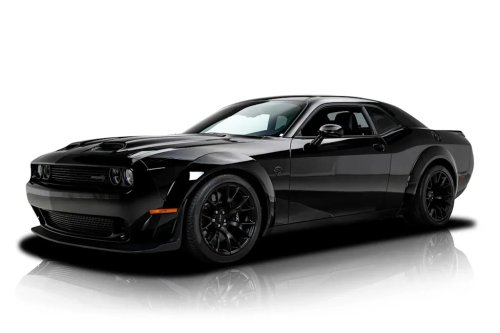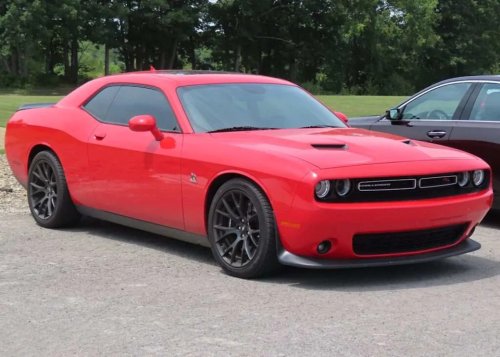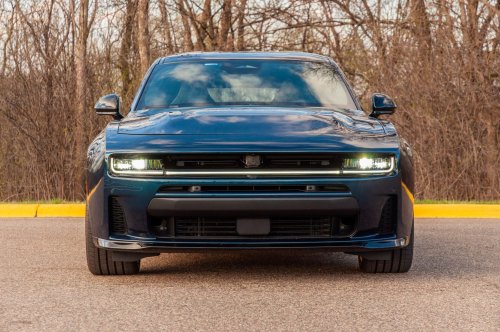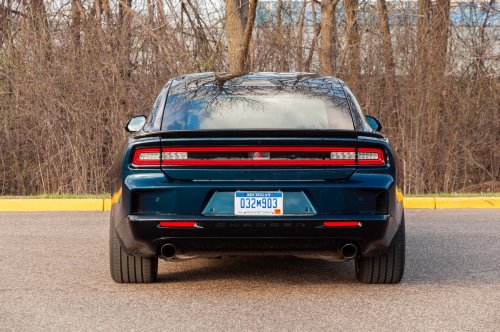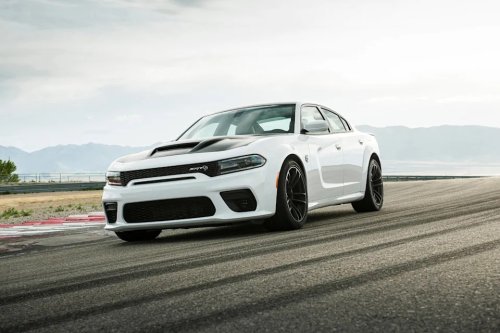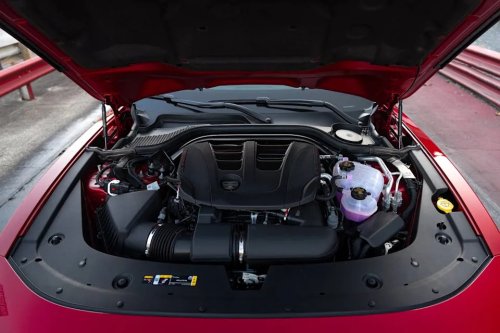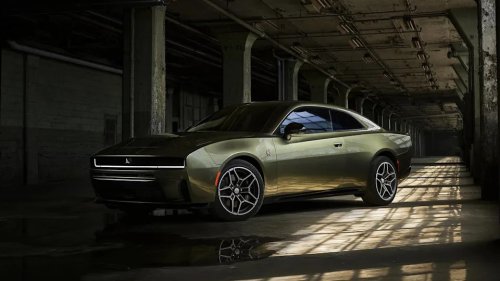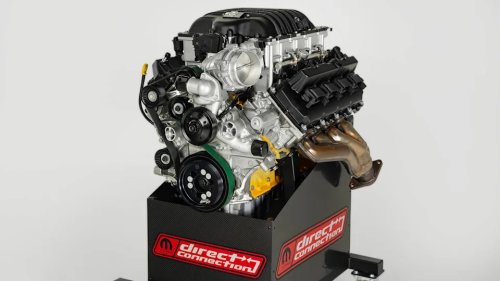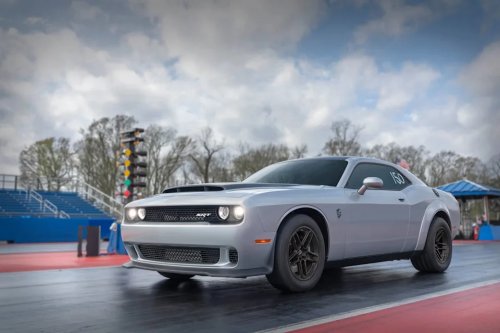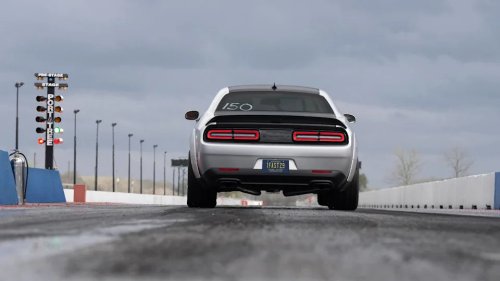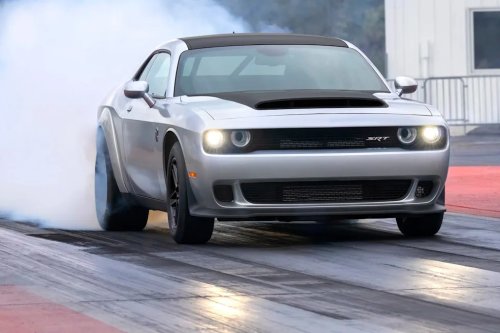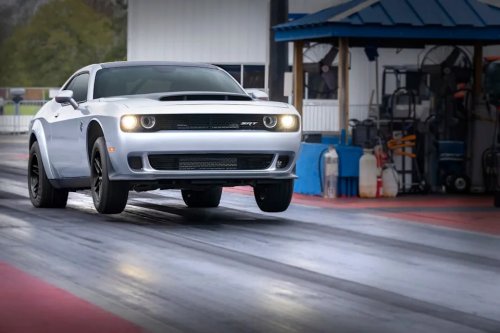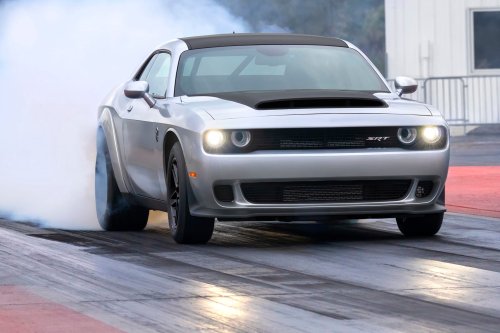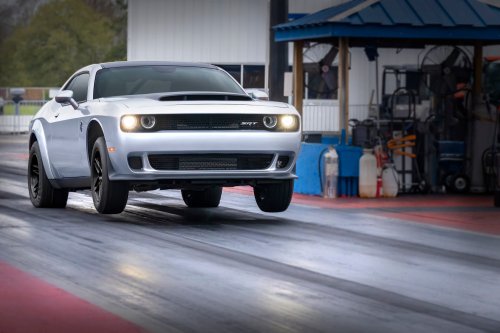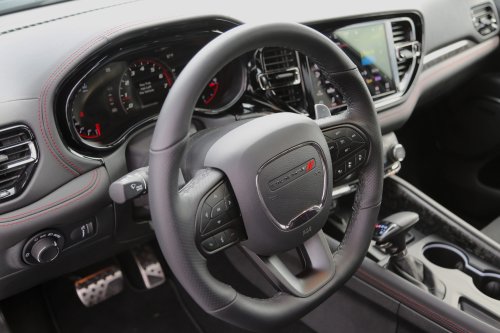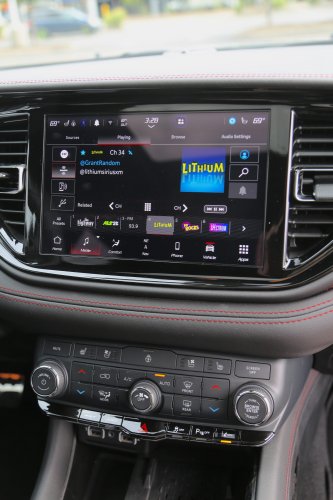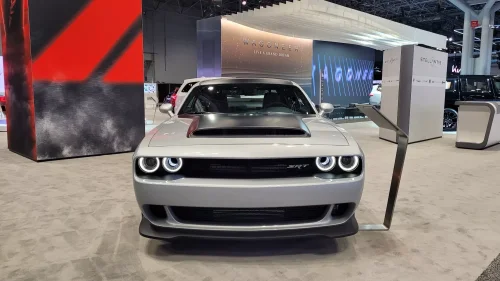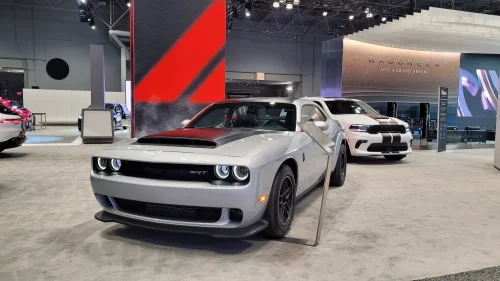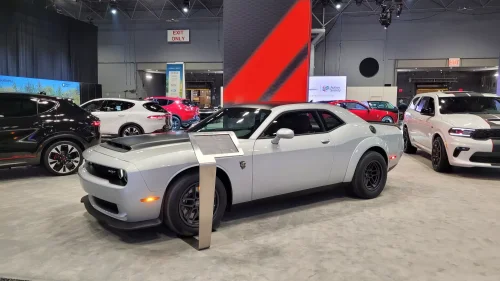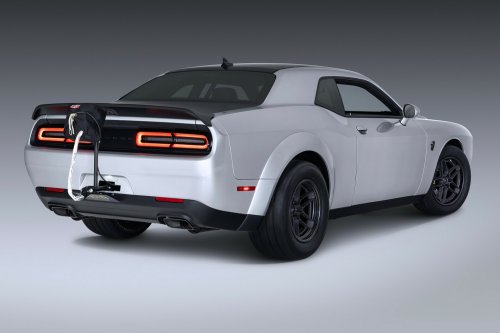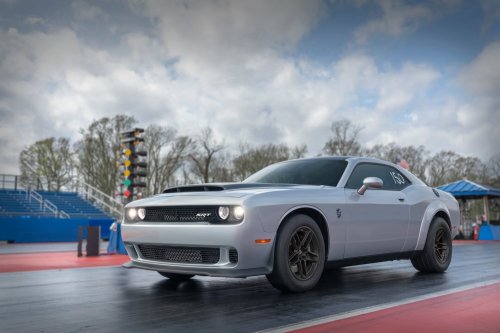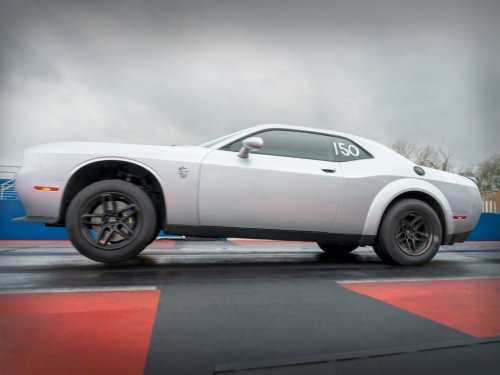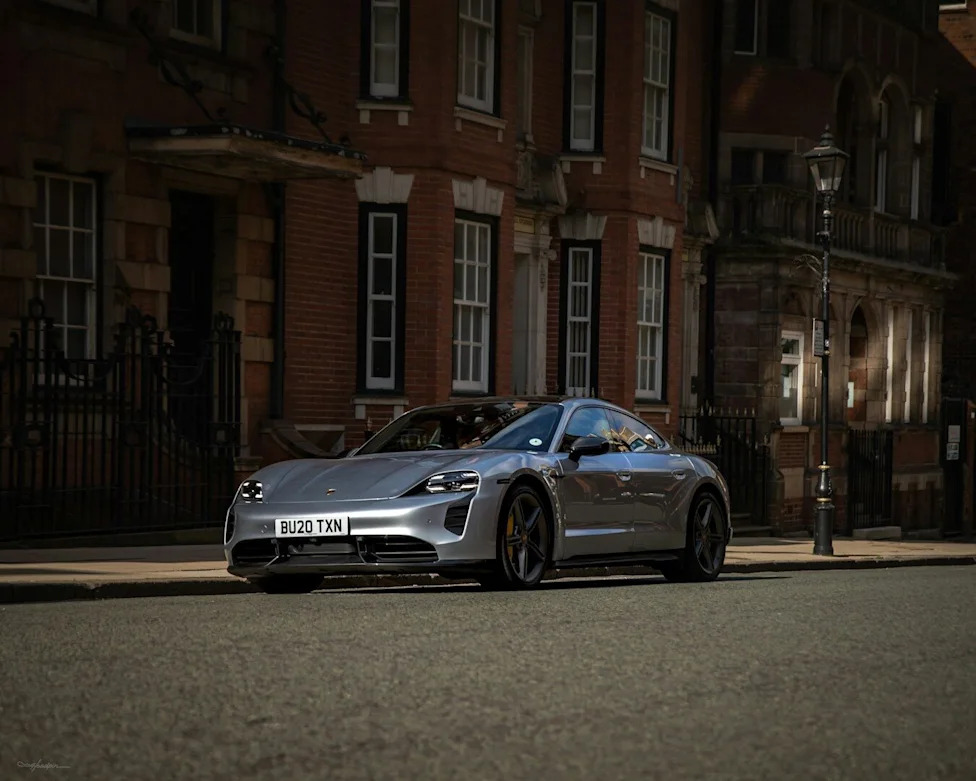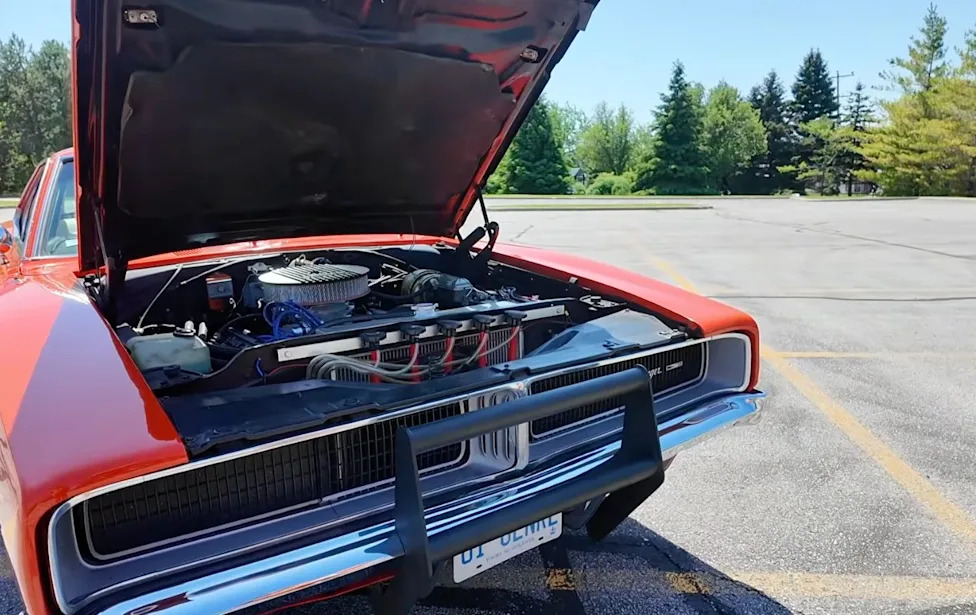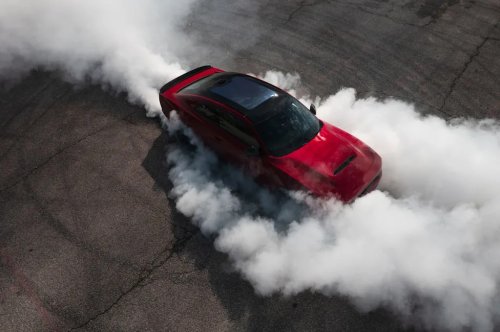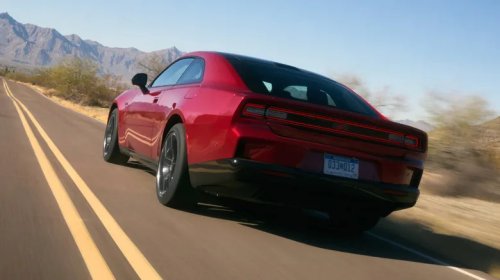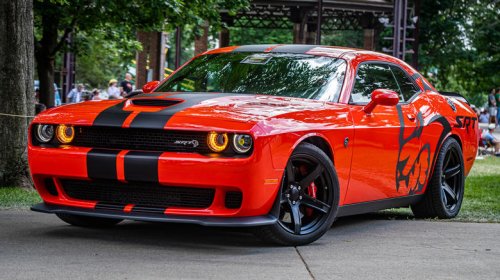
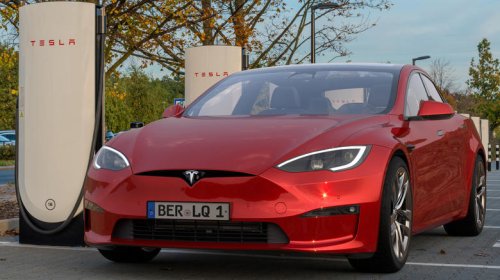
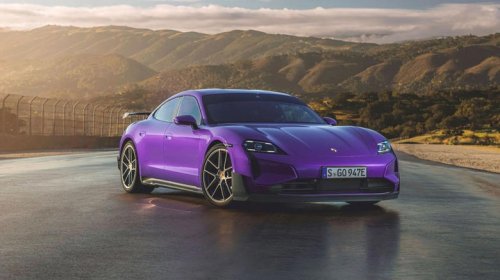
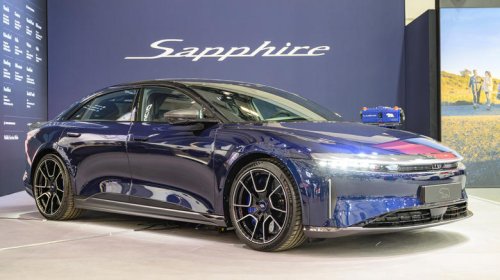
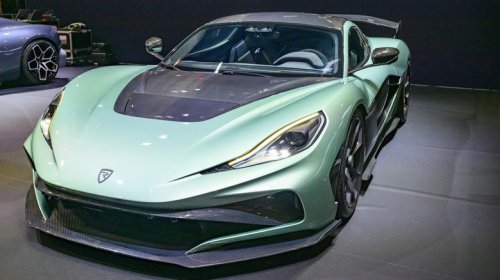
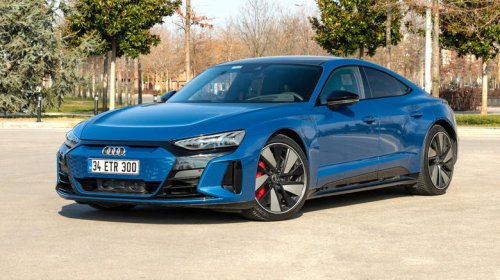


















A front three-quarter view of a red Dodge Challenger Hellcat parked in a green environment.For many years now, the Dodge Challenger Hellcat has been the gold standard of accessible, straight-line brutality. Put the red key fob in, and the supercharged 6.2-liter HEMI V8 wakes up with all 797 horsepower on tap. According to Dodge, the Challenger SRT Hellcat Redeye Widebody (the top dawg) covers the quarter mile in 10.8 seconds, reaches 60 mph in 3.6 seconds, and tops out at 203 mph.For $80,000 plus — at least when it was still in production — no other car offered that combination of muscle, heritage, and real-world speed for the money. Those numbers aren't just impressive on paper. A 3.6-second 0-60 time and a 10.8-second quarter mile still embarrass most sports cars at any given Cars and Coffee event. For years, pulling up to a stoplight in a Hellcat meant you were almost certainly the fastest thing within a quarter mile.However, while Dodge was busy perfecting the art of the pushrod V8, the EV industry quietly rewrote the very idea of brisk acceleration. No clutch, no gear changes, no waiting for boost to build. Just instantaneous torque delivered to all four wheels the moment your foot hits the floor. Here are five EVs that make the Dodge Hellcat look slow. 1. Tesla Model S PlaidA red Tesla Model S Plaid being charged on a Tesla Supercharger in Germany.Tesla's Model S Plaid uses a tri-motor all-wheel torque-vectoring drive system producing 1,020 horsepower. Tesla officially claims a 0-60 mph time of 1.99 seconds, a quarter mile of 9.23 seconds at 155 mph, and a top speed of 200 mph. Run those numbers against the Hellcat: the Plaid reaches 60 mph 1.61 seconds sooner and finishes the quarter mile nearly two full seconds faster.By the time the Hellcat crosses the quarter-mile marker, the Plaid is already pulling away at triple-digit speeds. Unlike the Hellcat — which was always best understood as a straight-line weapon — the Plaid does all of this as a five-seat sedan, with 359 miles of EPA-estimated range per charge. There are no sticky drag radials required, and no tuning is needed. The 1.99-second figure is achievable in launch control on any reasonably clean stretch of pavement, or is it?Tesla's claimed 1.99-second figure — the one Elon Musk didn't exactly mention — is measured with a one-foot rollout, meaning the timer only begins after the car has already traveled a foot. Also, achieving that number requires preconditioning the battery to a specific temperature and ensuring the car is in the right charge state. From a true standstill under normal conditions, independent testing consistently puts the Plaid at around 2.3 seconds. Even so, it still beats the Hellcat to 60 mph by more than a second. 2. Porsche Taycan Turbo GTA purple Porsche Taycan Turbo GT parked on the Laguna Seca racetrack.Porsche's answer to the performance EV question arrived as both a declaration and a lap record. The Taycan Turbo GT Weissach Package (WP) — the most powerful Porsche ever — produces a peak output of 1,034 horsepower (1,094 hp for short bursts) — available for two seconds via its overboost system. According to Porsche, the Turbo GT WP accelerates from 0 to 60 mph in 2.2 seconds. The WP variant also achieves a top speed of 190 mph.However, when MotorTrend tested the Turbo GT WP, it was the quickest car they had ever tested in their 76-year history, with a record 0 to 60 mph time under 2 seconds. These numbers were thanks to the aforementioned one-foot rollout; without it, the Turbo GT WP managed 2.1 seconds. Against the Hellcat, the Turbo GT WP is 1.5 seconds faster to 60 mph and reaches a terminal velocity nearly identical to the Dodge's ceiling.The Turbo GT WP also set a production EV Nürburgring lap record of 7 minutes and 7.55 seconds in 2024, making it not just faster in a straight line, but faster everywhere. The Weissach package strips the rear seats, replaces them with a carbon bulkhead, and replaces the active spoiler with a fixed one, also made out of carbon. Granted, the Taycan Turbo GT is not cross-shopping with the Hellcat. Still, as an illustration of how far EV performance has traveled in a short time, it's one of the most convincing exhibits in the business. 3. Lucid Air SapphireA dark blue Lucid Air Sapphire EV sedan parked on a Lucid Sapphire indoor displayLucid Motors entered the performance EV conversation with a fairly simple claim: to make "the world's first fully electric luxury super-sports sedan," and to take on the Tesla Model S Plaid. The Air Sapphire uses a three-motor powertrain developed in-house, producing 1,234 horsepower and 1,430 lb-ft of torque. Per Lucid's official specifications, the Air Sapphire covers 0 to 60 mph in 1.89 seconds.MotorTrend independently verified a 1.9-second run — but that required the optional $8,250 Track Tire package. On stock tires, the same publication recorded 2.2 seconds. Either way, it still dispatches the Hellcat Redeye by a fair bit, and it completes the quarter mile in 8.95 seconds at 158 mph, and has a top speed of 205 mph. Those figures mark a clean sweep against the Hellcat across all three metrics: 1.71 seconds faster to 60, 2.25 seconds faster through the quarter mile, and a 2 mph higher top speed.The Sapphire also achieves this while carrying five passengers and delivering an EPA-estimated 427 miles of range. What distinguishes the Sapphire technically is its twin rear-motor torque vectoring system. By sending opposing torque to each rear wheel, the car can effectively steer its rear axle. Such mechanical wizardry improves cornering in ways the Hellcat's multi-link setup cannot replicate. 4. Rimac NeveraA light green Rimac Nevera R parked on a Rimac indoor display.The Rimac Nevera is not a counterargument to the Hellcat. It's a different conversation entirely, quite possibly the final boss of electric performance cars. Rimac's official technical specifications list 1,914 horsepower from four independent motors, a 0-60 mph time of 1.85 seconds (one-foot rollout), a quarter mile of 8.58 seconds, and a top speed of 258 mph. For context, Rimac's even more extreme Nevera R pushed that 0-60 figure to just 1.66 seconds.Those figures aren't theoretical. In May 2023, Rimac set 23 performance world records in a single day at the Automotive Testing Papenburg facility in Germany, with all runs conducted on non-prepped asphalt with road-legal Michelin Cup 2 tires and independently verified by Dewesoft and RaceLogic. When CarWow tested the Rimac Nevera without a one-foot rollout, it managed a quarter-mile time of 8.62 seconds and a 0 to 60 mph time of 2.08 seconds. The Nevera's best recorded quarter-mile time was 8.26 seconds with a 0-60mph time of 1.74 seconds, and a top speed of 258 mph.The Nevera reaches 60 mph almost 2 seconds faster than the Hellcat, finishes the quarter mile 2.54 seconds sooner, and pulls to a terminal velocity 55 mph higher. At a price point of well north of $2 million, the Nevera and its racier counterparts occupy a stratosphere entirely separate from Dodge's muscle car. As a demonstration of what electric propulsion can achieve, it is the absolute ceiling of road-legal cars. 5. Audi RS e-tron GT PerformanceA blue Audi RS e-Tron GT Performance parked outdoors with trees in the background.When we reviewed the latest 2025 Audi RS e-Tron Performance, we named it a six-figure speed bargain because there aren't many cars that deliver supercar-level performance at this price. According to Audi, the RS e-tron GT Performance produces 912 horsepower. That output drives a 0-60 mph time of 2.4 seconds — almost 1.2 seconds faster than the Hellcat Redeye. Audi does not publish an official quarter-mile time for this model in its product materials.However, Car and Driver's independent test of the 2025 model actually recorded a quarter-mile time of 9.8 seconds at 139 mph, with a 0 to 60 mph time of 2.1 seconds (using a one-foot rollout). The RS e-tron GT Performance is (like the Porsche) a five-seat grand tourer available at Audi dealerships, starting at $168,295, with 278 miles of EPA-estimated range and a 10-to-80 percent charge time of 18 minutes. It also features adjustable air suspension and all-wheel steering.The RS e-tron GT performance doesn't just beat the Hellcat. It does so while offering more practicality, more technology, and a longer list of daily usability features than the Dodge ever could. However, as we all know, speed isn't everything. There is only so much you can do on a public road without ending up in jail. Although the Hellcat loses to all of these cars, there are some things an EV can't do, and that's ICE emotion. Want the latest in tech and auto trends? Subscribe to our free newsletter for the latest headlines, expert guides, and how-to tips, one email at a time. You can also add us as a preferred search source on Google.