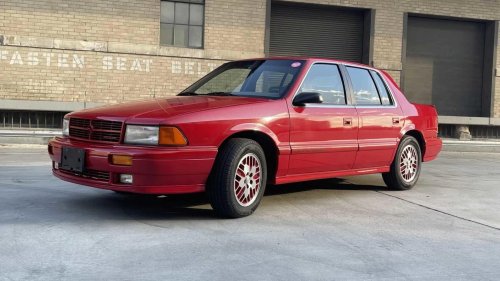
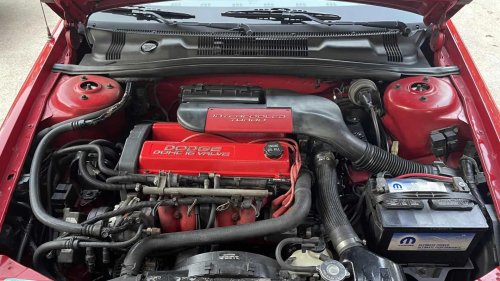
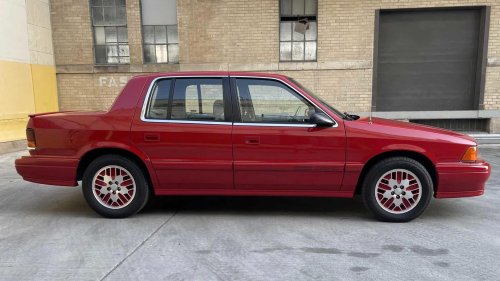
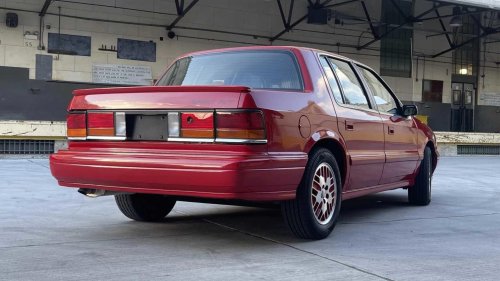
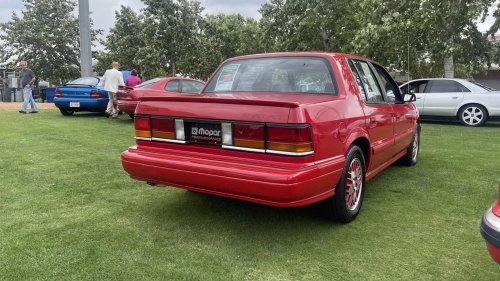
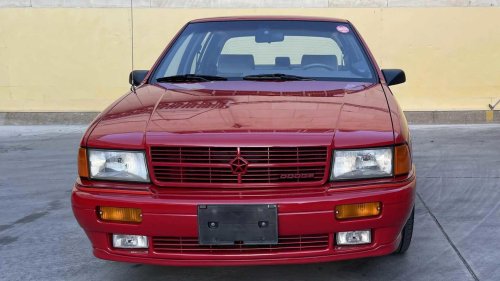



















In 1991, you could walk into a Dodge dealer, put $17,820 on the counter, and roll out of the lot with the fastest sedan in America. No press event announced it. No performance campaign backed it up. Just a Spirit wearing an R/T badge, a pair of two-tone stripes, and a 2.2-liter turbo four that Chrysler had quietly transformed with help from Lotus. Car and Driver took one to 60 mph in 5.8 seconds and covered the quarter mile in 14.5 seconds at 97 mph. It beat the Mustang GT 5.0 down the strip. Almost nobody bought one.nnThat's the Spirit R/T: a car that did everything right and still wound up forgotten.With a Lotus-designed DOHC 16-valve head topping the Turbo III block, 224 horsepower on tap, and the only transmission being a heavy-duty five-speed manual, it was the kind of accidental hero Chrysler built once and never quite figured out what to do with. Total production across both model years came to 1,399 units. That's not a typo. Here's the full story of how a four-door Mopar no one in the press office seemed eager to sell became one of the quickest sedans Chrysler ever built, and why the turbo faithful are only now hunting them down in serious numbers. The K-Car Era and Chrysler's Underdog Position Bring A Trailer The Spirit platform didn't come from the flashy side of Chrysler's product planning. It sat on the AC platform, a front-wheel-drive architecture evolved from the K-car bones that had kept the company solvent through the early 1980s. When the Spirit arrived for 1989, it was a sensible four-door for people who wanted transportation, not thrills. Nothing about the base car suggested Chrysler had any interest in chasing performance credibility.That context matters because the R/T didn't emerge from a dedicated skunkworks program. It came out of a decade of Chrysler turbo four development, accumulated engineering credibility, and a willingness to spend on a Lotus head program that most of the company probably assumed would generate halo-effect press coverage for the broader Spirit lineup. Performance wasn't the mission statement. It turned out to be the result.By the time the R/T landed in showrooms, Chrysler was still rebuilding its reputation after the near-collapse of the late 1970s. A four-cylinder performance sedan that could run with a Mustang GT wasn't the story anyone expected Chrysler to be telling. Which made it all the more remarkable when the stopwatch said it should be. The Turbo III Engine: Lotus's Sleeper Weapon Bring A Trailer Lotus Engineering spent most of its existence proving that smart engineering could transform ordinary cars into something extraordinary, so handing them the Turbo III cylinder head assignment turned out to be genuinely inspired. The British firm designed a 16-valve DOHC head for Chrysler's 2.2-liter block, and the result was the highest specific output per liter of any production Mopar engine at the time.The specs are worth running through because each one is doing real work: 87.5mm bore, 92mm stroke, 8.5:1 compression ratio pitched low enough to handle forced induction, twin balance shafts for refinement, four valves per cylinder, direct ignition, sequential electronic fuel injection, and a Garrett intercooled turbocharger feeding the whole assembly. Peak output landed at 224 horsepower at 6,000 rpm and 217 lb-ft of torque at 2,800 rpm.That torque arriving so early in the rev range meant the engine had real grunt well before the boost came on full.The only transmission offered with the R/T package was the A568 five-speed manual, a heavy-duty unit built by Chrysler's own New Process Gear division. No automatic option existed. If you wanted the Turbo III, you row gears. For 1992, Chrysler lowered the first gear ratio to reduce turbo lag off the line, the only notable mechanical change across the Spirit R/T's two-year run, and exactly the kind of detail that tells you somebody on the engineering team was still paying attention even as the marketing side looked the other way. Numbers That Surprised Everyone Bring A Trailer Car and Driver's test is the one that holds up: 0-60 mph in 5.8 seconds, quarter mile in 14.5 seconds at 97 mph, top speed around 141 mph. Those were serious numbers in 1991, coming from a four-door front-driver that stickered at $17,820 with air conditioning standard. MotorWeek's test came in softer at 6.4 seconds to 60 and 15.1 in the quarter, and that spread tells you something real about the front-wheel-drive layout. The R/T was sensitive to launch technique. Get it right, and the car was genuinely rapid. Get it wrong, and you leave power on the table.Now stack that against the 1991 Ford Mustang GT. The 5.0 V8 made 225 horsepower at 4,200 rpm and 300 lb-ft of torque, just one more pony than the Turbo III, with 83 lb-ft extra in reserve. By every conventional measure, the Mustang should be faster. Its quarter mile came in around 14.8 seconds, three tenths behind the Spirit R/T's best pass. A four-door Chrysler sedan with a four-cylinder engine had just run the Mustang 5.0 into the ground at a fraction of the V8's displacement.Chrysler wasn't shy about the claim in whatever press materials it did produce, billing the Spirit R/T as the fastest sedan made in America and drawing comparisons to the BMW M5. Independent testing showed the M5 held the edge, but the fact that the comparison was even plausible said everything about what the Turbo III and the Lotus head had accomplished together. Motor Trend awarded the Spirit R/T its Domestic Sport Sedan of the Year for both 1991 and 1992, beating the Taurus SHO each time. The only sedans that could arguably outrun it were the BMW E34 M5 at $59,905 and the Alpina B10 at $109,500. The Spirit R/T started at $17,820. Why Chrysler Buried It Bring A Trailer So how do you build the fastest sedan in America and sell fewer than 1,500 of them over two years?The production breakdown: 1,208 examples in 1991, split between 774 in red with white stripe and 434 in white with red stripe. In 1992, another 191 found homes, 92 in red, 68 in white, and 31 in a newly added silver. From the outside, the R/T looked nearly identical to any other Spirit in the dealer lot. No aggressive bodywork, no hood treatment, no interior transformation to match the engine's character. The badge and the two-tone stripes were about the extent of it.The car was a sleeper because Chrysler made it one by default, not by design.The factory option list confirmed the bare-bones approach. Of the 191 units built for 1992, 183 got dual road fog lamps, 171 got power windows and locks, 117 got anti-lock brakes, and 93 got the Infinity sound system. A legitimate performance car with a shorter option list than most base econoboxes. Whether Chrysler couldn't justify deeper investment at 1,200 units a year, or whether the marketing team never landed on a pitch that worked, the outcome was the same. The fastest American sedan of 1991 was invisible in its own showrooms. Chrysler earned two Motor Trend trophies and barely told anyone. The Collector's Perspective Today Bring A Trailer With 1,399 total examples built and most of those having survived three-plus decades of hard use and deferred maintenance, clean Spirit R/Ts are legitimately rare. Hagerty has positioned the car as a serious collector target, calling it a gateway to genuine K-car appreciation for an enthusiast community that tends to skip straight from the Hemi era to the LX platform. A clean example appeared on the Hagerty Marketplace at $17,500, real money for a car that spent the better part of two decades at the bottom of the depreciation curve.The ideal find: an original 1991 in red or white with documentation, a five-speed that still feels right, and a Turbo III still making the power Lotus designed it to make. These weren't barn finds when they were new, but they've become barn-find-adjacent through sheer attrition. Clean survivors take patience and some luck to locate.Bring A Trailer The Mopar community that knows about the Spirit R/T tends to be quietly obsessive about it, and that's exactly the right response. A Lotus-headed turbo four in a four-door Dodge body, running the Mustang 5.0 down the strip at a price that made the comparison embarrassing: that car deserves more than footnote status in the performance sedan conversation. Go find one before the people who already know about this start holding on tighter.Sources: The Autopian, Motales, Hagerty, Mopar Insiders, AutoEvolution, TurboDodge Forums