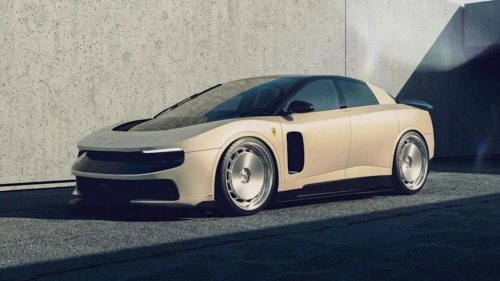
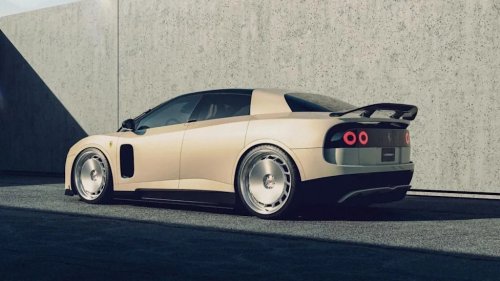
Ferrari has never been shy about taking risks. Through the decades, it has built outrageous race cars, crafted sleek supercars, and experimented with wild concepts. Some ideas became legends. Others quietly disappeared. One of the most surprising and least-known of these forgotten concepts didn’t have a screaming V12 or a stripped-down body made for speed. Instead, it had four doors, plush leather seats, and a presence that felt more like a luxury lounge than a track weapon.What if Ferrari had built a car not for the racetrack but for the boardroom? What if the world had a Ferrari meant for everyday luxury instead of weekend thrills? This is the story of a car that could have changed everything – but never got the chance. The Pinin Was A Ferrari For The Whole Family 1980 Ferrari Pinin Prototipo by PininfarinaIn 1980, at the Turin Motor Show, Ferrari shocked the automotive world. Unveiled on the Pininfarina stand was a sleek, four-door concept car bearing the Prancing Horse badge. It was called the Ferrari Pinin. Designed to celebrate Pininfarina's 50th anniversary, the Pinin was unlike anything Ferrari had ever shown.This wasn’t a reworked coupe or a stretched version of an existing model. The Pinin was a clean-sheet design, meant to explore the possibility of a true Ferrari sedan. At a glance, it looked elegant and understated. Long, low, and wide, it had a flat nose and sleek headlights, a design language typical of the era. But beneath that calm exterior was a bold idea: a Ferrari for the family, not just the driver.The Pinin wasn’t just a styling exercise. Ferrari actually commissioned Pininfarina to build a working prototype. That single prototype was roadworthy and powered by a 4.9-liter flat-12 engine. This wasn’t a show car with no guts – it had a real heart. The idea was to test whether Ferrari could enter the luxury sedan market, where brands like Maserati, Jaguar, and Mercedes-Benz already had a foothold.Inside, the Pinin aimed high. The cabin featured soft leather, wood accents, and four individual seats with generous legroom. It felt more like a luxury cruiser than anything Ferrari had done before. The dashboard was modern for its time, with digital displays and futuristic controls. Everything pointed toward comfort, elegance, and refinement.What made the Pinin special wasn’t just its format. It was the intention behind it. This was Ferrari entertaining the idea of changing its identity. Not abandoning performance, but expanding its vision. For enthusiasts, it posed a fascinating question: What would the world look like if Ferrari had gone all-in on luxury in 1980? A Fully Working Prototype With A Flat-12 Engine 1980 Ferrari Pinin Prototipo by Pininfarina Ferrari Pinin Key Specs Underneath its long hood, the Ferrari Pinin carried serious firepower. The heart of the car was the same 4.9-liter flat-12 engine found in the 512 BB. That engine produced over 360 horsepower and gave the Pinin performance that rivaled many two-door sports cars of its time.The flat-12 layout helped keep the center of gravity low, improving stability and handling. Although the Pinin was never pushed to its performance limits in public, early tests suggested it had the potential to match or exceed the performance of high-end sedans on the market.Unlike many concept cars, the was fully engineered with practicality in mind. It had working air conditioning, power windows, and even a trunk large enough for actual luggage. The chassis came from a modified 512 BB platform, which was adapted to fit the longer wheelbase and extra doors.Suspension was independent at all corners. Even the tires were selected not just for grip but also for a smooth ride. The steering was power-assisted, a rare feature in Ferraris at the time.The design also paid attention to safety. The body structure had reinforced sections around the doors and passenger cell, a notable feature for a one-off concept. Visibility was good, thanks to the slim pillars and wide glass area.Though it never saw mass production, the Pinin was fully functional. That fact alone sets it apart from most concepts, which often rely on mockups and speculative features. The Pinin was a real car, built with real parts, ready to drive. Why The Ferrari Pinin Never Reached Production Despite early enthusiasm and serious engineering, the Ferrari Pinin never went beyond the prototype stage. Enzo Ferrari himself was reportedly impressed by the design. He even discussed the possibility of turning it into a production vehicle. But when the proposal reached Ferrari's annual board meeting in 1980, it was quietly dropped.One major reason was lack of support from Fiat, Ferrari's parent company at the time. Eugenio Alzati, a former Ferrari executive, believed that Vittorio Ghidella – then-president of Fiat – saw the Pinin as a distraction. Ghidella prioritized larger projects aimed at stabilizing Fiat’s finances and didn’t see room for a low-volume luxury sedan that would require high investment and offer limited returns.Leonardo Fioravanti, the designer behind many iconic Ferraris, offered another angle. He speculated that Ferrari’s hesitation also came down to production quality. In the world of sports cars, small imperfections were more acceptable. Buyers focused on performance, not polish. But in the luxury sedan segment, the competition came from brands like BMW, Mercedes-Benz, and Rolls-Royce – companies with deep experience in refined, high-quality interiors and smooth-riding chassis. Ferrari would have been entering a different league, one it wasn’t prepared to dominate.There were also branding concerns. Ferrari had always been about performance, passion, and exclusivity. A four-door car, no matter how well it drove, might confuse that image. The company worried it would weaken the Ferrari identity built around racing and two-seater dynamics.Finally, the timing worked against the Pinin. The global economy in 1980 was volatile. Fuel prices were high, emissions rules were tightening, and luxury performance sedans were a niche market. Launching a bold, expensive new model during uncertain times added another layer of risk. The 4-Door Ferrari That Actually Went Into Production Purosangue Markups - 1 Ferrari Purosangue Key Specs Source: FerrariDecades after the Pinin faded from view, Ferrari finally did what once seemed impossible. In 2022, it revealed the Purosangue, the first four-door, four-seat vehicle in its history. But this time, it wasn’t a sedan – it was a performance SUV.The Purosangue was Ferrari’s answer to a changing market. Luxury performance SUVs from Lamborghini, Porsche, and Aston Martin were selling well. Customers wanted speed, utility, and comfort. Ferrari responded with a vehicle that could carry four adults, offer all-wheel drive, and still deliver 715 horsepower from a naturally aspirated V12.Unlike the Pinin, the Purosangue had no doubts about its identity. It was marketed as a Ferrari first, SUV second. It had the signature styling, the aggressive stance, and the performance numbers to back it up. Inside, the cabin balanced luxury with function. Rear-hinged doors allowed easier access, and every surface felt high-end.Critics were divided. Some purists argued it strayed too far from Ferrari's roots. Others praised the company for evolving without giving up on performance. But the market spoke loudly: the Purosangue sold out quickly, with strong demand from new and loyal customers alike.In a way, the Purosangue fulfilled the vision the Pinin hinted at. It brought Ferrari into the daily lives of more people. It offered speed and comfort in equal measure. And it proved that even the most tradition-bound carmaker can adapt, if it listens to its audience.






















 +34 others