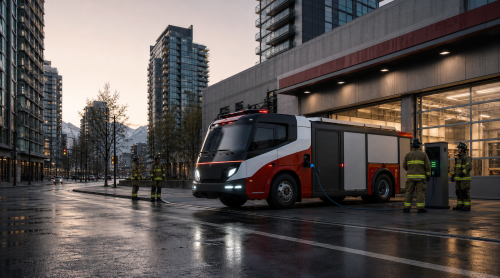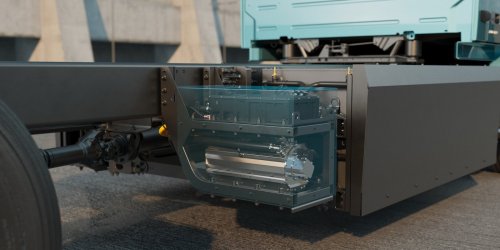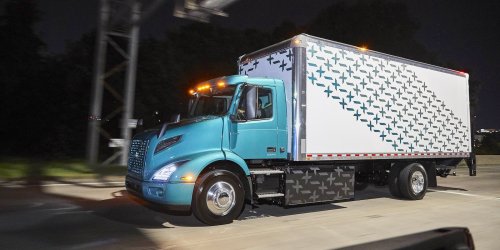



















The end of the federal EV tax credit spelled bad news for many automakers, and yet some persisted. In fact, some are doing quite well. Take a look at the electric truck market, for example, where the EV startup Harbinger reports practically doubling its sales quarter over quarter after the tax credit ended on September 30. Wait…what? Electric Truck Sales Jump After Tax Credit Ends To be clear, Harbinger is a relatively young startup with plenty of room to grow its sales, tax credit or not. The company launched in California in 2021 and began producing EVs at scale only last April. Still, the company earned a running start with backing from the EV-curious RV manufacturer THOR Industries (parent company of Airstream, among others) and the leading truck dealer ETHERO Truck + Energy, among others attracted by Harbinger’s fully customizable, all-electric stripped chassis. That’s a significant opening in the medium-duty market segment, where gas and diesel retrofits are common. Harbinger ran the numbers for its 2025 sales in an email to CleanTechnica earlier this week, affirming that it sold “roughly twice as many EVs in Q4 compared to Q3, post-IRA.” Harbinger also outran the competition in Class 4-6 compared to 2024 sale. “Harbinger sold nearly twice as many EVs in 2025 as new vehicles were registered across the entire U.S. Class 4–6 EV market in 2024,” the company added, with Class 4-6 referring to medium duty vehicles. If the comparison to 2024 sounds out of whack, it’s not, according to data compiled by the International Council on Clean Transportation. In a report on US sales posted in December of 2024, ICCT noted that 1,381 new heavy-duty electric trucks and other Class 8 zero emission vehicles were registered in the US in the first half of the year, while only 165 medium-duty Class 4-6 zero emission trucks were registered in the same period. The ICCT report also provides some insight into Harbinger’s decision to focus on the Class 4-6 market. ICCT notes that medium-duty EV sales in the US grew from 2022 to 2024 without an assist from industry leader Tesla, which did not, and still does not, manufacture Class 4-6 electric trucks. “The medium-duty truck market shows a high degree of fragmentation in terms of manufacturer market share,” ICCT emphasized, by way of saying that no single automaker dominated the Class 4-6 electric truck market in 2024. Harbinger also points to data compiled by S&P Global showing that just 460 Class 4-6 EVs were registered in the US for all of 2024. “In 2025, Harbinger sold more commercial medium-duty EVs than all competitors combined,” the company added. FedEx Grows Its Electric Truck Fleet Harbinger attributes a good deal of last year’s success to FedEx. “In 2025, Harbinger sold 733 commercial EVs (including its order from FedEx), representing $87M in vehicle sales (this is an invoiced amount based on issued purchase orders, not pre-orders or reservations),” Harbinger explained by email to CleanTechnica. The question is whether or not the momentum will carry into 2026. Part of the answer is FedEx, which is determined to electrify its entire pickup and delivery fleet by 2040. In addition to ordering 53 Harbinger class 5 and 6 stripped chassis EVs last year, Fed-Ex co-led a $160 million round of Series C funding for Harbinger. The other co-leaders were Capricorn’s Technology Impact Fund and THOR Industries. Among other participants, Harbinger lists returning investor Ridgeline (also backed by FedEx), along with other returnees including Tiger Global, Volkswagen’s US venture capital branch Leitmotif, and additional venture capital firms including Maniv Mobility, Schematic Ventures, Overture Climate, Ironspring Ventures, ArcTern Ventures, Litquidity Ventures, and The Coca-Cola System Sustainability Fund,. In a press statement announcing the Series C haul on November 12, Harbinger cited Paul Melander, FedEx SVP of Safety and Transportation, who said, “this trifecta of performance, price, and operational resilience is what we need to be able to continue to scale.” “We look forward to bringing these Class 5 and 6 units into our fleet and seeing electric medium-duty trucking options—like what Harbinger is offering—become more accessible in the marketplace for commercial fleets of all sizes,” FedEx emphasized. Trump Has Lost The War On EVs, Bigyly If that sounds like FedEx was not paying any attention to the anti-EV agenda of US President Donald Trump, that is correct. Trump sailed back into office last year and rallied the Republican majority in Congress to kill the well-known $7,500 federal tax credit for new zero emission cars. The credit expired prematurely on September 30 under the provisions of the July 2025 “OBBBA” tax bill. As expected, EV sales in the US took a nosedive after September 30, with Harbinger being among the few outliers. However, outliers there were, and this year a fresh wave of EV discounts is helping to keep the electrification movement afloat. In addition, while some leading automakers hit the brakes on their 2026 EV plans, other have introduced new models to help stimulate buyer interest. Perhaps lesser known, OBBBA also snuffed out the tax credit for electric trucks and other commercial vehicles, which ranged up to $40,000 depending on the vehicle. Ouch! Nevertheless, Harbinger was able to make a strong economic and performance case for Class 4-6 electric trucks last year, months before the Commander-in-Chief launched an unprovoked war on Iran on February 28. Now that Trump has single-handedly sent the cost of fuel through the roof, the case for electric trucks of all classes is stronger than ever. “Typical fuel consumption in a walk in van is about 6-8 mpg of gas or 7-9 mpg of diesel,” Harbinger CEO and co-founder John Henry Harris reminded everyone in a LinkedIn post earlier this week. “At 60 miles a day (a typical parcel delivery route, the sort that many of Harbinger’s ISP customers run every day for fleets like FedEx), the math is pretty wild,” Harris continued. He ran the numbers for the leading electric truck market California, where both conventional fuel and electricity costs run high: — 60 miles / 8mpg of diesel = 7.5 gallons— 7.5 gallons * 52 weeks/year * 6 days per week = 2,340 gallons a year— 2,340 gallons * $7.746/gallon of diesel in CA as of 4/8/26 = $18,125 (annual fuel cost) “A Harbinger truck running the same route typically consumes about 0.9 kWh/mile,” Harris continued, while emphasizing that the high cost of electricity in some regions does not change the outcome. Here’s the calculation for California fleets: — 60 miles * 52 weeks/year * 6 days per week * 0.9 kWh/mile = 16,848 kWh— Average commercial electricity price in CA: $0.2313/kWh, 69% (!) higher than the national average.— 16,848 kWh * $0.2313/kWh = $3,897 “$18,125 – $3,897 = $14,228,” Harris concludes. “And that’s just the fuel savings, with no credit for maintenance savings,” he emphasizes. “At $14,228 a year in fuel savings, you’d have to wonder why anyone is still buying diesel trucks?” Harris also notes that the savings keeps adding up for longer routes. According to his calculations, a 75-mile route saves $17,785 per year in fuel, and a 100-mile route saves $23,718. Readers, if you have numbers of your own, drop a note in the comment thread. Photo (screenshot): The California-based electric truck startup Harbinger has opened up new opportunities for fleet electrification in the medium-duty Class 4-6 vehicle market (screenshot via YouTube, courtesy of Harbinger).