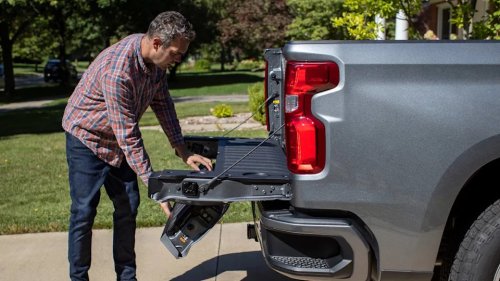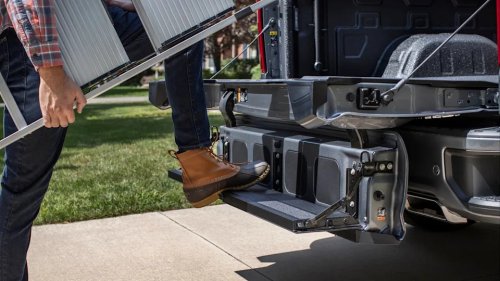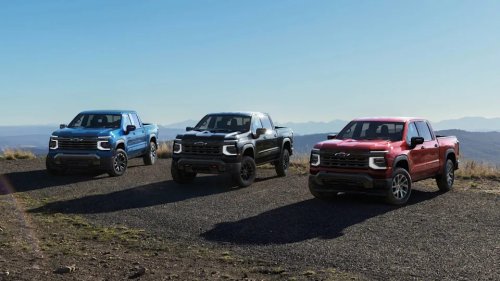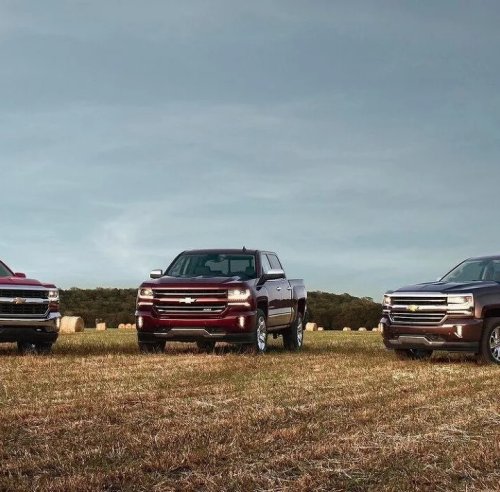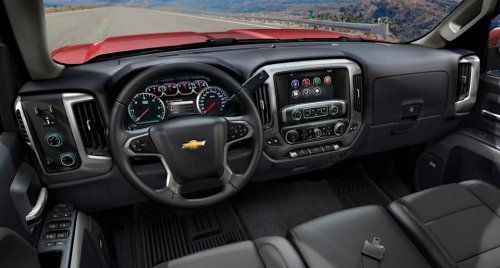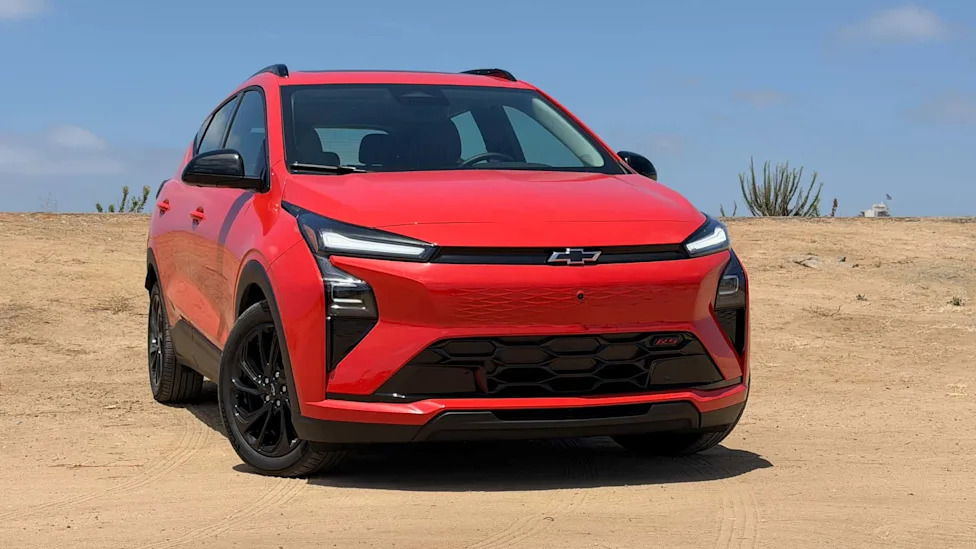



















In many ways, the region around El Paso is kind of a “backwater.” We don’t have much water, actually, but we do have lots of beach in the form of desert sands! When a new EV model comes out, we’re often the last place where you’ll see one on the streets, months and sometimes even years after you’d see one in LA or Phoenix. For this reason, my Silverado EV was the first one that I got a really good look at, and right before buying it! Seeing a picture of a Silverado EV, you might think it’s just an electric Chevy pickup, but once you’re around one a bit, you figure out pretty quickly that it’s no Silverado 1500. General Motors markets it as a 1500-series pickup (a “half-ton”) but one glance at its imposing stance, massive eight-lug hubs, and heavy-duty suspension tells a completely different story. Then you open the driver’s side door (before you climb UP onto a mountain of battery cells to drive it) and look at the tire and loading information stickers. The Silverado EV LT tips the scales at a rather impressive curb weight of 8,296 pounds. Yet, the Gross Vehicle Weight Rating (GVWR) is suspiciously capped at exactly 9,990 pounds, just ten pounds shy of a very round number. If you do the math, that leaves a maximum payload of 1,694 pounds. For a massive truck that physically dwarfs most pickup trucks (including some HD and Super Duties), that’s almost offensively low. Why would GM overbuild a chassis with Load Range E heavy-duty tires only to tell owners they can barely haul more than a midsize Chevy Colorado? The answer isn’t a lack of engineering capability. It’s a wall of bureaucracy. Specifically, it’s an outdated, 1970s-era Department of Transportation regulation that is artificially choking the capability of electric trucks. Even worse, if we aren’t careful, this exact regulation is going to completely kill the dream of a practical, mass-market electric Chevy Suburban. The 10,001-Pound Regulatory Cliff To understand why General Motors is artificially “de-rating” their electric trucks on paper, you have to understand the Federal Motor Carrier Safety Administration (FMCSA). Under FMCSA rules, the moment a vehicle used for any sort of business or interstate commerce crosses a GVWR of 10,001 pounds, it is legally classified as a Commercial Motor Vehicle (CMV). This isn’t just a simple categorization; it’s a massive regulatory cliff for a truck’s owner or driver to fall from. If you’re a local landscaper, a florist, or a small family business, crossing that 10,001-pound line means you suddenly need a federally registered DOT number plastered on the side of your truck. Your everyday employees have to pass strict DOT physicals to carry medical cards. You become subject to Hours of Service (HOS) tracking, mandatory maintenance logs, and the absolute joy of pulling into highway weigh stations along with the 80,000-pound semi-trucks for weighing and inspection. To save their fleet and small business customers from this paperwork and scale cop nightmare, automakers employ a simple workaround: the paper derate. They intentionally cap the GVWR at 9,990 pounds or 10,000 pounds, leaving just enough breathing room to stay under the federal commercial radar. In the world of gas and diesel, this worked fine. A gas-powered Silverado 2500HD might weigh 6,500 pounds empty, leaving a very comfortable 3,490 pounds of payload before hitting that 10,000-pound ceiling. But in the EV world, massive battery packs change the math entirely. The Battery Weight Penalty An Ultium battery pack capable of pushing a massive aerodynamic brick 400-plus miles down the highway (or 180-200 miles pulling another bricky trailer behind it) is incredibly heavy. The pack in the Silverado EV (especially the 170 kWh extended or 205 usable kWh max range options) weighs thousands of pounds by itself. Because we have a hard 10,000-pound legal cap for non-commercial light-duty trucks, the automotive engineering game has turned into a zero-sum nightmare. Every single pound of battery that GM adds to cure range anxiety and enable reasonable towing is a pound they have to legally steal from the truck’s cargo capacity. But, if you look at the specific gross axle weight ratings (GAWR) on the Silverado EV’s door sticker, a different engineering picture emerges. The front axle is rated to carry 5,300 pounds. The rear axle is rated to carry 5,750 pounds. If you add those two physical capacities together, the chassis is mechanically rated to support 11,050 pounds. The physical components of GM’s BT1 platform are practically begging to do more work and shoot right over that 10k DOT limit. Mechanically, my LT trim truck could comfortably operate at an 11,050-pound GVWR all day long without breaking a sweat. If GM were legally allowed to print “11,050 lb” on the door sticker without unleashing a regulatory nightmare on me, the Silverado EV’s payload would instantly jump from a modest 1,694 pounds to an incredibly capable 2,754 pounds, putting it squarely in ¾-ton territory to match the truck’s 8 lugs. But because of an imaginary line drawn decades before lithium-ion batteries existed in cars, this heavy-duty titan has to masquerade as a half-ton lifestyle truck despite being capable of so much more. (Note: don’t go loading the truck up past 10,000 pounds because Jenn said it could, as that can still potentially get you into legal trouble!) The In-Cradle Death of the Electric Suburban This regulatory squeeze is annoying for pickup owners, but it is an existential threat to the popular three-row family hauler. Let’s look at the Chevrolet Suburban. Americans love big SUVs, and if we want to seriously decarbonize the transportation sector, we have to electrify the vehicles that people are actually buying. An electric Suburban built on the BT1 platform is the holy grail for large families, road-trippers, and livery fleets. It would be able to haul the family and a boat or travel trailer without needing to load up more premium electrons every 50 miles. But let’s do the utility math under the current DOT rules. A BT1-based EV Suburban with decent range would easily have an estimated curb weight of around 8,500 to 8,800 pounds (imagine my LT, but with extra weight for the rear roof, third row seat, and passenger safety). If GM is forced to cap its GVWR at 9,990 pounds to keep it classified as a standard passenger vehicle and avoid triggering CMV rules for corporate fleets, you are left with a minuscule 1,190 pounds of payload capacity. In a Suburban, that capacity can disappear on you pretty fast. Seven average American adults will weigh somewhere around 1,200 pounds. Before you’ve even loaded a single suitcase, stroller, or set of golf clubs into the cavernous rear cargo area, you are legally overweight. Want to tow a boat to the lake? A moderately sized trailer requires 500 to 800 pounds of tongue weight resting on the rear of the SUV. Under a 9,990-pound GVWR, an EV Suburban towing a boat could legally carry maybe one driver and a remarkably light passenger. The rest of the family would have to take an Uber to the marina if they want to keep things strictly legal. We are facing a reality where GM literally cannot build a practical electric Suburban because it would require the driver to hold a professional medical certificate just to take the neighborhood kids to soccer practice (because that might compete with “interstate commerce,” see Wickard v Filburn). A Possible Solution — The Precedent for a 2,000-Pound “EV Credit” The frustrating part is that the federal government already knows how to fix this, and they’ve already done it for bigger electric trucks. To encourage the adoption of alternative fuels, Congress previously passed legislation that grants Natural Gas Vehicles (NGVs) and battery-electric Class 8 semis a 2,000-pound weight allowance on the interstate. Instead of the strict 80,000-pound federal weight limit, an electric semi can legally operate at 82,000 pounds to account for the heavy battery packs without sacrificing freight capacity and losing out on lucrative loads. Why hasn’t this exact same logic been applied to the 10,000-pound FMCSA threshold? Trade groups and sensible lawmakers have been quietly lobbying for an adjustment that would shift the boundaries for Class 2b and Class 3 vehicles specifically for EVs. Allowing a 2,000-pound “weight parity credit” would bump the threshold for light-duty electric trucks and SUVs up to 11,990 pounds, bypassing the DOT number requirements for small businesses while accurately reflecting the physical capabilities of platforms like the BT1. If they did this, my truck (assuming I could get GM to re-rate it with a new sticker) as well as new Electric Suburbans and Escalades could carry the family and a trailer, or carry a work crew to the jobsite without needing a DOT number. Technology Makes the Extra Ton Safer Than The Lighter Trucks Of Yesteryear The predictable, knee-jerk pushback from safety regulators and the more thoughtless urbanists is predictable: Heavier vehicles are more dangerous! Keep them off our roads unless you get extra training! Normally, they’d be right. Kinetic energy is a real thing, and an 11,500-pound SUV carries significantly more force in a crash than a 9,000-pound one. But that argument conveniently ignores the massive leaps in safety technology that have occurred since these weight classes were codified. If the DOT is concerned about stopping distance, modern EVs offer a massive advantage through blended regenerative braking. An 11,000-pound electric truck uses the resistance of its heavy-duty electric motors combined with massive friction brakes to stop in distances comparable to lighter gas trucks. More importantly, they don’t suffer from the catastrophic brake fade that plagues traditional heavy-duty trucks on long mountain descents. Furthermore, we are moving into an era where Automatic Emergency Braking (AEB) is becoming standard. An 11,000-pound EV Suburban with state-of-the-art AEB, precise electric torque vectoring, and an ultra-low center of gravity (thanks to the floor-mounted battery pack you sit atop) is statistically far safer and much less likely to roll over than an 8,000-pound top-heavy gas-guzzler from fifteen years ago. Regulators need to stop evaluating vehicle safety based entirely on a dumb scale and start looking at performance-based standards that reflect the reality of 2026. Unlocking the Last Ton It’s time to modernize the rules to match the technology. Adjusting the federal commercial threshold to 11,990 pounds for zero-emission vehicles wouldn’t put monster trucks in the hands of unqualified drivers; it would simply acknowledge the physical reality of battery chemistry, center of gravity, and modern safety systems that makes the weight largely disappear. Granting this leeway would instantly unlock the true mechanical capabilities of vehicles like the Silverado EV, turning them from compromised heavyweights into genuine, uncompromised workhorses with nearly 3,000 pounds of payload. More importantly, it would clear the path for the electric Suburban—allowing large families to finally ditch gasoline without having to leave their luggage, or their kids, behind. We have the engineering to build the ultimate zero-emission family haulers and heavy-duty work trucks. They’re literally coming off the line at Factory Zero in Michigan right now. But, convincing “small government” conservatives to get out of the way and let industry offer more compelling EVs is probably going to be like pulling teeth. Featured image: My Silverado EV LT Extended Range pulling a medium-sized travel trailer.