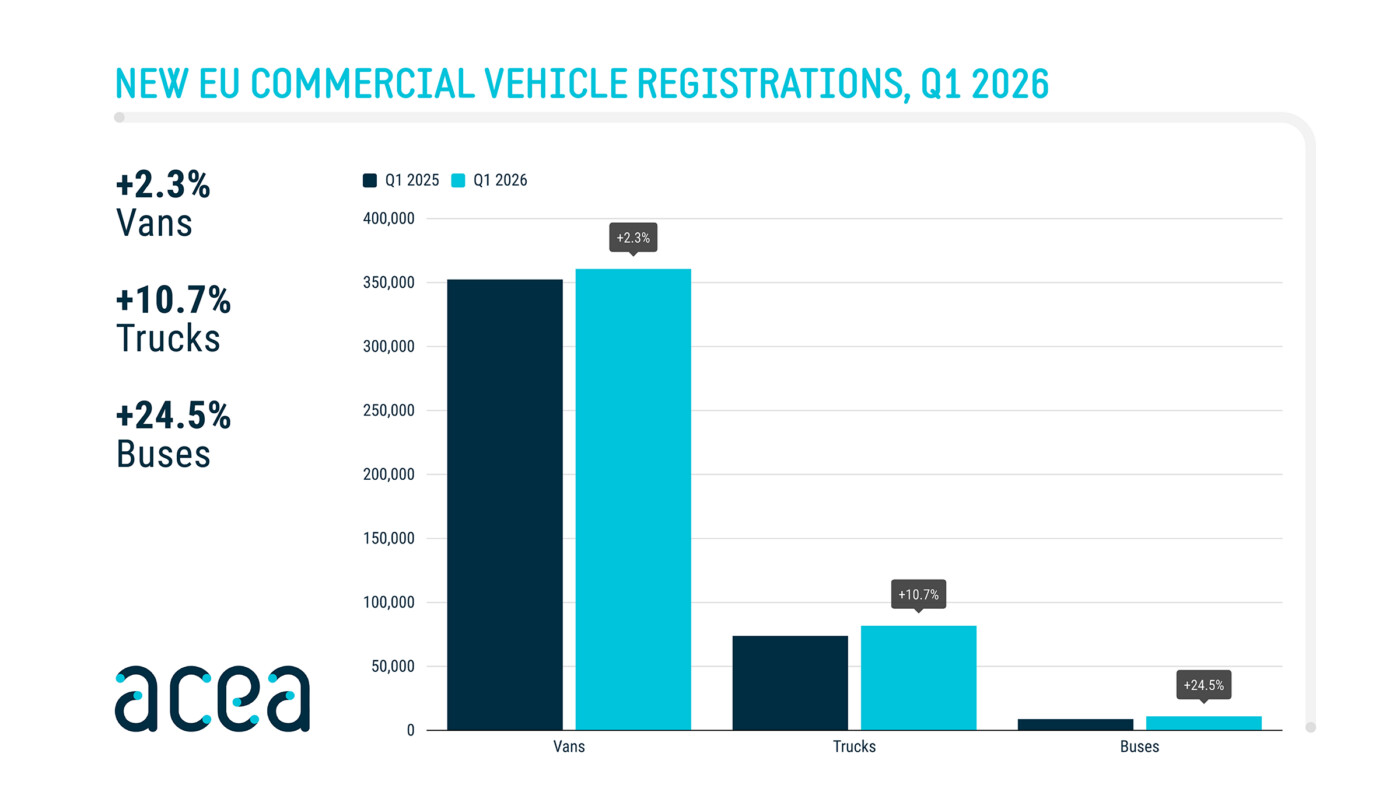
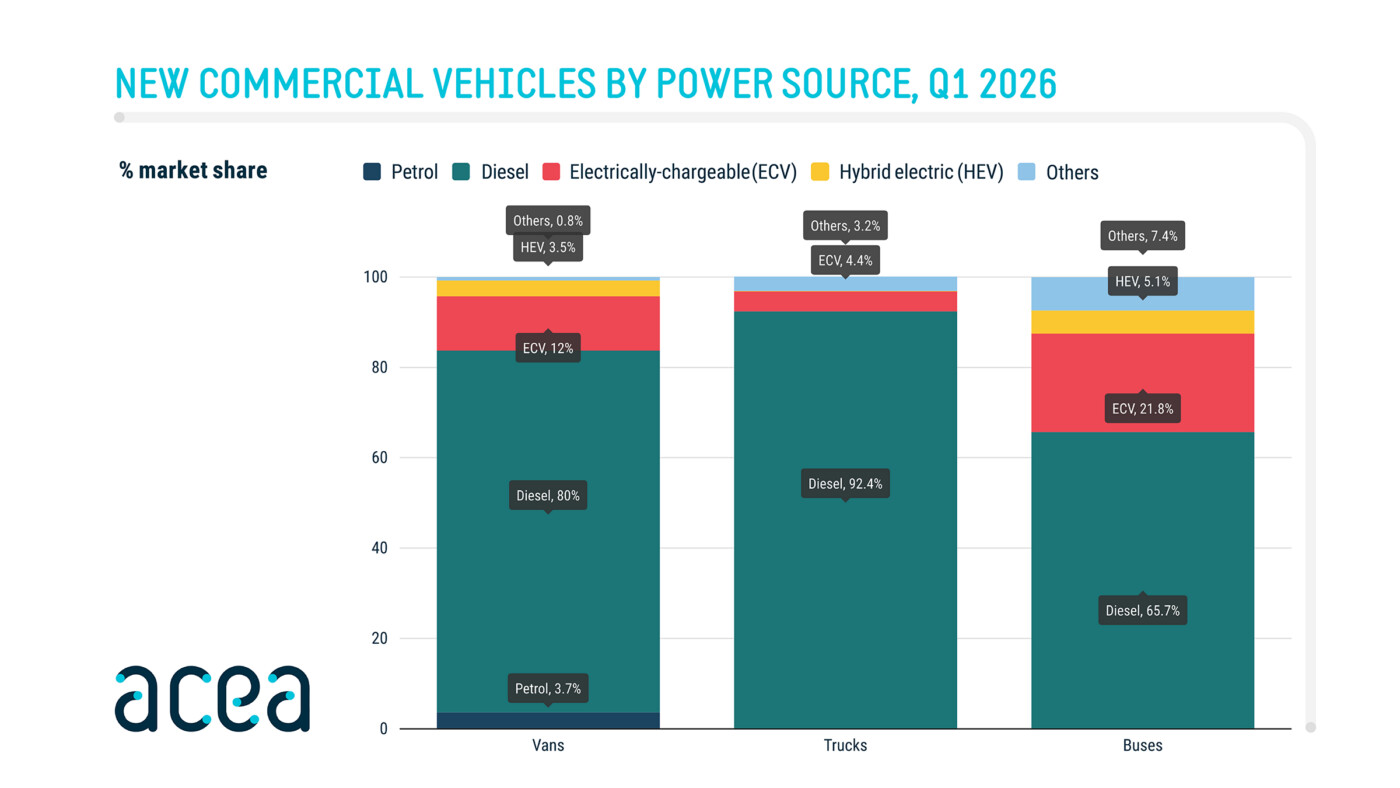
European customers are once again purchasing more buses and trucks, according to the latest commercial vehicle registration figures for the first quarter of 2026 published by the European Automobile Manufacturers’ Association (ACEA). Across all drive types, the EU market grew by 10.7 per cent to 81,766 trucks (over 3.5 tonnes) and by 24.5 per cent to 10,964 buses. ACEA describes this as a ‘recovery from a low base’ for trucks and ‘robust dynamics’ for buses. At the same time, the share of rechargeable electric vehicles in the mix continues to rise. However, ACEA notes: “progress remains too slow, with market uptake still constrained by insufficient enabling conditions”.To clarify: ACEA tracks the development of commercial vehicle markets in the EU and across Europe on a quarterly basis. While the association also provides figures for vans, this report excludes them and focuses solely on trucks over 3.5 tonnes and buses. In the first quarter of 2026, diesel-powered trucks accounted for a dominant 92.4 per cent of EU new registrations (+11 per cent year-on-year). The share of rechargeable electric trucks increased by 40.1 per cent, achieving a market penetration of 4.4 per cent (compared to 3.5 per cent the previous year). France (+66.3 per cent year-on-year) and Germany (+58.9 per cent year-on-year) led this growth, while the Netherlands (-1.3 per cent) saw a decline. Together, these three markets accounted for 71 per cent of total registrations in this segment.Italy drives growth in e-busesIn the bus sector, new registrations of electric buses grew by 36 per cent in the first quarter, increasing their market share from 20 per cent to 21.8 per cent. Italy, the second-largest market in terms of total registrations, recorded particularly strong growth (+161.2 per cent year-on-year). Germany, however, lagged behind – more on this below. Registrations of diesel buses also rose, according to ACEA (+24.8 per cent year-on-year), reaching a market share of 65.7 per cent between January and March. In contrast, hybrid bus registrations continued to decline (-10.6 per cent), accounting for just one in every 20 new registrations (5.1 per cent market share).Before examining the country rankings in detail, a brief clarification of terms: In the truck sector, ACEA divides its statistics into different weight categories. The association classifies trucks weighing between 3.5 and 16 tonnes as medium-duty trucks, and those over 16 tonnes as heavy-duty trucks – anything under 3.5 tonnes falls into the van category, which is not covered here. For buses, ACEA does not distinguish by weight classes; all vehicles intended for passenger transport over 3.5 tonnes are recorded. Additionally, the association does not differentiate between battery-electric vehicles and plug-in hybrids, instead grouping them simply as ‘electrically chargeable’. Grafik: ACEAFocusing on medium-duty trucks between 3.5 and 16 tonnes, it is clear that demand in this segment stagnated across the EU in the first quarter, with around 12,000 units registered (+0.7 per cent year-on-year). However, within this class, plug-in vehicles saw an upward trend (1,975 units, +18.3 per cent year-on-year). As a result, rechargeable trucks in this weight class now account for 16.2 per cent of registrations. For comparison: in the full year 2025, their market share was 14.8 per cent. This demonstrates that it is primarily medium-duty electric trucks driving the electrification of the European truck market.Germany alone registered 890 medium-duty electric trucks, representing 45 per cent of all newly registered electric trucks in the EU. Consequently, Germany’s growth rate of 44.5 per cent is significantly above the EU average. Other countries with high growth rates and relevant volumes include France (290 units, +179 per cent year-on-year), Poland (42, +133 per cent year-on-year), Sweden (133, +87 per cent year-on-year), and Denmark (107, +31 per cent year-on-year). In contrast, the Netherlands saw a sharp decline (296, -42 per cent year-on-year). Expanding the view to all of Europe, the UK is Germany’s closest competitor, with 727 electric trucks up to 16 tonnes (+10 per cent year-on-year).Nearly one in three electric HGVs registered in GermanyIn the EU, heavy-duty trucks over 16 tonnes account for a significantly larger share of total sales. Out of 69,608 total registrations (+12.6 per cent year-on-year), 1,624 were electric trucks, accounting for a 2.3 per cent share of the segment. Germany once again stands out, with 497 units registered (+93 per cent year-on-year), reflecting a marked acceleration compared to the full year 2025 (+38 per cent over 2024). This also means that 31 per cent of all heavy-duty electric trucks in the EU were registered in Germany during the first quarter. Other countries with above-average growth in this segment include Austria (164 units, +228 per cent year-on-year) and the Netherlands (328, +162 per centyear-on-year). France recorded a moderate increase of 15 per cent, reaching 262 units.Switzerland also deserves mention in the electric truck sector. The small Alpine nation registered 218 electric trucks over 16 tonnes (+137 per cent year-on-year) in the first quarter, achieving an electric share of 25 per cent in this weight class – leading Europe. Grafik: ACEAMoving on to ACEA’s statistics for the European bus market: the adoption of electric vehicles has long been established here. Of the 10,964 new buses registered in the EU between January and March (+24.5 per cent year-on-year), 2,393 were rechargeable electric – equating to a 21.8 per cent electric share. This represents a slight decline, as it falls below the 2025 full-year average of 23.8 per cent electric bus market share.Germany lags behind in e-bus registrationsWhile the EU’s electric bus market grew by an average of 36 per cent, Italy stood out in the first quarter with 491 units (+161 per cent year-on-year). It was supported by strong growth markets such as Portugal (253, +912 per cent year-on-year) and Poland (186, +251 per cent year-on-year), as well as reliable volume countries like the Netherlands (188, +56 per cent) and France (224, +53 per cent). In contrast, Germany and Sweden experienced significant declines (-27 per cent and -17 per cent year-on-year, respectively). Germany registered 278 electric buses in Q1, compared to 383 units the previous year. The full year 2025 in Germany was exceptionally strong, so the ACEA figures now likely reflect a normalisation of electric bus registrations.Notably, the electric bus market across the EU presents a far more homogeneous picture than that of electric trucks. In the past year, 17 of the 27 EU member states recorded two- or three-digit electric bus registrations. Looking at Europe as a whole, the UK remains the undisputed leader in electric bus registrations. In the first quarter, the country recorded 603 new plug-in buses, though this figure is 28% below the previous year’s result, as the overall bus market in the UK declined even more sharply. It seems that even the UK, a leader in electric buses, must occasionally weather some setbacks.acea.auto, acea.auto (PDF)