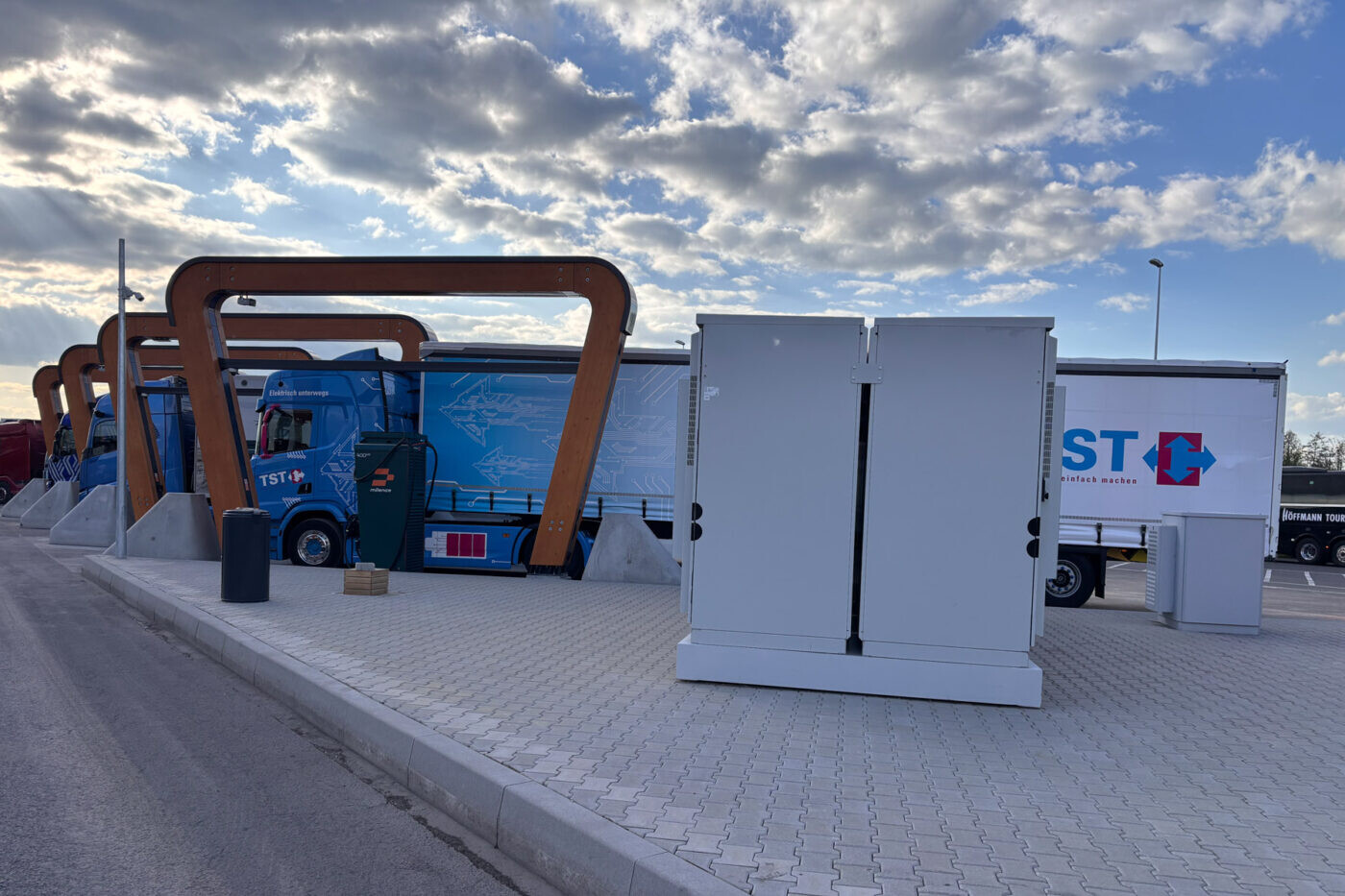
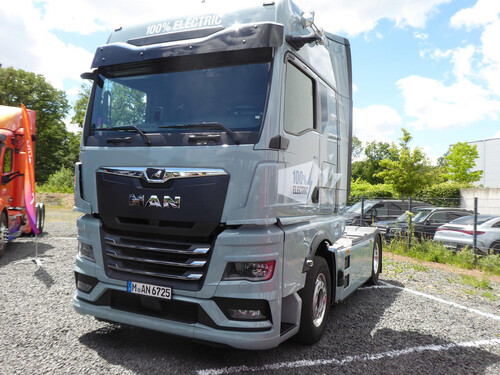
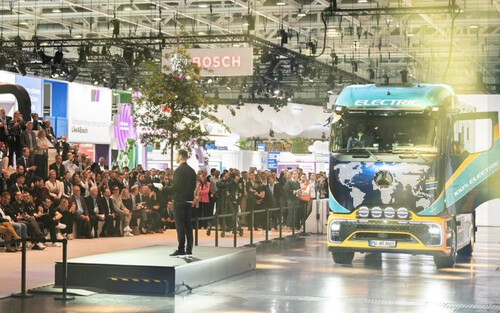
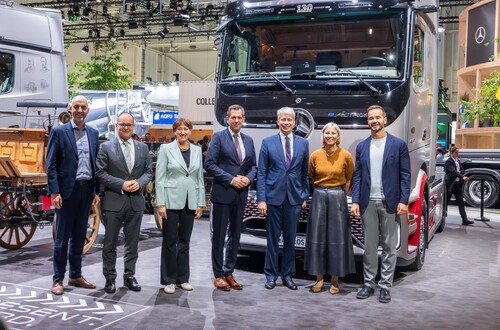
The charging park in Kassel-Lohfelden in central Germany is Milence’s ninth location in the country. Situated along the A7 and A49 motorways, it is integrated into the established HGV site SVG Autohof Lohfeldener Rüssel. From now on, four charging bays, each equipped with 400 kW CCS connectors, are available on-site. Drivers can also use the standard Milence service facilities during the charging process. A key advantage is the charging park’s proximity to an existing filling station.And there is more. Milence highlights that the Kassel-Lohfelden charging park is the first within its network to integrate a stationary battery storage system into the charging ecosystem. It demonstrates how storage technology ‘enables the expansion of charging infrastructure even at locations where sufficient grid connectivity has previously been lacking,’ the company’s representatives said.Milence is a joint venture established in 2022 by Daimler Truck, Traton, and the Volvo Group to create a Europe-wide public charging network for HGVs. While the first hubs were celebrated with great fanfare one or two years ago, the inauguration of charging parks has since become routine. This week in Kassel-Lohfelden, however, was different: the Milence-initiated roadshow ‘Power to Go Further’ made a stop there. electrive was also on-site. The joint venture used the high-profile event for a public charging demonstration and a panel discussion on the total cost of ownership in electric road freight transport. Image: Peter Schwierz Image: Peter Schwierz Image: Peter SchwierzAs part of the roadshow, four battery-electric trucks from Daimler Truck, MAN, Volvo Trucks, and Renault Trucks covered a 1,000-kilometre route from Paris to Berlin in several stages since 15 April, charging exclusively at Milence charging parks along the way. The convoy’s objective was to demonstrate the technical and economic advantages of battery-electric trucks over diesel models. The key message: long-distance transport with battery-electric trucks in Europe is not only feasible but also increasingly attractive from an economic perspective.Tour includes detour into central ParisThe tour followed public Milence charging points across four countries and concluded in Berlin on Thursday. The roadshow began last week in Saint-Witz (France), near Paris, before proceeding via Ghent (Belgium), Maasmechelen (Belgium), Zwolle (Netherlands), Mogendorf (Germany), Kassel-Lohfelden (Germany), and Vockerode (Germany) to the German capital. The German manufacturers participated with the Mercedes-Benz eActros 600 and the MAN eTGS ultra-trailer tractor. Volvo Trucks and Renault Trucks did not yet deploy their new long-haul trucks expected this year but instead used the current-generation Renault Trucks E-Tech T and Volvo FH Electric. The stages were tailored to the range of these two older models and were relatively tightly scheduled.Dirk Stranz, who drove the eActros 600, confirmed this. In an interview with electrive, the Daimler Truck test engineer described the trips into central Paris and Brussels as particularly exciting.“We drove to Parisian landmarks, around the Arc de Triomphe and the Eiffel Tower – with special permission but without a trailer.”In Brussels, manoeuvring for press photos required precision down to the centimetre. According to Stranz, the longest stage was around 320 to 350 kilometres, which the eActros 600 handled effortlessly. It set off with a partial load of 32 tonnes. Image: Milence Image: Milence Image: Milence Image: Milence Image: Milence Image: Milence Image: Milence Image: MilenceStranz emphasises that battery-electric trucks are even easier to control than diesel trucks, especially during precise manoeuvres. “And when faced with short merging lanes, the electric motor’s boost is very helpful,” he added.Overall, the test engineer is impressed by the maturity of battery-electric trucks. “It’s important to remember: the diesel truck was invented 130 years ago and has been optimised ever since. When you consider how recently the electric truck was introduced and how mature it already is, it’s truly impressive.”Anja van Niersen, CEO of Milence, shares this view: “The ‘Power to Go Further Tour’ marks a milestone for Milence […]. It demonstrates the impressive progress of electric road transport towards sustainable operations. Paris–Berlin is just one of many clean transport corridors that can already be operated fully electric and economically viable across Europe.”50 charging parks planned by the end of the yearCurrently, the Milence network comprises 34 operational charging hubs with 221 charging points across eight countries, forming the first interconnected logistics corridors – such as Paris–Amsterdam, Barcelona–Lyon–Paris, Antwerp–Stockholm, and Berlin–Stuttgart. Most charging parks are still equipped with CCS connectors offering a maximum output of 400 kW. However, the rollout of Megawatt Charging System (MCS) technology has begun at the sites in Antwerp (Belgium), Zwolle (Netherlands), and Landvetter (Sweden).With Kassel-Lohfelden, Germany now has its ninth Milence location in operation. Regarding further expansion, the joint venture aims to be ‘in line with market demand,’ ensuring that charging infrastructure is available at least one year ahead of the expected growth in electric trucks. Against this backdrop, 50 operational charging parks are planned across 10 European markets by the end of this year (18 of them in Germany). By the end of 2028, the goal is to have 90 charging parks and 284 MCS charging points at 71 locations. Milence no longer mentions its long-standing target of commissioning at least 1,700 high-power charging stations across Europe and the UK by 2027.The CPO has also published newly calculated operating costs for trucks, which are estimated at €0.995 per kilometre for electric models compared to around €1.003 per kilometre for diesel. The cost comparison is based on a scenario that accounts for depreciation and several key assumptions. Further details are available in the linked Milence announcement below.When using renewable energy, the joint venture estimates a CO₂ saving of up to 1,470 kg (based on 0.9 kg CO₂/km diesel emissions per truck).“These results show that electric freight can deliver both cost efficiency and significant emissions reductions on key European corridors,” the company’s representatives comment.The company also recently published a total cost of ownership (TCO) analysis, which indicates that in leading markets, electric trucks can already compete with diesel under favourable conditions. Policy measures such as toll incentives and CO₂ pricing further strengthen the business case.However, van Niersen points out that despite strong momentum, fragmented policy frameworks and uneven progress across countries continue to hinder large-scale adoption.“Charging infrastructure is developing in line with market demand, and electrification is increasingly driven by strong economics while supporting Europe’s energy resilience and strategic autonomy. Collaboration between industry and policymakers is essential to accelerate progress and turn today’s challenges into a strategic economic opportunity.”With specific regard to Germany, van Niersen told electrive that her company faces significantly longer waiting times for grid connections and planning approvals than in other markets: “We carried out a comparison: in Germany, it takes five to ten times longer than in other European countries. Germany cannot afford that.” Companies like hers would need “priority access, otherwise infrastructure rollout in Germany will be much slower than in the rest of Europe”.She added that while integrating stationary battery storage into charging hubs—such as at Kassel-Lohfelden—can help provide the required power, this must not slow down grid expansion. “We are planning the rollout of MCS at the same time, so we will continue to need these larger grid connections.”Source: electrive on site, milence.com, press.mantruckandbus.com