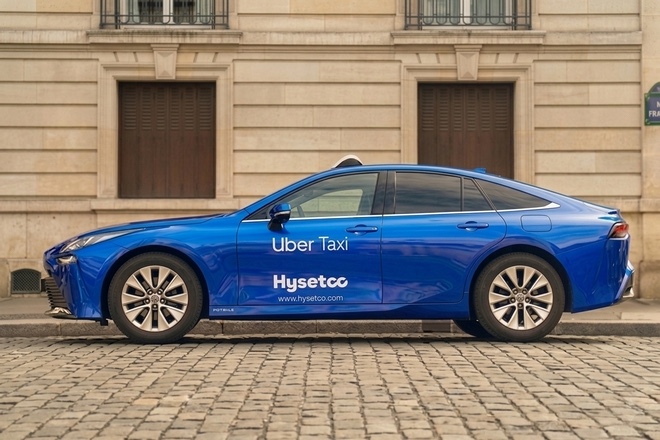





















Image: HysetCoIn addition to this short-term goal for the current year, HysetCo and Uber have agreed to integrate nearly 2,000 hydrogen taxis from the HysetCo fleet into Uber’s platform over the next five years. The deal marks the joint venture’s entry into the ride-hailing market. The consortium is backed by the fund Hy24 as the majority shareholder, alongside Air Liquide, TotalEnergies, and Toyota.As HysetCo states, Uber is investing in a French company for the first time, thereby strengthening its presence in the taxi sector. “Uber’s financial commitment takes the form of a convertible loan, which is intended to support HysetCo’s growth and enhance Uber’s taxi offering,” the joint venture explains, without disclosing further financial details.This collaboration is driven by Uber’s expanding taxi booking options via its app. Regarding the Paris metropolitan region, HysetCo’s announcement states: “Following the introduction of fixed-price taxi rides in 2025, Uber now offers a range of business taxis exclusively for the business customers of Uber for Business.”By the end of the year, hydrogen vehicles from HysetCo are expected to account for one in five vehicles in this business taxi fleet. However, the exact number of vehicles remains unspecified. The partners state that the H2 fleet is set to grow to 2,000 units within five years.HysetCo will contribute its established ecosystem and practical expertise to the partnership. The joint venture is one of the few players to have developed an integrated ecosystem for hydrogen-powered passenger cars. Its representatives state that they have been active in the Île-de-France region for five years, offering a comprehensive service for the rental and management of hydrogen vehicles. This includes providing the cars, maintenance, repairs, insurance, and access to its refuelling station network. Currently, HysetCo manages over 800 vehicles, though not exclusively in the taxi segment but also in corporate fleets.“This partnership with Uber sends a strong signal: hydrogen mobility is ready for large-scale deployment, particularly in high-usage applications. The infrastructure is in place, the vehicles are ready, and the use cases are established. Uber’s commitment alongside us is a decisive and very positive step. Together, we are pursuing an ambitious yet concrete path towards CO₂-free mobility and improved air quality with confidence and determination,” emphasised Loïc Voisin, President of HysetCo.“Through our investment in HysetCo […] we are anchoring ourselves even more firmly in the taxi industry. This partnership strengthens our offering […] in the B2B sector. Furthermore, we are expanding our fleet of zero-emission vehicles in the private hire sector with these hydrogen-powered cars, taking another step forward on our journey towards clean mobility,” explained Laureline Serieys, General Manager of Uber in France.That hydrogen taxis have a future in and around Paris is not guaranteed: in mid-2025, a dispute erupted between HysetCo and its closely partnered hydrogen taxi operator Hype. The latter subsequently announced a radical strategic shift towards battery-electric taxis, citing frustrating experiences with energy supply and sharply rising costs. The final straw was the insolvency of electrolyser manufacturer McPhy.Hype was already operating hydrogen taxis in Paris before the joint venture HysetCo even existed: the Hype fleet has been active in the French capital since 2015. At the time, the goal was to expand this fleet to 600 hydrogen taxis by 2020. To achieve this, the founding members—Air Liquide, Idex, Société du Taxi Électrique Parisien (STEP), and Toyota—launched the joint venture HysetCo in February 2019. TotalEnergies joined in 2021. However, the expansion of the Hype fleet did not gain significant momentum.Over the years, HysetCo gradually distanced itself from Hype and increasingly specialised in Mobility-as-a-Service (MaaS) offerings for hydrogen mobility in and around Paris. In 2024, the joint venture stated that it delivers nearly 30 tonnes of H₂ to its customers each month and manages a fleet of over 500 hydrogen vehicles (including, but not limited to, Hype’s hydrogen taxis). That same year, HysetCo raised €200 million in fresh capital and gained hydrogen fund Hy24 as its new largest shareholder.Since 2015, Hype’s operational business has been coordinated by the eponymous operator. Over the years, the two sides had clearly drifted apart. In any case, during the publicly aired dispute last summer, Hype openly criticised two of HysetCo’s parent companies—TotalEnergies and Air Liquide. While Hype is now focusing on battery-electric taxis, HysetCo can now count Uber’s entry as a success.hysetco.com (PDF, in French)