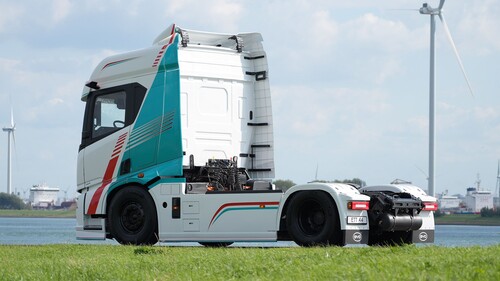
Image: MilenceTruck charge point operator Milence has published two new white papers. Let’s start with the good news: Electric heavy-duty vehicles are moving closer to cost parity with diesel trucks across Europe. However, Milence also looked at 14 European countries and identified significant differences in market readiness. There is only a small group of frontrunners already progressing beyond the pilot phase.Countries such as Switzerland, Denmark and the Netherlands have entered early large-scale deployment, while many other markets remain at an early stage of electrification. Milence states that ‘electric heavy-duty truck adoption is accelerating in leading European markets, moving beyond the pilot phase into early scale deployment,’ but notes that ‘progress remains uneven across Member States.’Policy frameworks drive diverging market developmentThe company links these differences primarily to policy frameworks. According to the report titled ‘Bridging the gap: market readiness and barriers in Europe’s transition to electric heavy-duty transport,’ successful markets combine several complementary measures, including competitive electricity pricing, CO₂-differentiated road tolling, long-term subsidies and access to reliable, truck-suitable charging infrastructure. Where these elements are in place, adoption increases; where they are missing, the transition slows.At the same time, the economic case for electric trucks continues to strengthen. Milence updated its Total Cost of Ownership (TCO) analysis based on lifecycle modelling for Germany, the Netherlands and Sweden. The results show that electric trucks are approaching or already achieving cost parity with diesel vehicles in key use cases.In the Netherlands, electric trucks already offer a cost advantage in several scenarios from 2026 onwards. In Germany, the extension of full toll exemptions for zero-emission trucks until 2031 provides a significant and predictable cost benefit, Milence states. In Sweden, lower electricity prices support electrification, although the absence of comparable toll incentives delays cost parity for long-haul operations.The CPO concludes that ‘the question is no longer if eHDVs become cost-competitive, but how quickly fleets can capture the advantage.’The report ‘Accelerating eHDV adoption: updated TCO Analysis confirms a strengthened cost advantage in 2026’ also highlights the impact of the broader energy context. The recent energy crisis has increased volatility in fossil fuel markets, raising operating costs for trucks by 9 to 11 cents per kilometre, Milence states. In contrast, electricity prices, particularly when linked to domestic renewable generation, are described as more stable and increasingly decoupled from global fossil fuel markets.Charging economics shift as utilisation risesTechnological improvements further support the business case. The truck CPO highlights that real-world data shows that modern electric trucks achieve energy consumption levels of around 1.1 kWh per kilometre, improving efficiency compared to earlier assumptions. At the same time, new market entrants and increased competition are expected to reduce upfront vehicle costs and expand the range of available models.The analysis also identifies a structural shift in the economics of charging infrastructure. As more electric trucks enter operation, utilisation rates at public charging stations increase, spreading fixed infrastructure costs across higher energy volumes. Milence describes this development as a transition ‘from shared investment to shared value.’ The company explains:“More electric trucks on the road lead to higher utilisation of charging points,” the company explains. “This, in turn, spreads infrastructure costs over more kilowatt-hours.”Milence also points out that ‘volume-based pricing models’ play a key role in this dynamic. As fleets increase their charging volumes, they can benefit from lower per-kilowatt-hour prices over time. Early adopters, in particular, may benefit from these effects across the lifecycle of their vehicles, as overall market volumes grow.“Europe does not face a technology gap, but a policy gap”At present, around 1,800 public charging points suitable for trucks are available along major European freight corridors. Milence itself operates 33 charging hubs with 221 charging points across eight countries. However, as with electric trucks, the rollout remains uneven and requires further acceleration to support large-scale electrification.Despite the progress, the CPO emphasises that Europe has not yet reached a self-reinforcing market dynamic. Vehicle adoption, infrastructure expansion and cost reductions are not yet fully aligned across all regions. Milence therefore concludes that Europe faces a policy gap rather than a technology gap.“Europe does not face a technology gap, but a policy gap,” the company states, warning that fragmented approaches could lead to a multi-speed transition and complicate cross-border logistics.Looking ahead, regulatory developments such as the introduction of the EU emissions trading system for road transport are expected to further strengthen the economic case for electric trucks by increasing fossil fuel costs.“Electric road freight is not only central to decarbonising transport, it is also a strategic pillar of Europe’s broader energy transition and independence,” Milence CEO Anja van Niersen summarises the findings. “The technology is ready, the business case is emerging, and the infrastructure is being built. What is needed next is the pace and consistency of policy to scale this transition across all Member States.”milence.com (TCO), milence.com (policy)