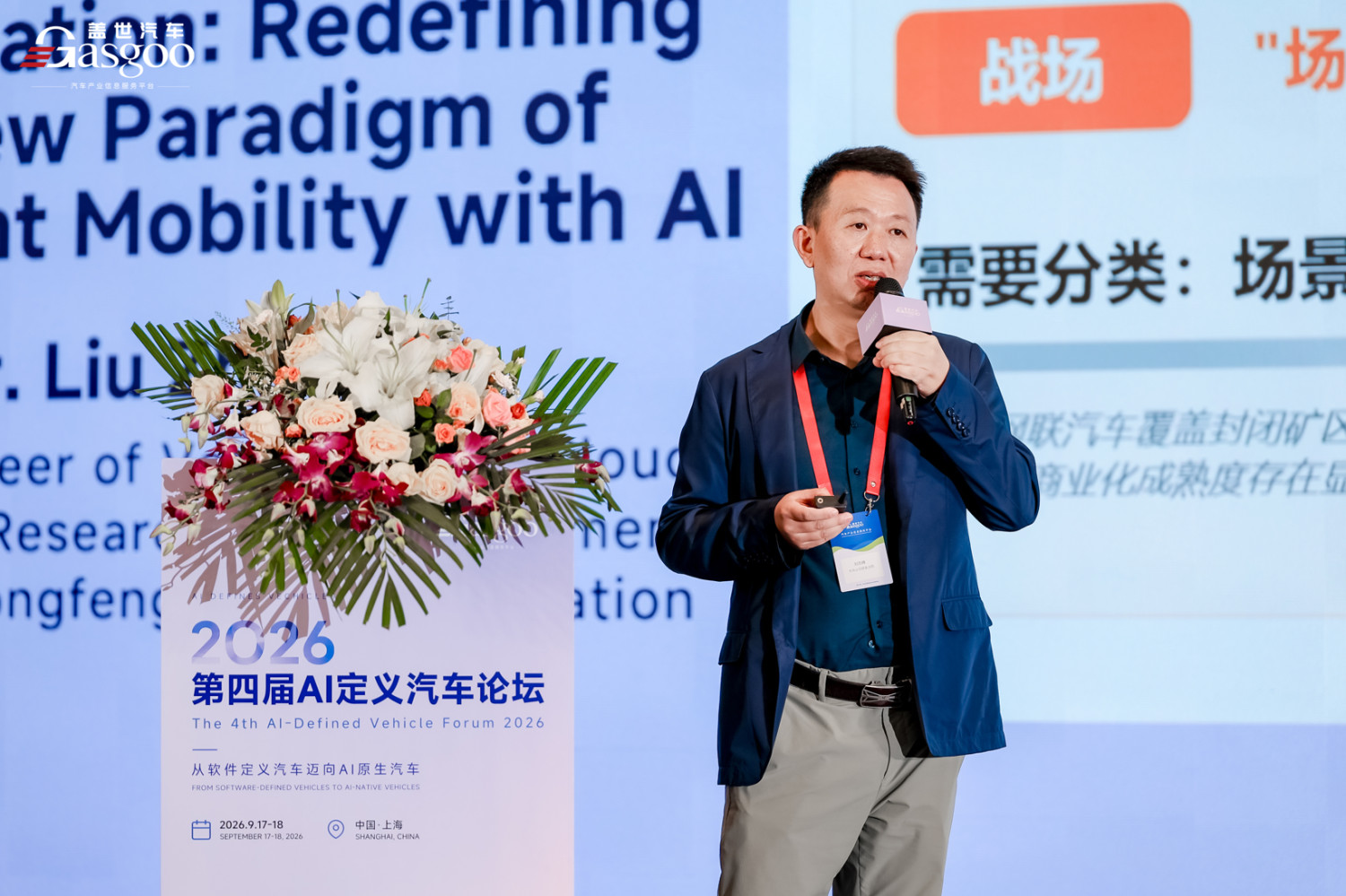
Gasgoo Munich- "Individual vehicle intelligence is nearing the long-tail boundary, while vehicle-road-cloud-chip synergy will become the second growth curve."Dr. Liu Zhifeng, a senior engineer for vehicle-road-cloud integration at Dongfeng Motor Corporation's General R&D Institute, spoke on Sept. 17 at the 4th AI-Defined Vehicle Forum. He noted that L2 driver-assist systems are spreading and L3 is reaching implementation. Intelligent connected vehicles are shifting from sole reliance on tech innovation to a "dual-wheel drive" of technology and institutional innovation. Meanwhile, the battleground for smart mobility is moving beyond individual vehicle features to focus on system reliability and the reconstruction of industry boundaries.According to Liu, technical difficulty, safety requirements, and commercial maturity vary across scenarios. Future development will emphasize tiered classification. Enclosed parks, mining, and trunk-line logistics are poised for early breakthroughs.On the technological front, Dongfeng is building a "one core, two foundations, two elements" system centered on "Tianyuan Intelligence." The "core" is the enterprise-level Tai Chi large model. The "foundations" are the Tianyuan electronic-electrical architecture and Tianyuan OS. The "elements" correspond to Tianyuan Intelligent Driving and Tianyuan Intelligent Cockpit. Dongfeng previously revealed that the Tianyuan architecture enables deep integration across power, body, cockpit, and intelligent driving domains.Liu disclosed that in cockpit-driving fusion, Dongfeng achieved 1-millisecond cross-domain communication latency. Intelligent agent scheduling response is about 300 milliseconds, with a collaborative task success rate exceeding 92%. This fusion reduces components by 15% to 30%, lowering costs by over 15%.While individual vehicle capabilities matter, Liu focused more on vehicle-road-cloud integration. Dongfeng is advancing operations in Wuhan, Shiyan, Xiangyang, and Beijing's Yizhuang district. It is also participating in the Beijing-Tianjin-Hebei highway project. notably, in Shiyan, over 230 manned vehicles and 15 unmanned logistics vehicles are in routine operations. Liu stated that vehicle-road-cloud collaboration boosts operational efficiency by over 20% compared to standalone vehicles.In the Beijing-Tianjin-Hebei highway scenario, Hebei Communications Investment Group joined Dongfeng and others. They are implementing "innovative outcomes for two-way empowerment on the Rongwu Expressway." This explores bidirectional data flow between vehicles and highway infrastructure.Of greater significance, the role of the vehicle itself is shifting. Liu indicated that cars will not only pull data from roads and the cloud but also provide data services to highways, infrastructure, and safety systems. This marks a shift "from one-way data acquisition to two-way vehicle-road empowerment."In Liu's view, the evolution of intelligent vehicles will depend on more than just compute power and models. Standards, data circulation, and the operational closed loop are also critical. Ultimately, the automobile will evolve from a "smarter car" into a "mobile intelligent agent." It will be capable of continuous learning and coordination with roads and cities.



















 +80 others