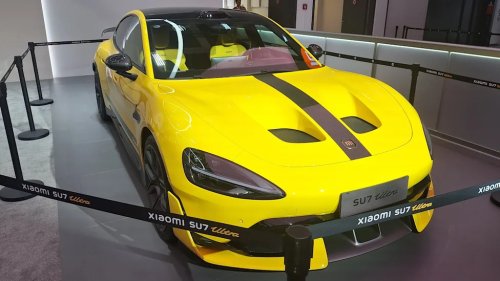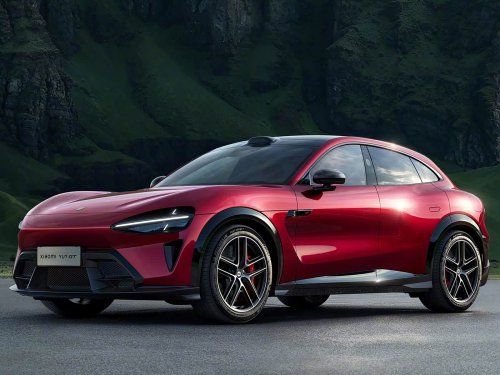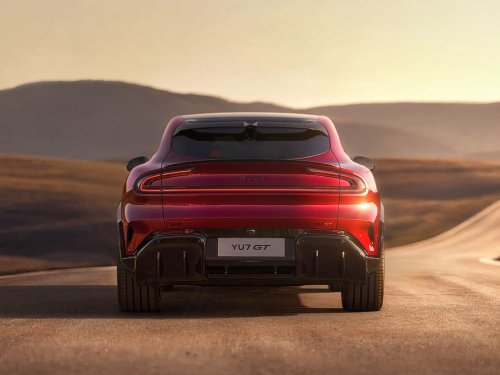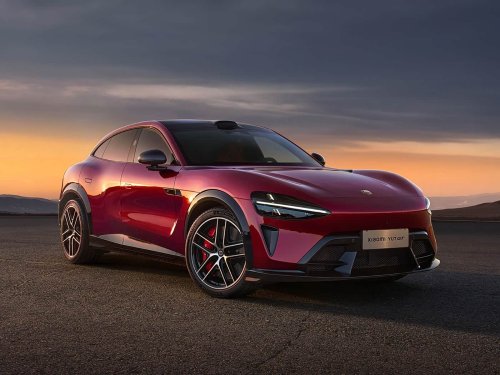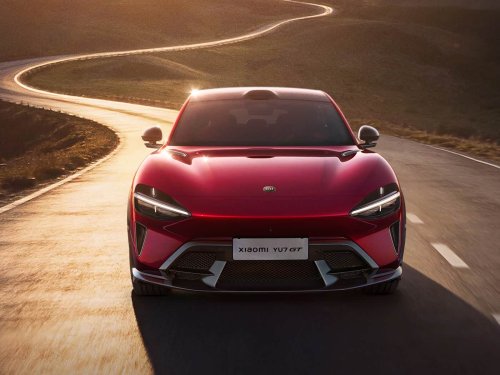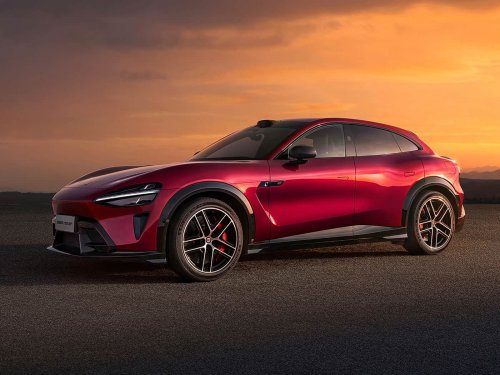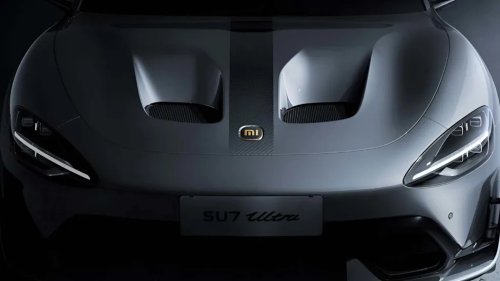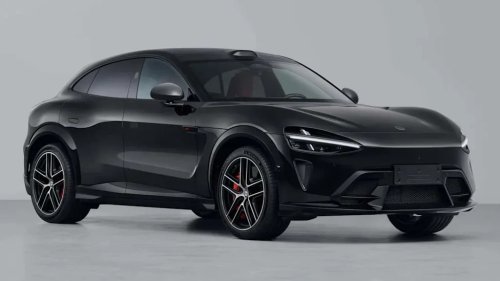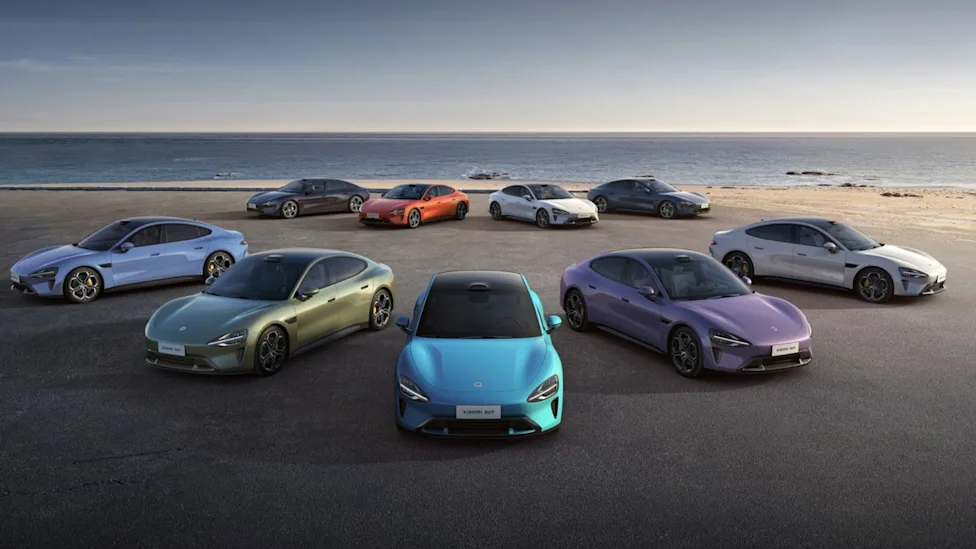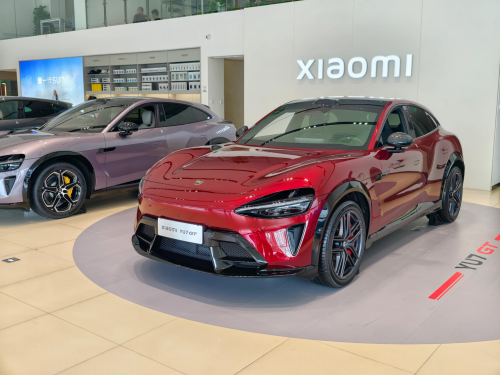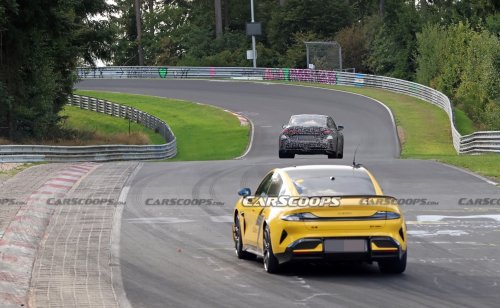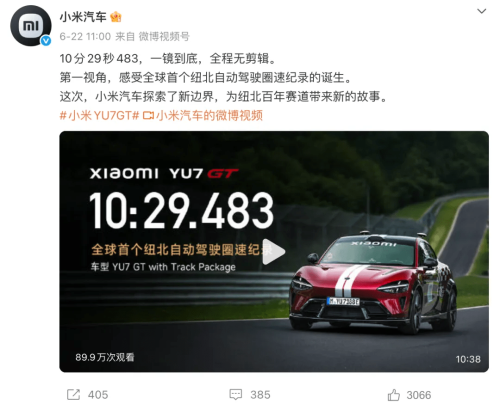
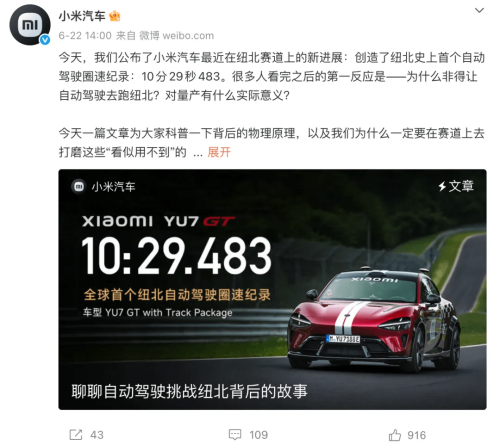
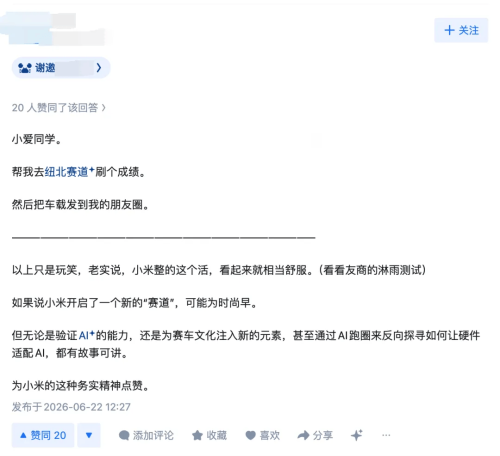
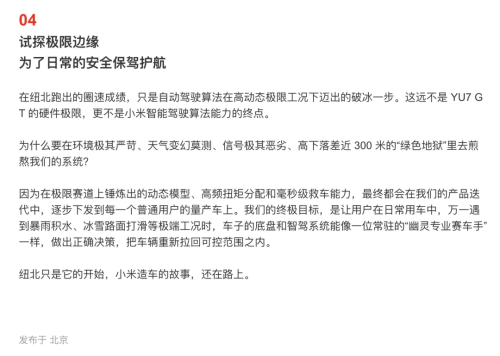
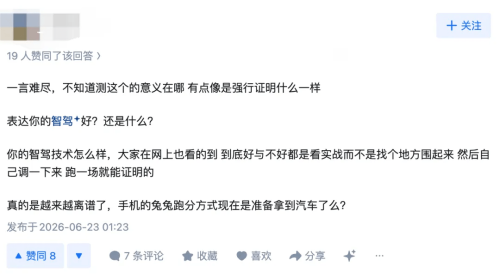
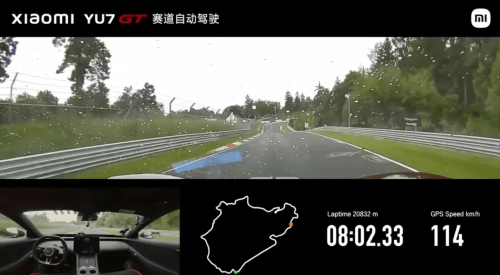
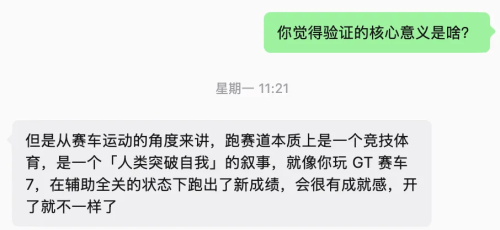
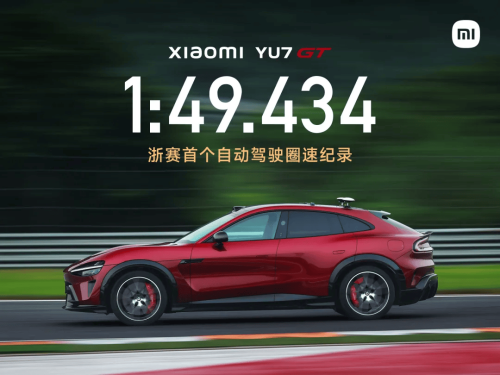



















Xiaomi Auto’s association with racetracks is growing deeper. When it comes to showcasing a vehicle’s performance credentials, the strategy makes sense. For the Xiaomi SU7 Ultra and Xiaomi YU7 GT, Nürburgring lap times have become some of the most valuable labels attached to both high-performance models. The discussion widened, however, when Xiaomi announced on June 22 that it had set the Nürburgring’s first autonomous driving lap record. Xiaomi’s social media post of the YU7 GT’s autonomous Nürburgring lap time. Supporters viewed the achievement as proof of Xiaomi’s autonomous driving capabilities. In their eyes, the company turned the long-running joke of “AI racing on a track” into reality, delivering a result with genuine technical substance. Critics offered a different view. Some argued that using autonomous driving technology on the Nürburgring carries greater marketing value than practical significance. A closed racing circuit differs sharply from real-world traffic environments. The capabilities demonstrated on a racetrack may not align with the scenarios consumers care about most in daily driving. Shortly after releasing the lap time, Xiaomi Auto published an article explaining why it chose the Nürburgring challenge, outlining the engineering objectives behind the project, the potential real-world benefits for production cars. Xiaomi Auto published an article explaining why it chose the Nürburgring challenge Unsurprisingly, Xiaomi’s explanation did not end the debate. What is the real significance of running autonomous driving systems on a racetrack? Does the exercise offer meaningful lessons for other automakers or technology suppliers? Or is it primarily a branding exercise wrapped in technical language? Beyond the familiar divide between supporters and skeptics, ChinaEV Home sought a third perspective. By speaking with fellow journalists, industry experts, autonomous driving engineers, vehicle dynamics specialists, the publication attempted to move the discussion beyond online arguments. The goal was to explore what the Nürburgring challenge actually reveals about the future development of autonomous driving technology. Xiaomi’s Nürburgring Autonomous Lap: A Precedent? Across Chinese and international social media platforms, supporters largely agree on one point: the biggest value behind Xiaomi’s autonomous Nürburgring lap lies in how rare it is. Few automakers have managed to post a meaningful lap time using a fully autonomous system. Fewer still have attempted it at the Nürburgring Nordschleife, one of the world’s most demanding racing circuits. Some users on Zhihu noted that even after countless laps in racing simulators, many crashes, they still struggled to break the 11-minute barrier. Against that backdrop, Xiaomi’s autonomous system completing the circuit in roughly 10 minutes, without human intervention, came as a surprise to many observers. Others took a broader view. Some argued it may be premature to say Xiaomi has opened an entirely new competitive arena. Even so, the project creates a new narrative around AI validation, racing culture, vehicle engineering. It also raises a new question: how should automotive hardware evolve to better support AI-driven vehicle control? A view expressed by a Chinese netizen on Zhihu. Comments of this nature attracted significant engagement online. Yet much of the positive reaction appeared emotional rather than technical. Many praised Xiaomi for being the first mover or for turning a science-fiction concept into reality. Few engineers or autonomous driving specialists stepped forward publicly to explain the underlying technology. One reason may be that Xiaomi itself has already attempted to fill that role. In the technical article published on June 22, Xiaomi outlined two core challenges involved in autonomous driving on a professional racing circuit. The first is operating at the limit of tire grip. The second is maintaining high speed throughout the lap. Combined on a circuit as demanding as the Nürburgring, those factors dramatically increase system complexity. The autonomous stack must continuously manage vehicle dynamics, calculate optimal trajectories, adjust steering inputs, control acceleration, execute corner entry, apexing, and corner exit decisions in real time. Many of those calculations occur in highly nonlinear conditions. Video footage released by Xiaomi revealed additional details. The vehicle rarely touched curbs. Top speed remained below 210 km/h. The lap was completed on a damp surface. Those details suggest Xiaomi deliberately retained a significant safety margin during the attempt. Perhaps the project’s significance is best captured by Xiaomi’s own explanation. The company argues that capabilities developed under extreme track conditions can ultimately help vehicles respond to real-world emergencies. Heavy rain, standing water, snow-covered roads, or sudden loss of traction all require rapid vehicle-control decisions. Xiaomi officially explains why it used autonomous driving to take on the Nürburgring. In Xiaomi’s view, the chassis and autonomous driving stack should function like a permanently onboard professional racing driver, capable of bringing the vehicle back under control when conditions deteriorate unexpectedly. Viewed through that lens, the Nürburgring challenge becomes less about setting a lap record. Instead, it serves as a stress test for the system’s ultimate safety envelope. The concept resembles previous demonstrations from Chinese automakers. Geely showcased autonomous drifting capabilities. Denza demonstrated unmanned circular drifting exercises. All sought to evaluate vehicle-control systems under extreme dynamic conditions. Xiaomi simply placed the narrative inside a complete racing-lap scenario. The result produced a more comprehensive demonstration. It also generated significantly greater public attention. The downside is equally clear. Stronger publicity inevitably creates misunderstanding. One of the most common misconceptions emerging from online discussions is the tendency to equate Xiaomi’s autonomous Nürburgring run directly with consumer-facing assisted-driving functions. When those discussions reached professionals working in the assisted-driving sector, one industry practitioner offered a blunt reaction during a conversation with ChinaEV Home: “I don‘t understand the significance of Xiaomi YU7 GT’s autonomous driving lap time at the Nürburgring.” His response highlights the core issue behind the debate. A racing-focused autonomous control system, designed for a closed circuit with known parameters, differs fundamentally from assisted-driving technologies intended for public roads filled with unpredictable vehicles, pedestrians, traffic signals, and regulatory constraints. The two may share underlying technologies. They do not solve the same problem. What Was the Point? Xiaomi’s wording has been precise from the start. None of its official statements mention advanced driver-assistance systems (ADAS). The discussion has been framed strictly around autonomous driving. Yet such careful language has not silenced critics. Under the same discussion thread on Zhihu, some users openly questioned the exercise. Several said they struggled to understand Xiaomi’s objective; others asked what practical value the test could deliver. A view expressed by a Chinese netizen on Zhihu. The skepticism is understandable. In today’s automotive market, comparisons between intelligent driving systems largely revolve around driver-assistance capabilities. Even if Xiaomi stresses that the Nürburgring run belongs to the autonomous-driving category, many consumers inevitably associate it with ADAS performance. “Xiaomi doesn’t operate a commercial autonomous-driving business,” one commenter argued. “Any technology developed from this effort will ultimately flow back into driver-assistance products.” Liu Xing, a pseudonym used by an engineer working at an ADAS supplier, also challenged Xiaomi’s claim that Nürburgring testing helps push the boundaries of active safety technology. “Our active safety functions have strict speed limits,” he said. “They don’t operate above 135 km/h.” In his view, exploring vehicle recovery capabilities at 150 km/h or even 210 km/h offers limited real-world value. Screenshot of the autonomous Xiaomi YU7 GT on the Nürburgring. Most drivers never reach such speeds. More importantly, an unintended intervention at those velocities could create severe safety risks. His broader argument is that active-safety development can be completed under controlled conditions at far lower speeds. There is little need to go to the Nürburgring. Track environments differ too greatly from public roads; the resulting data may have limited relevance to production vehicles. When the conversation shifted to ADAS, Liu revealed a different priority. The capability his team values most is defensive driving. The key metric is user confidence. A high-quality driver-assistance system must operate in real-world traffic. It must process uncertainty; respond to constantly changing conditions; make decisions amid interactions with other road users. Those variables are largely absent on a racetrack. A circuit is closed. Routes are fixed. Traffic interactions do not exist. Strategic negotiation with other road users is unnecessary. Under such conditions, Liu believes modern ADAS systems face relatively few challenges. “Xiaomi’s autonomous Nürburgring lap feels unrelated to production ADAS,” he concluded. The phrase “unrelated” may carry two meanings. On the surface, Xiaomi is indeed testing autonomous-driving capabilities rather than mainstream driver-assistance functions. At a deeper level, Xiaomi may be pursuing something else entirely. Xiaomi YU7 GT As some Zhihu users suggested, the company appears to be building an entirely new narrative around AI-powered circuit driving. On June 24, Xiaomi announced the second stop of its AI lap program at Zhejiang International Circuit. The vehicle posted a lap time of 1:49.434, ranking 11th on the circuit’s overall leaderboard. The rapid release of a second benchmark suggests Xiaomi is moving quickly to establish a new product identity. Rather than competing solely in the crowded ADAS arena, the company appears eager to claim an early position in a new category: driverless performance driving. Whether that category becomes a meaningful technology benchmark remains open to debate. What is clear is that Xiaomi is no longer treating AI lap times as a one-off demonstration. It is turning them into a long-term branding strategy; one designed to fuse artificial intelligence, motorsport culture, vehicle dynamics, and software capability into a single narrative. In that sense, Xiaomi may not be racing against rival automakers at all. It may be trying to create an entirely new track. And with this move, is Xiaomi playing at a level above everyone else? Why the Nürburgring? The debate surrounding Xiaomi’s autonomous Nürburgring lap has expanded beyond engineering circles. Industry observers increasingly view the effort as both a technology demonstration and a carefully designed branding exercise. In conversations with automotive journalists, one recurring view emerged: a strong autonomous lap time does not necessarily translate into superior driver-assistance performance. Yet from a motorsport perspective, the achievement carries a different kind of value. “Racing is ultimately a competitive sport,” one journalist told ChinaEV Home. “An autonomous system completing a demanding lap creates a narrative about human progress through technology.” ChinaEV Home’s discussion with fellow media. That helps explain Xiaomi’s choice of the Nürburgring Nordschleife. The circuit combines global recognition with extreme technical difficulty. Few venues offer a stronger stage for a technology showcase. Lap time itself remains central to the story. Although Xiaomi’s autonomous run still trails elite professional drivers, a time of roughly 10.5 minutes already exceeds the capabilities of most ordinary motorists. The implication is straightforward: with Xiaomi’s autonomous system, an average person could theoretically complete a respectable Nürburgring lap without driving the car. That shifts the public conversation. The discussion moves beyond Xiaomi’s engineering capability toward a broader narrative of technological advancement. The story becomes larger, more emotional, more memorable. Viewed from that angle, the autonomous Nürburgring run is first a marketing event; only then a technology event. Automakers routinely search for performance limits through specialized testing programs. Winter validation in Heihe or Yakeshi remains common. Simulation laboratories continuously train software through virtual scenarios. Yet very few companies choose racetracks as the primary stage for intelligent-driving validation. Even automakers pursuing similar projects, such as Geely’s autonomous drift demonstrations or Denza’s driverless drifting exhibitions, have largely avoided turning racetrack performance into a core intelligent-driving benchmark. The reason comes down to cost versus return. Unlike chassis tuning or vehicle dynamics development, intelligent-driving systems do not rely exclusively on real-world physical testing. Software can improve through simulation, data training, virtual validation, lower-cost development tools. Liu Xing, an engineer working in the ADAS sector, made the same point. According to Liu, data training remains the most effective method for improving driver-assistance systems. Real-world road testing also delivers more relevant feedback at substantially lower cost. From a communications perspective, however, racetracks offer a unique advantage. “Conquering a racetrack” is easy for consumers to understand. It supports a dramatic narrative. It attracts attention. Real-road validation often appears routine. Simulation testing can feel abstract. Both are harder to turn into compelling stories. Xiaomi YU7 GT autonomous lap record poster at Zhejiang Circuit. Under that framework, Xiaomi’s strategy becomes easier to understand. If the objective is convincing consumers that a vehicle remains safe under extreme conditions, then “AI conquers the racetrack” may be one of the most effective narratives available. It is not the only one. In late 2025, Harmony Intelligent Mobility Alliance used the China Digital Automotive Competition’s Digital Ring Around China Challenge to demonstrate system reliability. The campaign highlighted metrics such as more than 40 days of continuous operation, over 13,000 kilometers of driving. Both campaigns relied on large-scale storytelling. Both sought to validate intelligent-driving capability. The difference lay in the setting. Huawei chose real Chinese road conditions. Xiaomi chose one of the world’s most demanding racetracks. Different packaging; same destination. The divergence also reflects brand positioning. Xiaomi has spent the past two years building a performance-oriented image through Nürburgring records. A racetrack naturally reinforces that identity. Whether rivals will follow remains uncertain. Most automakers are unlikely to copy Xiaomi’s approach. For many brands, a racing image offers limited value. Even if competitors attempt autonomous or assisted-driving lap records, the publicity impact remains uncertain. Some could simply be accused of imitating Xiaomi. Technical considerations also matter. As Liu noted, mainstream ADAS development rarely requires racetrack validation. When cost, engineering priorities, expected returns are weighed together, track-based testing is unlikely to become the industry’s preferred route. The strategy also raises expectations. By creating the “AI lap-record” category, Xiaomi has set a higher bar for itself. Consumers may increasingly expect its production intelligent-driving systems to rank among the industry’s best. That expectation creates opportunity. It also creates pressure. Can Xiaomi’s mass-production intelligent-driving systems deliver industry-leading performance? That is a question, a hope, and a burden. Those who have experienced Xiaomi’s intelligent driving firsthand are welcome to share their thoughts in the comments. Where does it stand? Is it among the top tier?