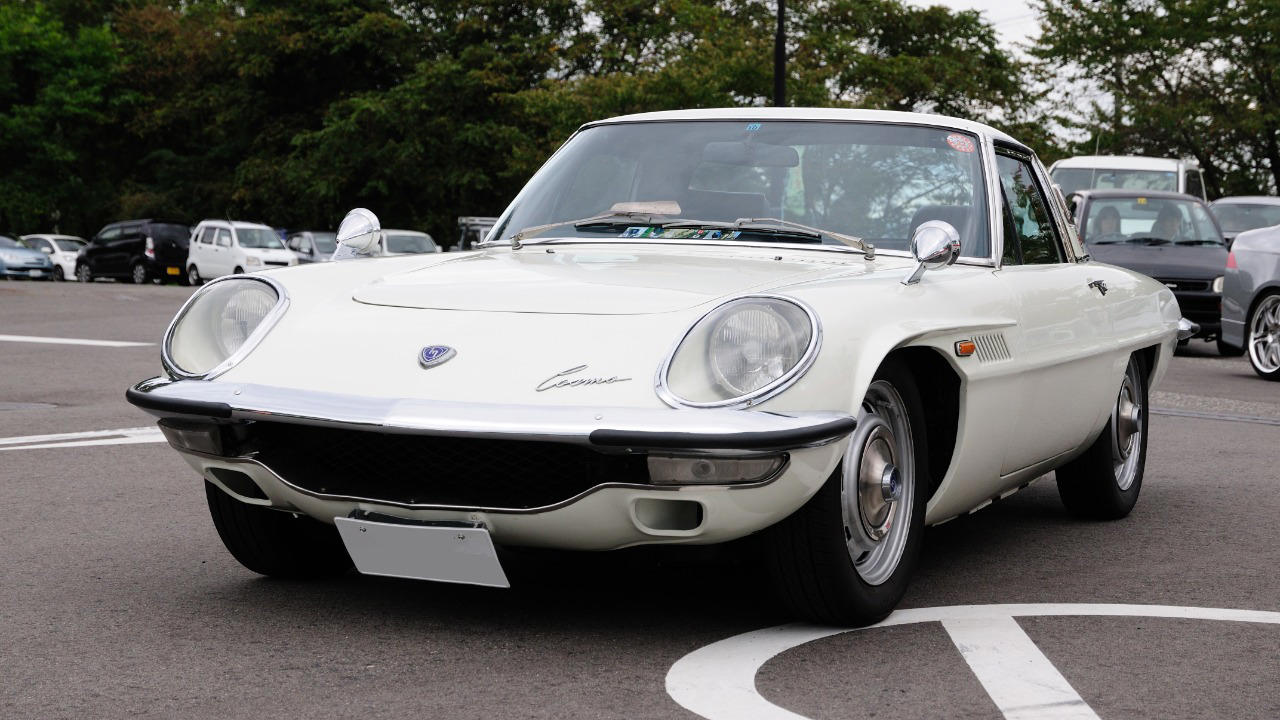
At launch the 1968 Mazda Cosmo introduced rotary power to the worldThe first time the public saw the 1968 Mazda Cosmo, it looked like a spaceship that had somehow slipped onto a show stand. Low, clean and improbably elegant for a company better known for utilitarian machines, it hid an even stranger secret under its long hood: a compact rotary engine with no pistons at all. With that car, Mazda did more than launch a new model. It turned an experimental powerplant into a production reality and tied its identity to rotary power in a way no other manufacturer dared. The Mazda Cosmo Sport, known overseas as the 110S, became the company’s rolling manifesto. It was a small-series production coupe, but its impact far exceeded its build numbers. At launch, it announced that rotary engines were not just laboratory curiosities or limited experiments. They could power a refined sports car, endure real-world use and carry a brand into a new era. From Hiroshima to the rotary frontier The story of the Mazda Cosmo begins long before the first car left the line. Mazda Motor Corporation started life in the 1920s as an industrial firm that gradually moved into automobiles, building its reputation on small, efficient vehicles. By the end of the 1950s, Mazda was looking for a technological signature that could distinguish it from larger Japanese rivals. That search led the company to the compact rotary design created by Felix Wankel. According to a history of the rotary engine, Mazda first showed an early and sustained interest in the Wankel concept in 1959, when Mazda signed a and began adapting the design to its own needs. The company committed substantial engineering resources to solving the rotary’s chronic issues, such as sealing and durability, at a time when other manufacturers treated the engine as a side project. That early commitment would eventually produce the compact two-rotor unit that powered the Cosmo. The decision was bold. Conventional engines were improving rapidly and the rotary was unproven in long-term use. Yet Mazda saw an opportunity. A lightweight, high-revving powerplant could give a small sports car the performance and refinement of larger rivals while also signaling that the company was willing to challenge technical orthodoxy. Cosmo Sport: Mazda’s first rotary production car That vision took shape in the Cosmo Sport, which Mazda presented as a futuristic flagship. The company describes the COSMO SPORT 110S as a legendary sports car and the world’s first production model powered by a dual-rotor rotary engine. Sold domestically as Cosmo Sport and overseas as the 110S, it became the first Mazda to carry the Cosmo name and set the template for the brand’s rotary line. Under its sleek body, the Cosmo Sport used a compact two-rotor engine that delivered 110-horsepower in early form, a figure highlighted in period descriptions of the 110-horsepower Cosmo Sport. That output, combined with light weight and a low center of gravity, gave the car brisk performance for its size. The engine’s smoothness and willingness to rev set it apart from the four-cylinder units common in contemporary Japanese sports cars. Later accounts of the model emphasize that the Mazda Cosmo Sport was the first rotary-powered production car, effectively turning a research engine into a showroom product. Enthusiast coverage of Mazda Cosmo Sport powered production car notes that Mazda took a significant risk by putting such an unconventional powerplant into a halo model. The Cosmo’s success in demonstrating real-world reliability helped convince buyers that rotary power was more than a marketing stunt. Series I and Series II: rarity and evolution The Cosmo Sport was never built in large numbers, which only adds to its mystique. A detailed look at early cars notes that the 1967 Mazda Cosmo Sport Series I Coupe was produced in tiny quantities, with only 343 Series I leaving the factory. That first Series used a slightly shorter wheelbase and an initial tune of the rotary engine, making it the purest expression of Mazda’s early rotary experiment. Series II cars gained incremental updates to power and refinement as Mazda learned more about real-world rotary use. The Cosmo entry on Series L10A and describes how these variants carried the Cosmo name from 1967 through the early 1970s, with the 110S designation applied to export models. Although production remained limited, the two Series established a lineage that would later expand into larger, more luxurious Cosmo-badged coupes. The scarcity of early cars has made them highly collectible. Auction listings for a 1968 Mazda Cosmo Sport 110S, highlighted by Bonhams Cars and, show how the combination of rarity, design purity and rotary heritage has driven values upward. For collectors, the Series I Coupe in particular represents the moment Mazda first committed to rotary power in a road car. Rotary revolution: how Cosmo changed Mazda’s identity Within Mazda, the Cosmo Sport quickly became more than a low-volume showpiece. Corporate history celebrates the Cosmo Sport as that marked the start of the company’s rotary journey. By proving that a dual-rotor engine could be smooth, compact and reliable, the car opened the door for rotary power to reach mainstream models. Official commemorations of Mazda’s rotary heritage describe how the Cosmo Sport 110S followed a well-received debut at the Tokyo Motor Show and then entered the market with the world’s first production two-rotor engine. In those accounts, the Mazda Cosmo Sport is portrayed as the car that allowed Mazda to package sports car performance in compact dimensions, something the company would later repeat with models like the RX series. That corporate identity shift is still visible in Mazda’s own communication channels. The company’s global newsroom presents rotary projects as part of a long-running effort to challenge convention, with the Cosmo at the origin of that story. Visitors to Mazda’s newsroom encounter references to COSMO, SPORT and HISTORY that frame the rotary as a core element of the brand’s DNA rather than a short-lived experiment. Standing out in a world of pistons To appreciate what the Cosmo achieved, it helps to consider the broader context. Early rotary efforts in Europe, including the NSU Wankel Spider, had shown that the engine could work in a production car, but they also exposed durability issues. One retrospective on the NSU notes that World First Rotary engine car was bold to think global, yet it struggled to translate that boldness into long-term success. Before Mazda introduced the Cosmo Sport, the rotary remained a niche curiosity. Mazda’s approach differed in several ways. The company invested heavily in sealing technology, testing and incremental refinement before putting the engine into a halo sports car. By the time The Mazda Cosmo was introduced, the firm had enough confidence in its engineering to position the car not as a fragile prototype but as a genuine grand touring machine. That confidence extended to styling, which blended a low nose, crisp beltline and subtle tailfins into a shape that still looks modern. Contemporary reactions underline how futuristic the car appeared. A later analysis of early rotary sports cars notes that When the Mazda sports car hit the market, it was considered one of the most advanced and cutting-edge models available. The combination of a smooth, high-revving engine and a clean, almost concept car silhouette set it apart from rivals that still relied on traditional styling cues and mechanical layouts. From show stand to endurance racing Rotary power might have remained a curiosity if it had not proven itself under stress. Mazda therefore took the Cosmo into motorsport, using endurance racing to validate its engineering. Later summaries of the car’s achievements point out that Mazda’s first sports car, with its engine that had no pistons, once raced for 84 hours straight. That feat, achieved in long-distance competition, demonstrated that the compact two-rotor engine could survive sustained high-load conditions. Endurance racing also helped refine the engine for road use. Data from those events fed back into sealing improvements, cooling strategies and lubrication systems that later benefited production rotaries. Motorsport therefore served a dual purpose: it built the Cosmo’s reputation and provided real-world testing that laboratory benches could not replicate. Public-facing channels for Mazda in the USA have highlighted this heritage for modern audiences. A feature on the company’s social platforms describes the 1967 Mazda Cosmo Sport as the first rotary-powered sports car and frames it as the moment when a rotary revolution begins. By linking the Cosmo to American muscle car culture and broader performance history, that storytelling keeps the car relevant well beyond its original production run. A design that still looks like tomorrow Part of the Cosmo’s enduring appeal lies in its styling. Mazda’s own heritage site describes the Cosmo Sport as a legendary sports car, and the design justifies the label. The long hood and short rear deck follow classic sports car proportions, yet the details are distinctly Japanese. The front fascia, with its simple grille and inset lamps, avoids the aggression of many Western contemporaries in favor of a clean, almost serene expression. The cabin reflects the same philosophy. Period photographs show a driver-focused cockpit with clear gauges, a thin-rimmed steering wheel and minimal ornamentation. The emphasis is on lightness and clarity rather than luxury excess. This approach aligned with the rotary engine’s character: smooth, eager and technically advanced rather than brute-force powerful. Collectors and historians often place the Cosmo alongside later icons such as the RX-3 and RX-7, but the original car occupies a unique space. It is both a product of the 1960s, with its optimism about space-age technology, and a precursor to the modern Japanese sports coupe. That dual identity helps explain why the Cosmo continues to captivate enthusiasts who were not yet born when the car was new. Heritage, community and digital memory Although the Cosmo Sport was built in small numbers, its community presence is surprisingly strong. Enthusiast groups dedicated to Mazda’s early rotary cars regularly share images and details of surviving examples. One such group highlights the rarity of the Mazda Cosmo Sport I Coupe and emphasizes that only 343 units were produced, a figure that has become part of Cosmo lore. Official and semi-official social channels extend that storytelling. Mazda’s Japanese presence on platforms like Mazda Japan often references COSMO, SPORT and HISTORY when discussing the company’s heritage, reinforcing the idea that the Cosmo is not just a museum piece but a living part of brand identity. Visual platforms such as MazdaJapan on Pinterest circulate images of restored cars, concept sketches and period advertising that keep the Cosmo’s image in front of new audiences. Enthusiast media also plays a role. Dedicated channels for rotary fans, including HotCars official pages and similar outlets, regularly revisit the Cosmo’s story when discussing the evolution of rotary engines. These pieces often trace a line from the first production rotary coupe to later performance icons, reinforcing the sense that every subsequent Mazda rotary owes a debt to the original Cosmo Sport. More from Fast Lane Only Unboxing the WWII Jeep in a Crate 15 rare Chevys collectors are quietly buying 10 underrated V8s still worth hunting down Police notice this before you even roll window down



















 +57 others