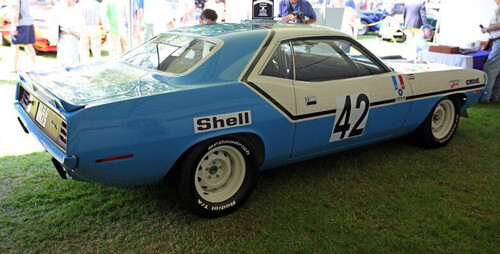
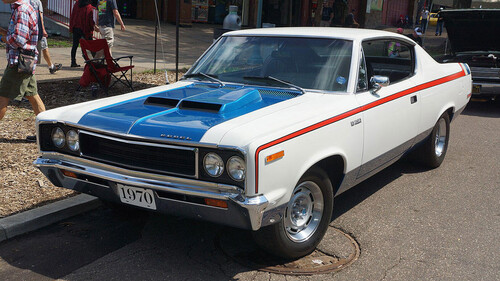
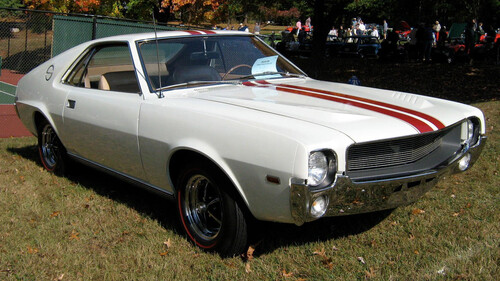
AMC painted the Rebel Machine loud because it wanted attentionThe 1970 AMC Rebel Machine did not whisper its intentions. It shouted them in red, white, and blue, a rolling billboard for a company that refused to be ignored by the Big Three. American Motors painted its hottest Rebel loud on purpose, using color and graphics as a marketing weapon to pull buyers into showrooms who might never have considered AMC at all. Beneath the stripes sat serious hardware, but the strategy started with eyeballs. The Machine’s look was engineered to stop traffic first, then sell performance, and finally redirect some of that attention toward AMC’s regular Rebel lineup. From “frumpy” to in-your-face The AMC Rebel did not begin life as a showboat. Earlier Rebel models were designed under the leadership of Roy Abernethy with an objective to change AMC‘s conservative image and position the intermediate line as one of the so-called “now cars.” Even so, American Motors still carried a reputation as a sensible, slightly dowdy alternative to Detroit’s glamour brands. By 1970, the horsepower wars were raging and image mattered as much as elapsed times. Born from America’s smallest carmaker, the Rebel Machine was framed in period descriptions as packing the heart of a giant. One source describes how it was born from America’s smallest carmaker yet pitched as a declaration of rebellion in the horsepower wars. The Machine had to look like a break from the company’s past, not just a quicker version of the family sedan. The marketing plan behind the paint American Motors did not stumble into the Rebel Machine’s outrageous graphics. Internal planning material spells out that the objective was to entice new customers into AMC showrooms with flamboyant paint schemes, then switch them over to the non performance, regular line Rebels. A period description of the concept explains that AMC expected the car’s spectacle to act as bait rather than the main course. The strategy extended to distribution as well. Every AMC dealer would receive one Rebel Machine that was to be displayed in the showroom, the idea being to use the flamboyant paint scheme to lure non AMC potential customers into the building. Period summaries of the program note that each Rebel Machine served as a kind of full scale advertisement parked under bright lights, impossible to miss from the sidewalk. In other words, the Machine’s paint was not simply decoration. It was the centerpiece of a showroom traffic plan that treated the car as a marketing asset first and a retail product second. Red, white, blue and nothing subtle The initial exterior specification underlined that intent. Contemporary documentation states that they will be painted white and blue and have red, white and blue reflective tape stripes, the purpose giving it a very distinctive identity which will be easily recognized. That description of how they were finished shows that recognition, not restraint, guided the design. Early production cars were effectively locked into one exterior decor format: Red, White, Blue and Beige. Factory information notes that the Machine was initially available in that single arrangement, with the familiar patriotic striping over a light body color. Only later did the palette open up. After January 1st any of sixteen colours could be ordered, according to documentation that lists the original Red, White, Blue expansion to a much broader selection. The shift did not dilute the core identity. Even when buyers chose different body colors, the Machine carried bold stripes and graphics that made it stand out in traffic and in front of dealers’ plate glass windows. How loud looks translated to showroom buzz Period accounts of dealer practice back up the idea that the Machine was meant as a magnet. Enthusiast histories describe how every AMC store was guaranteed at least one example, often parked near the entrance or on a turntable. The car’s red, white, and blue layout was visible from the street and contrasted sharply with more muted family Rebels parked nearby. Modern observers still describe the Machine as unapologetically AMC, with one analysis arguing that what makes the Rebel Machine so cool is how unapologetically AMC it feels. The red, white, and blue paint scheme was loud even by muscle car standards. That assessment of how what defined the car underscores that the visual drama still dominates its reputation more than half a century later. At shows today, that strategy continues to pay dividends. A patina-rich example at an AMC homecoming event was described as cranking out 340 horsepower, wrapped in a loud, unapologetic red, white, and blue paint. The same account contrasted that unrestored car with a restored 1970 Rebel Machine finished in the same patriotic theme. The fact that enthusiasts still single out the paint in their descriptions shows how completely it dominates first impressions. Under the graphics, real performance credentials The Rebel Machine’s paint would have been an empty stunt if the mechanicals had not backed it up. They did. Under the hood sat a 6.4L (390 cu in) V8 that pushed out 340 bhp and 430 lb ft of torque, figures that made it one of the most potent street machines of its time. Period performance summaries highlight that the 390 delivered 340 horsepower and 430 pound feet through a four speed manual and Hurst shifter. Contemporary testing backs up those numbers. One breakdown of the car’s specifications notes that while the base price was $3,475 in 1970, it achieved 0 to 60 m ph in about 6.4 seconds and a quarter mile time of around 14.4 seconds at 100 mph. Other period figures line up closely. A detailed profile reports that the Machine clocked 14.4-second quarter miles at 98 m ph and carried a patriotic paint scheme rivaled only by its SC Rambler sibling. That description of its Rambler relative shows that AMC had already experimented with loud graphics on the smaller SC/Rambler and simply scaled up the idea for the intermediate Rebel. Pricing the spectacle Performance and presentation came at a premium, but AMC kept the numbers competitive. The base price of $3,475 put the Machine in the same general bracket as better known muscle cars from larger rivals, while offering a distinctive look that those competitors could not match. For buyers who wanted the full patriotic treatment, the original color scheme eventually became a $75 option once other paint choices entered the catalog. Contemporary descriptions explain that When buyers did this, they got silver striping and the blacked out hood, while the original graphics package was reclassified as a $75 extra. The move turned the loudest version of the car into a deliberate choice. Customers could opt for a slightly toned down Machine in one of sixteen colors, or pay specifically to advertise AMC’s most eye catching graphics on their driveway. Beyond the catalog: color myths and realities Because the Machine is so strongly associated with its patriotic look, a cottage industry of debate has grown around what other colors were available and how rare they are. Enthusiast discussions describe how the most recognizable muscle car version of the AMC Rebel was named The Machine and available for the often seen red, white, and blue scheme, but other colors were available. One summary of those conversations notes that the Machine and its alternative finishes still generate questions among collectors. Factory paint documentation confirms at least part of that lore. The early limitation to Red, White, Blue and Beige, followed by the After January expansion to sixteen hues, shows that AMC treated color choice as a second phase. The initial push relied almost entirely on the patriotic layout to establish the car’s identity before more conventional orders were allowed. A car that still sells itself on sight More than five decades on, the Machine’s visual strategy continues to define how people encounter it. Modern write-ups of the car often begin with the paint, describing a flamboyant red, white, and blue scheme that made as much of a statement as the exhaust note. One period style description emphasizes that the car’s graphics were a declaration of rebellion as much as a styling exercise. At shows, a single Rebel Machine can still draw a crowd away from rows of better-known Chevrolets and Fords. Enthusiast groups dedicated to the model, such as communities built around the AMC Rebel The Machine, frame it as American Motors’ most powerful car and celebrate the graphics as part of that identity. One such group describes the Rebel The Machine as American Motors’ most powerful car, linking the mechanical claim directly with the name and image. Even in online marketplaces and auction listings, sellers highlight the paint before the drivetrain, often leading with whether a car still wears its original stripes or a correct reproduction. The Machine’s look has become a form of provenance, a quick way to signal authenticity and desirability. Why the Rebel Machine’s loudness still matters The Rebel Machine’s story illustrates how visual identity can reshape a brand’s reputation. AMC used color, graphics, and showroom placement to turn a relatively small production run into a disproportionate amount of attention. The car’s performance figures, from 0 to 60 m ph in 6.4 seconds to 14.4-second quarter miles, were impressive, but the marketing plan depended on people noticing the car before they learned any numbers. In an era when shoppers increasingly rely on digital tools to compare vehicles, the Machine’s strategy looks unexpectedly current. Modern product discovery systems aggregate information from brands, stores, and other content providers into what one company describes as a Product graph, but the underlying challenge is the same that AMC faced in 1970. Something has to catch the eye first. By painting its Rebel Machine in unapologetic red, white, and blue, AMC solved that problem in the most literal way possible. The company built a car that could not blend into any parking lot or showroom, then used that attention to pitch the rest of its lineup. The strategy worked well enough that the Machine is still remembered less for how many were built and more for how impossible they are to ignore. More from Fast Lane Only Unboxing the WWII Jeep in a Crate 15 rare Chevys collectors are quietly buying 10 underrated V8s still worth hunting down Police notice this before you even roll window down