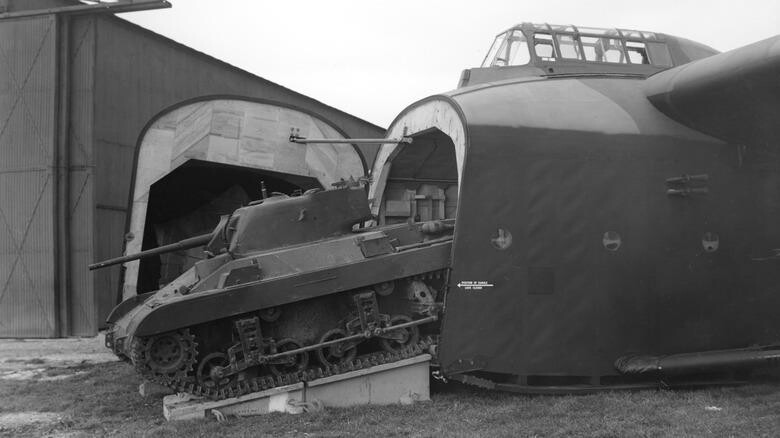
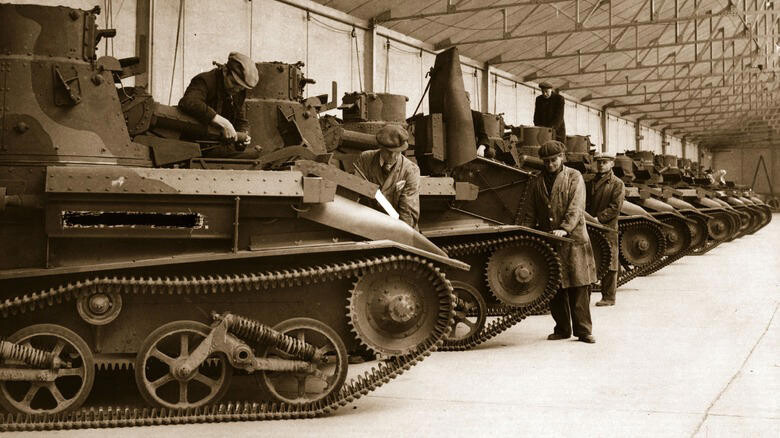
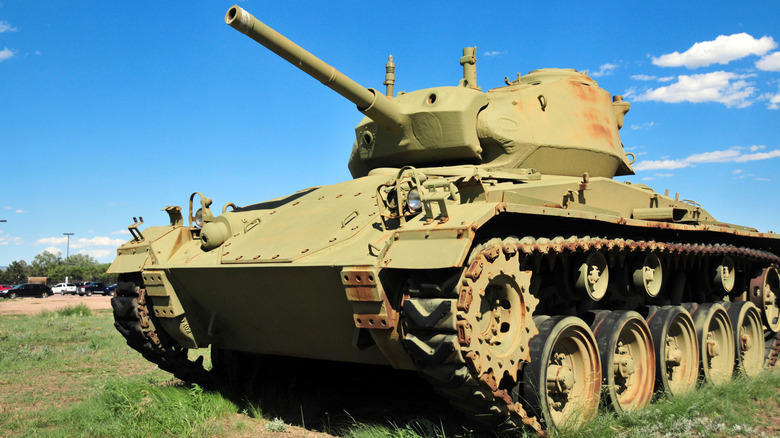
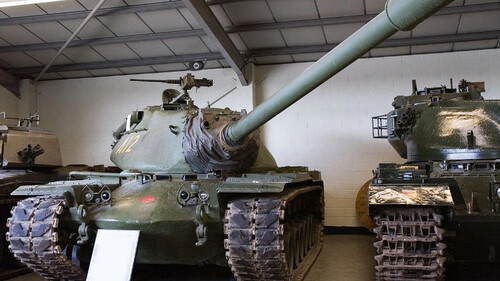
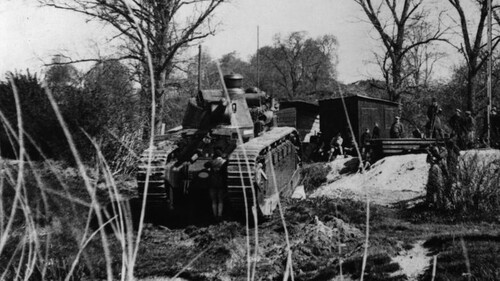
M22 LocustIt makes a lot of sense that the M22 Locust would be small, as the American-made tank was specifically intended to be an airborne unit that could drop onto the battlefield. Development began in 1941 at the insistence of the British government, who wanted a light armored tank that a glider could carry. The hope was that such a vehicle would then be able to provide support to troops parachuting behind enemy lines.Several tanks that may have been a fit for this type of role already existed, but British authorities wanted something dedicated to this specific job. Alternatives such as the Light Tank Mark VII Tetrarch were dismissed, and the U.S. began work on what would become the M22 Locust. By 1945, more than 800 had been produced and the finished design was small enough to be transported by a Douglas C-54 Skymaster aircraft or a General Aircraft Hamilcar glider.The tank weighed just 16,400 pounds, barely 13% of the weight of a modern M1 Abrams main battle tank. In total, it was just over 12 feet long, 7 feet wide, and some 6 feet tall, requiring a crew of three people to operate. The small size didn't make the tank a pushover, though, as it came armed with an M3 37 mm anti-tank gun and a 7.62 mm Browning machine gun, along with just under half an inch of armor.Mark VI Light TankLike many other of the smallest tanks that have ever been constructed, the Mark VI Light Tank was active during World War II. Designed and manufactured by Vickers-Armstrongs, the first model entered active service in 1936 and over 1,500 were produced until it was discontinued in 1940. While no more were produced during the war, they remained in active service up until the 1948 Arab-Israeli War, where some of the tanks were utilized by Egypt. The vast majority of Mark VI Light Tanks were used by the British Army alongside Commonwealth allies such as Australia, New Zealand, and Canada.While this light tank was small compared to its heavier and more powerful counterparts, the Mark VI Light Tank was not only built for reconnaissance but also warfare. The tank featured a 50 caliber Vickers machine gun often used as an anti-aircraft weapon, alongside a smaller 7.7mm machine gun. Along with a range of 120 miles and a maximum top speed of 35 mph, it was capable enough to offer a serious threat on the battlefield.The original version of the tank weighed just 4.9 tons and was 13 feet long, with a width of 6 feet, 10 inches and a height of just over 7 feet. Despite that small size, it still took a crew of three people to operate.Carro Veloce 33The Carro Veloce 33 — otherwise known simply as the L3/33 — is an Italian tank that was developed during the early 1930s and eventually went on to serve a significant role for Italy's military during the Second World War. Manufacturer Ansaldo based the design on the British Carden Loyd tankette and built more than 2,000, although some were variants with slightly different weaponry and armor as part of a retrofit to modernize the tank.The L3/33 saw action during the Second Italo-Ethiopian War and then prominently in World War II. It was involved in warfare with Axis powers in European countries such as Spain, France, and Russia, as well as in Italy's campaigns in Africa against British colonial forces. However, there is little information about how well the tank performed in combat and how much action it saw in the various theaters of war during this time.Thanks to the fact it was based on a tankette, the Carro Veloce 33 was very small even for a light tank of that period. It weighed less than 3 tons and could only carry a crew of two people. That's because it was under 10 feet in length and less than 5 feet wide and 4 feet high. It was also limited in terms of firepower, with a single 6.5 mm machine gun acting as the main weapon. Meanwhile, welded armor with a maximum thickness of 12 mm provided little protection against anti-tank weaponry.M2 Light TankThe American M2 light tank was developed and manufactured during the peaceful time between the end of the First World War and the outbreak of the Second World War. Less than 1,000 were built, with production ending by 1942 in favor of more effective tanks with thicker armor, more firepower, and a still-reasonable top speed.Despite having a large number of the M2 light tanks available, the U.S. military didn't use them extensively during the Second World War. In fact, the tank's only actual combat came during the Pacific conflict with Japan, although how widely it was used even in that theater is unclear. The basic chassis of the tank was the basis for the M3 Stuart and the M4 Tractor, both of which were more successful.Original versions of the M2 were equipped with a heavy machine gun, although the later M2A4 variant was fitted with the 37 mm M3 anti-tank gun in an attempt to make it more effective against armored targets. The tank also carried up to five 7.62 mm machine guns and could reach a top speed of 36 mph. In terms of size, it was one of the larger light tanks from the time period but still small by modern standards. It had a total weight of 11.6 tons, was around 8 feet tall and wide, and had a length of 14 feet, 6 inches.