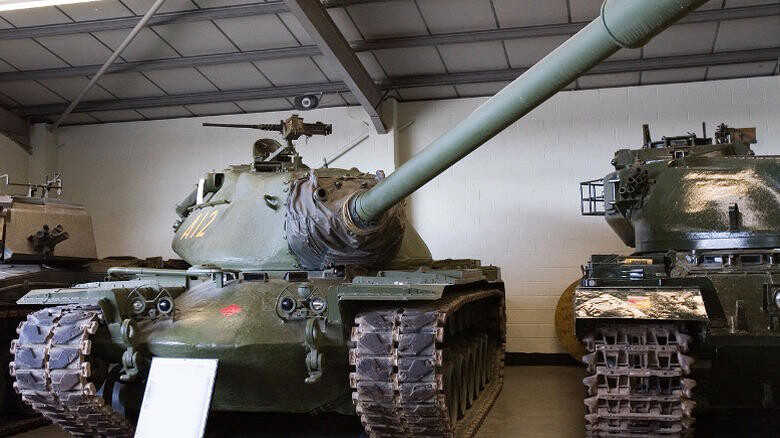
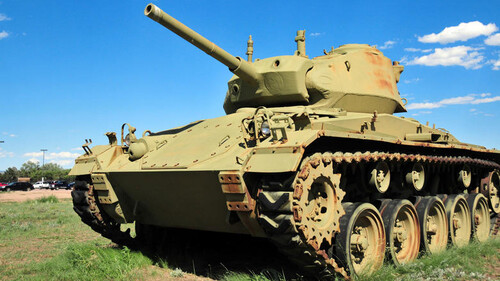
M103 heavy tank — 62 tonsWhile the most famous tank to serve in the U.S. military is undoubtedly the M1 Abrams, American forces had another workhorse that predated it by almost two decades. The M103 is a heavy tank, a classification of vehicle that includes tanks that were produced during World War I and continued to be used through the Cold War. These tanks became popular in the Second World War because their increased firepower made them a bigger threat on the battlefield, while the heavier, thickened steel armor protected them from most forms of attack.However, they eventually fell out of favor when advances in technology meant that medium tanks could have similar levels of protection and firepower in a far more maneuverable form. That's the fate of the M103, which was ultimately replaced by the superior M1 Abrams. That didn't stop it from being an effective tool while it was in operation, though, and around 300 of them were produced between 1957 and 1974. Manufactured by Chrysler, the tank had a total weight of 62 tons and was both longer and wider than the M1 Abrams.Much of that weight came from the impressive 120mm M58 main gun and up to five inches of steel armor at the forward position. The M103 also came equipped with an M89 turret for close-quarters combat but was limited by its top speed of just 21 miles per hour and its range of less than 100 miles. As it never saw active combat, it is not possible to know exactly how effective this tank was, yet there's no denying it was one of the heaviest ever built.Leopard 2 — 64.5 to 67 tonsAmong the most expensive and widely used main battle tanks in the world, the Leopard 2 is a German-made tank that was first introduced in 1979 and has since gone on to become the backbone of more than a dozen nations' military forces. A third-generation tank, it is Germany's equivalent of the Challenger II and M1 Abrams, and has seen more than 3,600 units produced over the last 40 years. The Leopard 2's versatility, maneuverability, and advanced technology makes it a standout tank, with the most recent models costing in the region of $30 million each.Standard Leopard 2 tanks feature a 120mm main cannon, two 7.62mm machine guns, and a 1,500-horsepower engine that allows the tank to reach a top speed of 42 miles per hour. In terms of armor, the German tank boasts modular armor that includes hardened steel, tungsten, and titanium to ensure it can withstand direct hits. The current Leopard 2A7V model has a weight of around 64.5 tons. However, the sheer number of different models means that there is a wide range of weights for each variant of the Leopard 2. For example, the upcoming Leopard 2A8 will have an operation weight of between 65 and 67 tons.Tiger II — 68 tonsGoing by many names, the Tiger II is a German heavy tank that was designed in 1943 and entered active service the following year. Less than 500 were created, despite an order of more than 1,500 from Germany's high command, due to British RAF bombing campaigns that severely damaged facilities responsible for manufacturing the tank. A successor to the Tiger I, this new tank was more mobile than its predecessor and also included a number of notable improvements, including more effective sloping armor and a more powerful engine.The need for a heavier and better-protected tank led to the Tiger II weighing significantly more than the Tiger I, with a mass of 68 tons. Much of that weight was due to the newly produced 88mm KwK 43 main gun (which gave the tank a maximum firing range of around 6 miles and allowed it to effectively take down opposing tanks) and six-inch thick armor to defend it from incoming attack.The Tiger II played an important role at the Normandy landings and was arguably the most deadly tank that was in active operation at that stage of the war. Manned by a crew of five individuals, the Tiger II had a top speed of just under 26 miles per hour and could travel cross-country at more than 12 miles per hour.Char 2C — 69 to 77 tonsMany of the heaviest tanks come from the era of the First and Second World Wars. This was a time when tanks first entered service, and designers were constantly looking to improve them to make them more effective machines of war. Yet, the technology of the day often meant that these tanks were limited in terms of their mobility and weight, especially when they were intended to be heavily fortified and use incredibly powerful weapons. That was certainly the case with the French-made Char 2C, a super-heavy tank that was created with the intention of being larger and heavier than any other tank of the era.Design for the Char 2C began during the First World War but wouldn't be completed until 1921 when it first entered service. However, the vehicle saw little action and they were intentionally destroyed when Germany invaded France during the Second World War to prevent them from being captured and used against the French. Just 10 of these behemoths were put into service and they were mainly seen as a propaganda effort to keep the French population content after the success of British and German tanks during the First World War.While other tanks have been heavier than the Char 2C, it is considered to be the heaviest of those that were in operation and were not mere prototypes. While there is some debate over their exact weight, estimates suggest that it is anywhere between 69 tons and 77 tons. That makes sense considering the huge size of the Char 2C, which was more than 33 feet long and required a crew of 12 to run.Tortoise heavy assault tank — 79 tonsWorld War II posed many challenges for the Allied forces. Germany had built up extensive fortifications during the war and in the run-up to the start of the conflict, with the Atlantic Wall and Siegfried Line being two of the most famous examples. Even the most powerful tanks and gun platforms would pose little threat to these heavily fortified positions as they often included devastating weapons, bunkers, and strong barriers. With an invasion of Europe from the UK necessary to defeat German forces, plans were put in place to create tanks that would be able to destroy such fortifications and allow Allied troops to break through.The Tortoise heavy assault tank was the result of these plans, although production only began near the end of the Second World War and they never had the chance to enter active service. With the war concluded and hostilities over, in addition to newer designs being commissioned for future tanks, the Tortoise heavy assault tank was shelved after just six of them had been fully constructed.The purpose of the tank, though, meant that those that were created were incredibly heavy and large. To withstand enemy fire from fortified positions, the Tortoise heavy assault tank had armor that was up to nine inches thick. It came equipped with an Ordnance QF 32-pounder 94mm gun capable of easily penetrating German tanks, along with several machine gun turrets. At 79 tons, the tank was only able to travel at a top speed of 12 miles per hour.