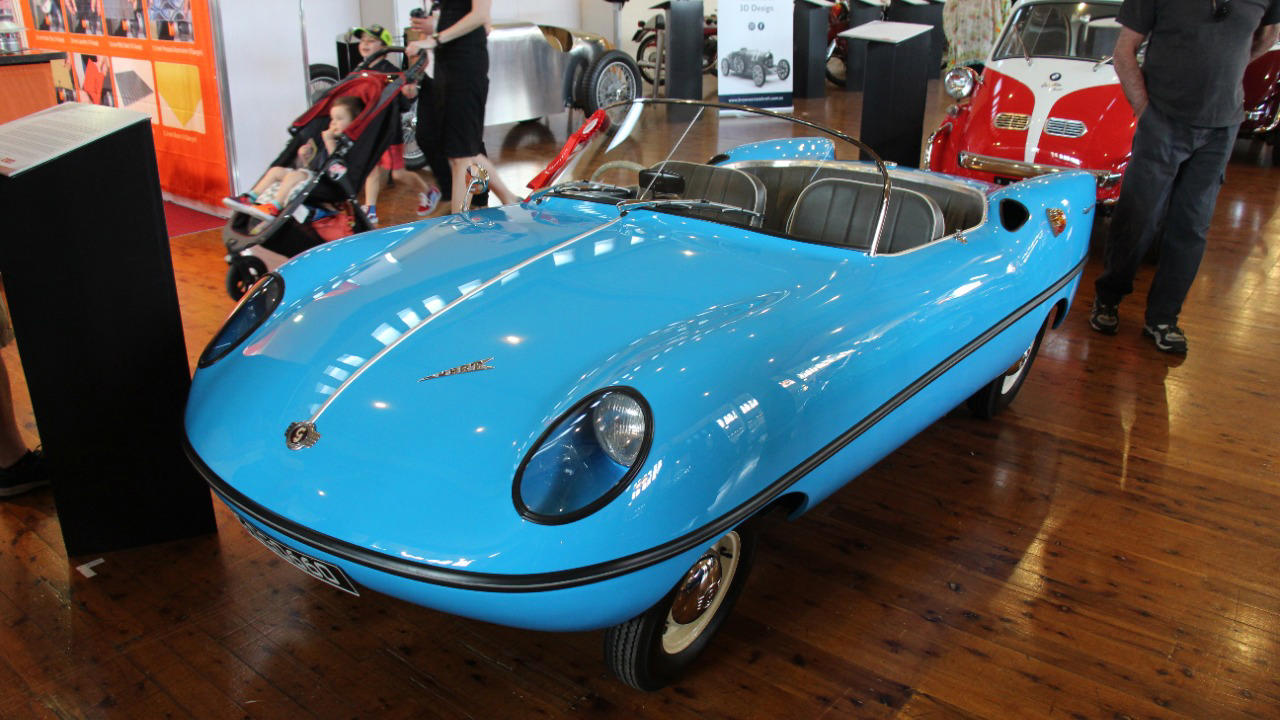






















You’ve probably never heard of the 1959 Goggomobil Dart and it refuses to be ignoredThe 1959 Goggomobil Dart is the kind of car that can slip past most enthusiasts, yet once it appears in a parking lot or auction listing it dominates every conversation. Tiny, doorless and improbably cheerful, it looks more like a toy boat than a roadgoing machine, but its story connects German microcar engineering, Australian ingenuity and a modern collector market that now treats it as a cult object. Built in small numbers and overshadowed by bigger, faster sports cars of its era, the Dart has never been a mainstream classic. That obscurity is part of its pull: it is a car many people have never heard of, yet it refuses to blend into the background, either on the street or in the history of Australian automotive design. From German microcar to Australian original To understand why the Goggomobil Dart exists at all, it helps to start with the German Goggomobil. The original Goggomobil was a microcar produced by Hans Glas in Dingolfing, built for a Europe that needed cheap, efficient transport in the 1950s. It used a small two stroke engine and a compact pressed steel chassis that kept weight and cost low. That humble platform would become the unlikely foundation for a distinctive Australian sports car. In Australia, importer Buckle Motors saw potential in the German Goggomobil beyond its role as a basic city runabout. The company secured rights to assemble the cars locally and began looking for ways to adapt the mechanical package to local tastes. The result was the Dart, which took the chassis and running gear of the German Goggomobil and wrapped them in a radically different fiberglass body. According to History, The Dart was based squarely on those German components, yet it emerged as a uniquely Australian answer to affordable fun. The Dart sat on the Goggo’s pressed steel structural platform, which used simple swing axles front and rear with coil springs and telescopic dampers. That mechanical layout kept costs down and made the car easy to service with existing Goggomobil parts. According to a detailed enthusiast account, it was launched in 1959, and the Dart sat on that Goggo platform with a wheelbase of 1,797 millimetres. The basic engineering was modest, but it provided a stable base for something far more visually adventurous. The fiberglass bodywork was the key transformation. Australian regulations and road conditions encouraged lightweight, corrosion resistant designs, and fiberglass allowed Buckle Motors to shape a body that would have been prohibitively expensive in steel. The Dart’s shell was low, rounded and almost cartoonish, with integrated fins and a cut down windscreen. It looked nothing like the upright German saloon that donated its parts, yet beneath the surface the connection to the German Goggomobil remained unmistakable. Bill Buckle’s audacious little sports car Behind this transformation stood Sydney automotive entrepreneur Bill Buckle. Buckle had already experimented with fiberglass construction on other models and saw in the Goggomobil platform an opportunity to create a local sports car without the overhead of a clean sheet design. According to one recollection, Bill later kept two Goggomobils on display at his Church Point home, along with a plaque from Goggomobil that acknowledged his work. That detail hints at the pride both the Australian and German sides took in the project. Buckle’s approach was pragmatic. Rather than chase outright speed, he focused on character and accessibility. The Dart used the existing two stroke engine, initially in 295 cubic centimetre form, and relied on extreme lightness to create a sense of agility. The fiberglass body helped keep the weight down to roughly 345 kilograms, which meant that even modest power could feel entertaining on the right road. A later video profile refers to the Dart as Australia’s iconic 345 and jokes that subscribing to the channel gives a 0.0000 1 percent chance of waking up to one in the driveway. The exact figure of 0.0000 is played for comedy, but the underlying point is serious: the Dart is rare and highly sought after. That rarity is no accident. Production volumes were always limited, in part because the Dart was a niche proposition even in its home market. It had no doors in standard form, which meant owners had to climb over the side like getting into a racing dinghy. At least one car had doors added after the fact to improve usability, a modification noted by enthusiasts who track these surviving examples. The seating layout was strictly for two people, with minimal luggage space and very little in the way of weather protection. This was not a practical family car but a weekend toy for those willing to put up with its quirks. Despite those compromises, or perhaps because of them, the Dart quickly developed a following among drivers who wanted something different from the usual British sports cars of the period. The car’s affordability at launch helped. One retrospective account explains that the Dart was priced at the equivalent of just £685, at a time when an Austin Healey cost significantly more. That comparison, recorded in a history that notes how Even the Dart, shows how Buckle positioned the car as an attainable entry point into sports motoring. Dimensions, performance and the “GTI of the range” On paper, the Goggomobil Dart’s numbers look almost comical by modern performance standards. The early 295 cubic centimetre engine produced modest power and was paired with a simple manual transmission. Yet the combination of low mass and compact dimensions made the car surprisingly lively in city traffic and on tight country roads. The chassis, with its swing axles and coil springs, delivered a ride that was more supple than its tiny footprint might suggest. Later cars were available with a larger 400 cubic centimetre engine and a four speed manual gearbox. One auction listing for a 1959 example describes a Dart fitted with that high performance 400cc unit and a four speed, calling it the GTI of the range. In that description, the Goggomobil Dart GTI is framed as the sportiest configuration available from Buckle Motors, one that gave the tiny car a bit more punch without changing its fundamental character. Weight figures vary slightly between sources, in part because of differences in equipment and measurement standards, but one detailed feature pegs the Dart at 840 pounds. That number, recorded in a profile that calls it the 840 lb Goggomobil, reinforces just how featherweight the car really was. At 840 pounds, or around 381 kilograms, the Dart weighs less than many modern motorcycles and far less than any contemporary sports car. The Dart’s footprint is equally striking. Enthusiast measurements describe a wheelbase of 1,797 millimetres and an overall length that would make a modern city car look large. One comparison notes that the Dart is shorter, narrower and lower than a 2015 Mazda Miata, a car already regarded as compact. A photo feature highlights the Dart’s proportions and explains that its dimensions are significantly smaller than later sports cars. The Dart’s size is not just small; it is almost miniature. Performance figures are harder to pin down because few period tests survive, but contemporary owners describe acceleration that is leisurely by modern standards yet engaging because of the noise and involvement. The two stroke engine produces a distinctive buzz, and the lack of sound insulation means every mechanical action is audible. Steering is unassisted and direct, the manual gearbox requires deliberate shifts, and the low seating position places the driver close to the road surface. In an era of heavy, insulated vehicles, the Dart’s rawness feels novel. Practicality, unsurprisingly, is limited. The absence of doors makes entry and exit a minor athletic event, particularly for taller or less flexible drivers. One detailed listing for a 1959 Buckle Dart notes an example that left the factory with a driver’s door, described as the only one produced that way, and explains that this feature helps with the nearly impossible task of entering the car without it. That account, which highlights how only one factory, underscores how committed the original design was to its pure, doorless concept. Production numbers, survival and global reach Part of the Dart’s mystique comes from its scarcity. Exact production figures are debated, but one widely cited estimate suggests that approximately 700 examples were built by Buckle Motors. An auction description that traces the car’s history calls a featured 1959 Dart one of approximately 700 examples produced, a figure echoed in other enthusiast circles. Production appears to have run for only a few years, with sources tied to the German Goggomobil noting that Dart assembly ceased around the early 1960s. The same historical overview that traces the German microcar’s evolution states that Dart production stopped while Goggomobil saloons, coupés and vans continued in various configurations until 1969. That timeline, recorded in a summary that points out how Goggomobil Dart production, reinforces the idea that the Dart was a short lived side project rather than a core product line. Visual documentation of these survivors is extensive. Online archives host galleries of Dart vehicles in various colors and conditions, from concours level restorations to patinated drivers. One such collection, which groups images of Goggomobil Dart vehicles, shows the car in bright reds, creams and blues, often with period correct hubcaps and minimalist interiors. The images highlight how consistently the basic design was executed, even as individual cars acquired unique details over decades of use. There are also international language references that attest to the Dart’s global curiosity factor. German and Hebrew language entries describe the Goggomobil Dart within the context of microcar history, linking it to the broader story of postwar European and Australian automotive development. The German page that covers the גוגומוביל דארט and the associated English entry together show how a car built in relatively small numbers in Australia has drawn attention from enthusiasts far beyond its home market. From cheap oddity to high value collectible When new, the Dart was positioned as an affordable alternative to established sports cars like the Austin Healey. That pricing strategy made it accessible to younger buyers and those willing to trade outright performance for character. Over time, however, the car’s value trajectory has reversed. What began as a budget sports car has become a prized collectible, with restored examples commanding significant sums at auction. Enthusiast recollections of visits to Bill Buckle’s home mention that collectors are now prepared to pay upward of 40,000 dollars for a well presented Dart. That figure appears in the same account that recalls seeing two Goggomobils at Church, along with a plaque from Goggomobil acknowledging Buckle’s contribution. The comment about upward of 40,000 dollars speaks to how far the car has come in the eyes of collectors. Special examples can command even more attention. The unique factory Dart with a driver’s door, mentioned earlier, was offered at a price that reflected both its rarity and the cost of a high quality restoration. One detailed listing suggests that finished cars can reach around 29,500 dollars, a figure tied to the cost of a completed restoration by specialists familiar with Buckle’s methods. Those numbers, set against the original £685 price, illustrate the car’s transformation from cheap curiosity to investment grade classic. Part of that value lies in the Dart’s status as a rare German Australian sports car. One feature explicitly describes it as a Rare German Australian and emphasizes that it is likely the smallest production sports car ever sold in Australia. That combination of national identity, engineering novelty and visual charm is difficult to replicate. Collectors drawn to microcars and unusual fiberglass specials see the Dart as a key piece in a broader story of postwar experimentation. The modern media ecosystem has also boosted the car’s profile. Video channels that focus on obscure or charming vehicles frequently feature the Dart, often highlighting its 345 kilogram weight and its doorless entry routine. One such video, which calls it Australia’s iconic 345, plays up the improbability of such a tiny machine sharing the road with modern SUVs. The mention of a 0.0000 chance of waking up to one outside underscores how unlikely it is to encounter a Dart in daily life. Online communities and social media pages dedicated to classic cars further amplify the Dart’s visibility. Enthusiast groups share restoration tips, parts sources and event sightings, often linking back to historical references on Goggomobil Dart Wikipedia pages or to photo archives that show the car in period settings. The result is a feedback loop in which each new article, auction listing or video brings a fresh wave of attention to a car that was once almost forgotten. Why this obscure micro sports car still turns heads The enduring appeal of the Goggomobil Dart comes down to a blend of aesthetics, narrative and scale. Visually, it is unlike almost anything else on the road. The rounded nose, integrated fins and tiny wheels give it a playful, almost cartoon character that invites smiles from passersby. Its fiberglass body, often painted in bright colors, stands out in a sea of metallic grey modern cars. Even people who know nothing about microcars or Australian automotive history instinctively recognize that they are looking at something unusual. The narrative behind the Dart adds another layer. It represents a moment when a small Australian company took a German microcar platform and reimagined it as a local sports car, using fiberglass and ingenuity instead of big budgets. That story resonates with enthusiasts who value creativity and resourcefulness. The fact that Buckle Motors managed to create a car that is now recognized in multiple languages on Wikipedia, and that images of Darts are catalogued across dedicated galleries, reinforces its cultural footprint. Scale is the third element. The Dart is small even by microcar standards, and that compactness changes how people relate to it. Parked next to a modern hatchback, it looks like a scale model. Drivers and pedestrians tend to approach it with curiosity rather than intimidation. Owners report that the car draws crowds at shows, with children in particular fascinated by its toy like proportions. The lack of doors and the need to climb over the side only add to the sense of occasion. From a driving perspective, the Dart offers an experience that is increasingly rare. Its two stroke engine, manual gearbox and unassisted controls demand active involvement. There are no driver aids, no screens and almost no instrumentation beyond the basics. Speeds are low, but the sensations are intense, because the car transmits every vibration and sound directly to the occupants. In a world where performance figures have climbed far beyond what most roads can safely accommodate, the Dart’s modest capabilities feel refreshing. There is also a broader cultural context. Microcars and small displacement sports cars from the 1950s and 1960s have enjoyed a resurgence among collectors who are priced out of blue chip classics or simply prefer something more approachable. Cars like the Fiat 500, BMW Isetta and Messerschmitt KR200 have moved from oddball status to coveted collectibles. The Goggomobil Dart fits neatly into that trend, but with the added advantage of being a locally designed Australian sports car built on a German base. Enthusiast media continues to fuel this interest. Photo features that spotlight the Dart, such as those shared by Photo Feature accounts and their associated outlets, frame the car as a conversation starter and a key example of fiberglass experimentation. Podcasts and social feeds linked through The Daily Drive and similar platforms introduce the Dart to audiences who may never have encountered one in person. Each new mention chips away at the car’s obscurity while reinforcing its status as an enthusiast favorite. Behind the scenes, the infrastructure that preserves knowledge about the Dart is surprisingly robust. Entries across multiple language editions of Goggomobil Dart Wikipedia, along with structured data on Wikidata and image collections on Wikimedia Commons, ensure that basic facts about the car remain accessible. Donation pages such as those linked from Discovered Goggomobil Dart references indirectly support that archival work. For a car built in such small numbers, that level of documentation is remarkable. All of this helps explain why the Goggomobil Dart, despite its tiny footprint and limited performance, refuses to fade into obscurity. It might never match the global recognition of an Austin Healey or a Jaguar E Type, but among those who encounter it, the impression is lasting. The combination of visual charm, improbable origins and modern collector enthusiasm turns what could have been a footnote in microcar history into a standout story. For enthusiasts who care less about outright speed and more about character, the Dart offers something rare. It is a car that invites questions, sparks conversations and demands to be noticed, even if most people have never heard its name before they see one. In that sense, the 1959 Goggomobil Dart has achieved a form of immortality that many larger, faster and more famous cars can only envy. More from Fast Lane Only Unboxing the WWII Jeep in a Crate 15 rare Chevys collectors are quietly buying 10 underrated V8s still worth hunting down Police notice this before you even roll window down The post You’ve probably never heard of the 1959 Goggomobil Dart and it refuses to be ignored appeared first on FAST LANE ONLY.