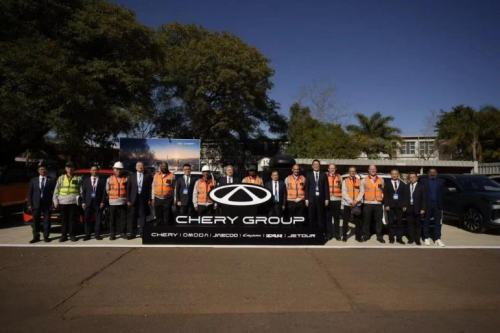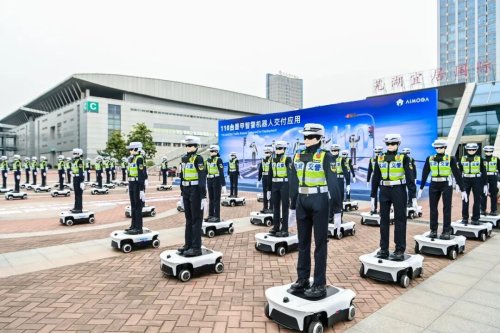
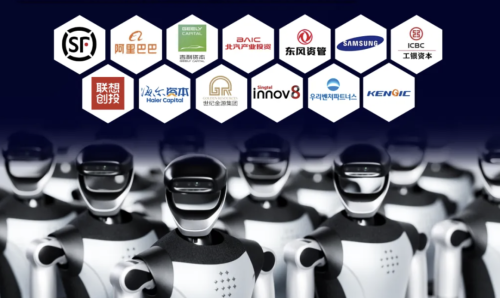
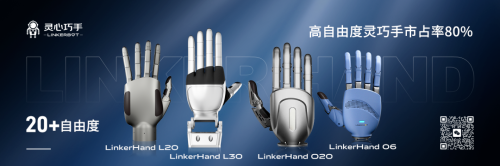
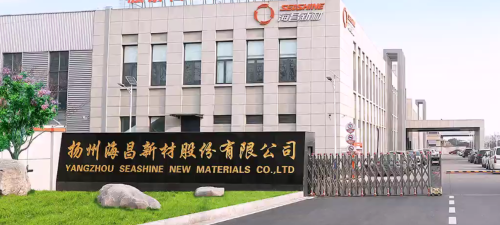



















Here are the major developments in the fields of embodied intelligence and driver assistance this week:Chery's Moja Robot Signs for 1,000 Units and Delivers 100On April 27, Chery held its global Moja launch in Wuhu, Anhui, under the theme "Scenario Driven, Collaborative Co-prosperity." Chery Group Chairman Yin Tongyue attended the event to outline the automaker’s strategic vision for the robotics sector.The full Moja product lineup made its debut, featuring the humanoid "Moyin," police robots, hospital guides, and robotic dogs. The smart police robot secured contracts for 1,030 units and delivered 110.Image Source: CheryIn his address, Yin emphasized Chery's edge: robots and intelligent vehicles share the same underlying technologies in perception, planning, and control. Essentially, a smart car is a robot on wheels. He outlined Chery's three-pronged approach: bringing reliability, cost, and lifespan to mass-market standards; refining the technology across more than 50 countries and 100 real-world scenarios; and achieving the delivery of 100 police robots with 1,000 orders. "This marks Moja's full entry into a new stage of large-scale commercialization," he said.The newly delivered police robots are already operational across various scenarios—including school crossings in Wuhu, the Jiangyin Marathon, and events in Changzhou—handling traffic control, parking enforcement, and security to supplement police forces. Moving from pilot trials to 1,000-unit orders signals a critical leap for Moja from technical verification to large-scale deployment and commercial operations.Moja also launched the "Qizhi Jiatianxia Robot Leasing Platform" to lower entry barriers through leasing, financial services, and operational support. Additionally, the company partnered with 100 universities to cultivate talent, aiming to secure the long-term workforce needed for the robotics industry.Moja General Manager Zhang Guibing unveiled a new strategic vision: defining technology through specific scenarios and validating value through real-world use. The roadmap involves three phases—starting with companion robots for children, expanding into public and corporate services, and finally bringing robots into homes as intelligent daily assistants.Leveraging Chery's automotive network across more than 130 countries, Moja is rapidly building a multi-channel system of specialty stores, dealerships, and retail spaces to export China's embodied intelligence technology from Wuhu to the global market.Xiaozhi's Take: Automakers are proving their versatility through action.SF Express Leads Investment as Robotics Startup Raises Nearly 1.5 Billion YuanStar Era has secured over $200 million in a new funding round, just two months after closing a 1 billion yuan strategic round in March, according to Gasgoo.Image Source: Star EraThe round was led by SF Group, with participation from top-tier financial firms including Sequoia China, IDG Capital, and CICC Capital. Industrial players like Dongfeng Industrial Investment, Kejie Smart, ICBC Capital, and a fund under China Unicom also joined in, while existing shareholders Qingkong Tiancheng and Hongruida doubled down. Investor interest reportedly far exceeded the fundraising target.In less than three years, the startup has assembled arguably the most comprehensive capital lineup in the embodied intelligence sector.By the end of 2025, Star Era's cumulative commercial orders surpassed 500 million yuan. The company is set to begin batch deliveries of 1,000 robots in the second quarter of 2026, representing a 300% growth rate. In an industry still in its infancy, these figures carry significant weight.Xiaozhi's Take: Capital is voting with its feet, gradually identifying the embodied intelligence players capable of commercialization.Seeds | LinkerBot Closes B+ Round FinancingLinkerBot (Beijing) Technology Co., Ltd. officially announced the completion of a B+ financing round on April 29, Gasgoo reported.The round drew investment from prominent firms including Zhongguancun Science City Fund, BOCOM Asset Management, Fosun Chuangfu, Baker Capital, Jiu Zhao Investment, Hongzhang Investment, Yuannuo Capital, Yingke Yingzhi, Yixin Technology (300674.SZ), and Hardcore Nut Capital. Existing shareholders such as Bojia Capital, Lihe Finance, Lihe Capital, Huafu Investment, and DT Capital also increased their stakes.This marks the company's second fundraising effort since closing its Series B round in mid-February.Image Source: LinkerBotLinkerBot is currently the only company globally producing over 4,000 units monthly, commanding more than 80% of the market for high-degree-of-freedom dexterous hands. Its L20, L30, and O30/R30 models cover linkage, tendon, and direct-drive technologies.Proceeds will be used to ramp up production capacity and upgrade intelligent manufacturing lines, targeting monthly deliveries exceeding 10,000 units. By employing a "dexterous hands building dexterous hands" closed-loop manufacturing model and a tightly integrated supply chain, the company aims to provide downstream manufacturers and industrial clients with stable, reliable, and consistent core components.Xiaozhi's Take: The dexterous hand is a critical component of humanoid robots, and the capital interest is undeniable.Humanoid Robot Stocks Rally; Seashine New Materials Surges Over 12%Humanoid robot stocks have been active recently, according to Gasgoo.Seashine New Materials jumped more than 12%, while Zhejiang Rongtai and EFORT climbed over 6%. Tuopu Group, Sanhua Intelligent Control, Shangwei New Materials, and Ruineng Technology also followed suit.Founded in 2001, Seashine New Materials is a high-tech enterprise focused on the R&D, production, and sales of powder metallurgy products. Listed on the Shenzhen Stock Exchange's ChiNext board in September 2020, the company is a leader in powder metallurgy parts for power tools, with products also serving the automotive, office equipment, and home appliance sectors. Additionally, Seashine is expanding into emerging fields like robotics and new energy through MIM (metal injection molding), SMC soft magnetic materials, and precision gear actuators.Image Source: Seashine New MaterialsOn the news front, Japan Airlines announced on April 29 that it will begin deploying humanoid robots for ground services at Tokyo's Haneda Airport starting in May, aiming to alleviate labor shortages.Xiaozhi's Take: The entire embodied intelligence supply chain is riding this wave of industry enthusiasm.Kinetix AI Unveils "KAI," a Full-Size Humanoid Robot with 115 Degrees of FreedomOn April 26, Kinetix AI—an angel-round portfolio company of Qingniao Intelligent Control—hosted its "GIFTED" launch event. The company debuted "KAI," a full-size humanoid robot boasting 115 degrees of freedom, marking a significant step in moving embodied intelligence from the lab into real-world scenarios.Image Source: Kinetix AIKAI features 115 degrees of freedom across its body, including a 36-DOF dexterous hand that mimics human movement for fine grasping and smooth interaction. It is powered by a 1.7 kWh semi-solid battery supporting three hours of continuous dual-arm operation with a payload of nearly 20 kg. The robot's full-body tactile skin incorporates 18,000 sensors capable of detecting touches as light as 0.1N, enabling safe and natural close-quarters collaboration.Kinetix AI's world model system operates as a closed loop. Beyond the core model, it includes an action module and an evaluation module. The action module generates candidate moves based on the current state, which the base model uses to predict future states, while the evaluation module assesses the trajectory's value—tracking task progress and ensuring safe contact.Xiaozhi's Take: Degrees of freedom remain a core challenge that humanoid robot companies are striving to master.