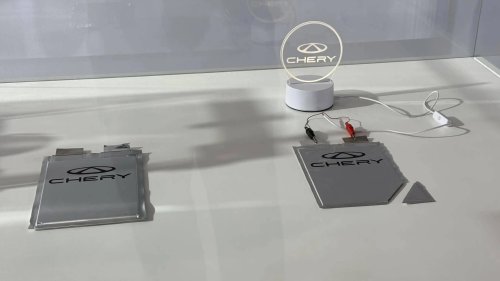
Chery targets 2027 pilot production with new sulfide solid state cell patent. Credit: CNC Understand China EV’s Market Real-time notifications when critical EV data is released All important data in one place 2,000,000+ data points Become a member Chery’s proprietary powertrain division has advanced its solid-state battery development with a new patent for a sulfide electrolyte surface coating. The technical specification, registered under publication number CN122348252A with the National Intellectual Property Administration, addresses the core interface instability of next-generation battery cells. This filing provides the physical blueprint for the brand’s premium passenger electric models scheduled to debut in upcoming production blocks, reports Jrj. The engineering framework introduces a chemical bonding mechanism that applies a functional coating layer directly onto sulfide electrolyte substrates. By establishing direct molecular links rather than relying on standard physical boundaries, the architecture prevents the structural degradation typically triggered by lithium-ion transport during high-velocity charging. This surface refinement underpins the manufacturer’s upcoming vehicle platforms targeting extended high-performance applications. Sulfide interface design The newly exposed architecture specifically targets cell interface resistance, which remains a primary engineering roadblock for sulfide-based solid-state systems. Chery utilises functional groups within the coating layer to actively regulate electrochemical performance and maintain uniform ion transport across boundary areas. This chemical stabilisation aligns with parallel efforts by domestic market rivals racing to protect their cell architectures against rapid capacity losses. Similar structural paths appeared when a BYD sulfide solid-state battery patent emerged in regulatory filings to secure cell contact points against thermal degradation. Additionally, industry leaders have deployed comparable localised engineering counter-measures, as seen when a CATL sulfide instability patent introduced specialised interface boundaries to stabilise ion flow. Chery’s latest chemical coating represents an independent mechanical variation aimed at achieving equivalent cell durability. National pilot roadmaps The publication of this patent aligns with a broader state-backed manufacturing push to achieve initial pilot operations for solid-state vehicles by 2027. Chery previously unveiled its self-developed Rhino S solid-state cell during its battery technology conference, targeting an ultimate energy density milestone of 600 Wh/kg. The vehicle group intends to utilise these high-density sulfide assemblies to power its passenger vehicle trims under a multi-year development phase. The automaker maintains a substantial technical infrastructure from its corporate headquarters in Wuhu, supported by a registered capital of 5.8 billion yuan (854.9 million USD). Financial and registry records show that the manufacturing group controls 27,153 patents and holds direct equity investments in 68 separate automotive and supply chain enterprises. This centralised capital strategy enables the brand to execute independent chemical R&D without relying on upstream cell suppliers. Commercialisation timeline hurdles Despite accelerating patent filings across the domestic landscape, the broader rollout of all-solid-state batteries across mass-market consumer segments is expected to face extended manufacturing timelines. CATL recently offered a pragmatic, solid-state battery reality check, noting that true mass commercialisation remains multiple years away due to lingering production cost barriers. These manufacturing constraints mean early high-density cell integration will likely remain restricted to premium niche vehicle trims. Engineering metrics highlight that the entire domestic supply ecosystem is still navigating early validation phases before achieving high-volume scale. This operational reality is underscored by reports indicating that CATL’s solid-state battery technology remains at level four out of nine technical maturity tiers. Chery’s localised chemical coating solution represents a crucial step toward climbing these structural tiers ahead of scheduled 2027 fleet deployment targets.