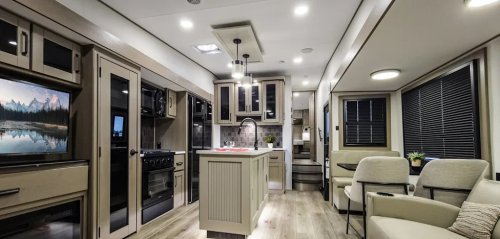
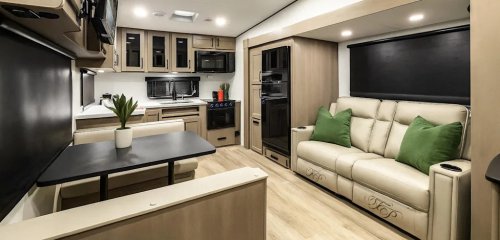
Winnebago And Grand Design Just Recalled The Same Fire Hazard. Neither One Built It.That's not a coincidence. It's the RV industry accidentally admitting, in a federal filing, that it doesn't build the parts that can burn its product down.Two Brands, One PartOn July 10, Grand Design RV recalled 448 of its 2026-2027 Lineage travel trailers. Four days later, Winnebago recalled 134 of its 2027 Navion and View motorhomes. Both recalls trace back to the same component: a MaxxAir N-Series Maxxfan rooftop ventilation fan whose printed circuit board can fail mid-cycle and overheat, raising the risk of a fire on the roof of a vehicle that's often parked a few feet from a fuel tank, a propane line, or both.Neither company designed that fan.AdvertisementAdvertisementNeither company built it. Both companies just bolted it into a hole cut in their own roofs.One Sentence, Two NameplatesSet the two filings side by side and the defect summary reads like a mail-merge. Grand Design's Lineage trailers are, in NHTSA's language, equipped with fans whose circuit board "may fail during certain operations and overheat." Winnebago's Navion and View motorhomes get the identical eight words, minus the model names.That's because Winnebago and Grand Design didn't write that sentence. MaxxAir did. Federal law requires whichever company sells the finished vehicle to file the recall, even when the defect lives entirely inside a part it bought from someone else. In practice, that means the parts supplier writes the defect description once, and every customer using that part pastes it into its own paperwork under its own name.Why RV Builders Don't Build MuchThis is where the RV business looks nothing like the car business, and owners rarely realize it until something like this happens.AdvertisementAdvertisementA car company designs and validates almost everything bolted to its platform, even the parts it doesn't manufacture in-house. An RV company, by contrast, is closer to a very sophisticated cabinet shop. It builds a box, frames it, wraps it in fiberglass or aluminum, then buys nearly every system that makes it livable off the shelf, from a small handful of suppliers: Dometic and Airxcel for air conditioning and appliances, Suburban for water heaters and furnaces, Furrion for entertainment and cooking equipment, and Airxcel's MaxxAir brand for rooftop vents and fans.That's not a knock on the industry. It's a function of math. RV manufacturers ship dozens of floor plans a year across a much smaller unit volume than any car company, with margins that don't support in-house engineering of climate systems, water heaters, or ventilation electronics. Buying proven components from specialists is how the math works. It also means a single bad batch of circuit boards can surface, brand by brand, for months.A Loophole Hiding in Plain SightThe same week Grand Design and Winnebago filed their recalls, a much bigger one landed from a company almost no RV or car owner has ever heard of: Tenneco. Its recall covers 5,290 aftermarket steering tie rod ends, sold under the NAPA brand, fitted to older Ford Escapes, C-Maxes, and Focuses.That recall is filed differently. NHTSA classifies it as an equipment recall, not a vehicle recall, because Tenneco sold the defective part directly, as a service part, rather than a vehicle manufacturer installing it at the factory. Same federal reporting law, same Part 573 defect requirement, different name on the door.AdvertisementAdvertisementThe MaxxAir fan defect could have gone either way. Because MaxxAir's fans ship pre-installed on RVs at the factory, the recall math attaches the supplier's mistake to the brand name on the roofline, not the brand name stamped on the part that actually failed. Read enough NHTSA filings and that gap becomes obvious: the manufacturer named in a recall isn't always the company that caused it. It's just the company that happened to buy the part.Rooftops Are a Brutal Place for a Circuit BoardThere's a reason this kind of failure shows up in a rooftop vent fan more than almost anywhere else in an RV.A rooftop vent lives in direct sun for years, cycling from freezing overnight lows to well over 150 degrees under a black plastic housing, whether the rig is doing 70 mph on the interstate or sitting still in a campground. Add the condensation from the humid air the fan is designed to move, plus years of highway vibration, and you get one of the harshest thermal and electrical environments a circuit board will ever see, on a vehicle that's often stored outdoors for months at a time. Automotive engineers spend enormous effort designing electronics to survive underhood heat. RV suppliers are learning that a roof in July can be almost as punishing.This Almost Certainly Isn't the Last OneWinnebago and Grand Design aren't small, obscure builders. They're two of the largest names in North American RVs, and MaxxAir's Maxxfan is one of the most widely installed rooftop vents in the entire towable and motorized market, found on brands well beyond these two.AdvertisementAdvertisementIf a manufacturing defect exists in a run of circuit boards MaxxAir shipped to Grand Design, there's no engineering reason it stops at Grand Design's factory door. The reasonable expectation is that more brands using the same part, from the same supplier, in the same production window, turn up with their own version of this recall in the coming weeks. Owners of any RV with a MaxxAir N-Series Maxxfan should check their unit's serial number against MaxxAir's own service bulletins, not just their coach brand's recall list.What This Really IsNone of this makes Winnebago or Grand Design bad manufacturers. It makes them normal ones, operating in an industry built on outsourced systems and thin margins, filing paperwork exactly the way federal law requires when a supplier's part goes bad.It's a different kind of failure than the one behind Subaru's 541,000-vehicle recall this month, which wasn't about a broken part at all. And it's not the kind of recall where an owner needs to stop driving tomorrow. But it is a reminder worth keeping in mind the next time a recall notice lands in your mailbox, no matter what you drive or tow: the name on that notice tells you who sold you the vehicle. It rarely tells you who actually built the part that failed.Look past the logo. The story usually isn't the roofline. It's the roof vent.AdvertisementAdvertisementIf you own an affected unit, the fix is free either way. Grand Design's owner notification letters are expected by July 27; Winnebago's by September 4. Dealers will inspect and replace the circuit board at no cost in both cases. If you've never dealt with a recall notice before, here's how to actually handle one.Join our Newsletter, follow our Instagram page, and connect with us on Facebook.



















 +54 others