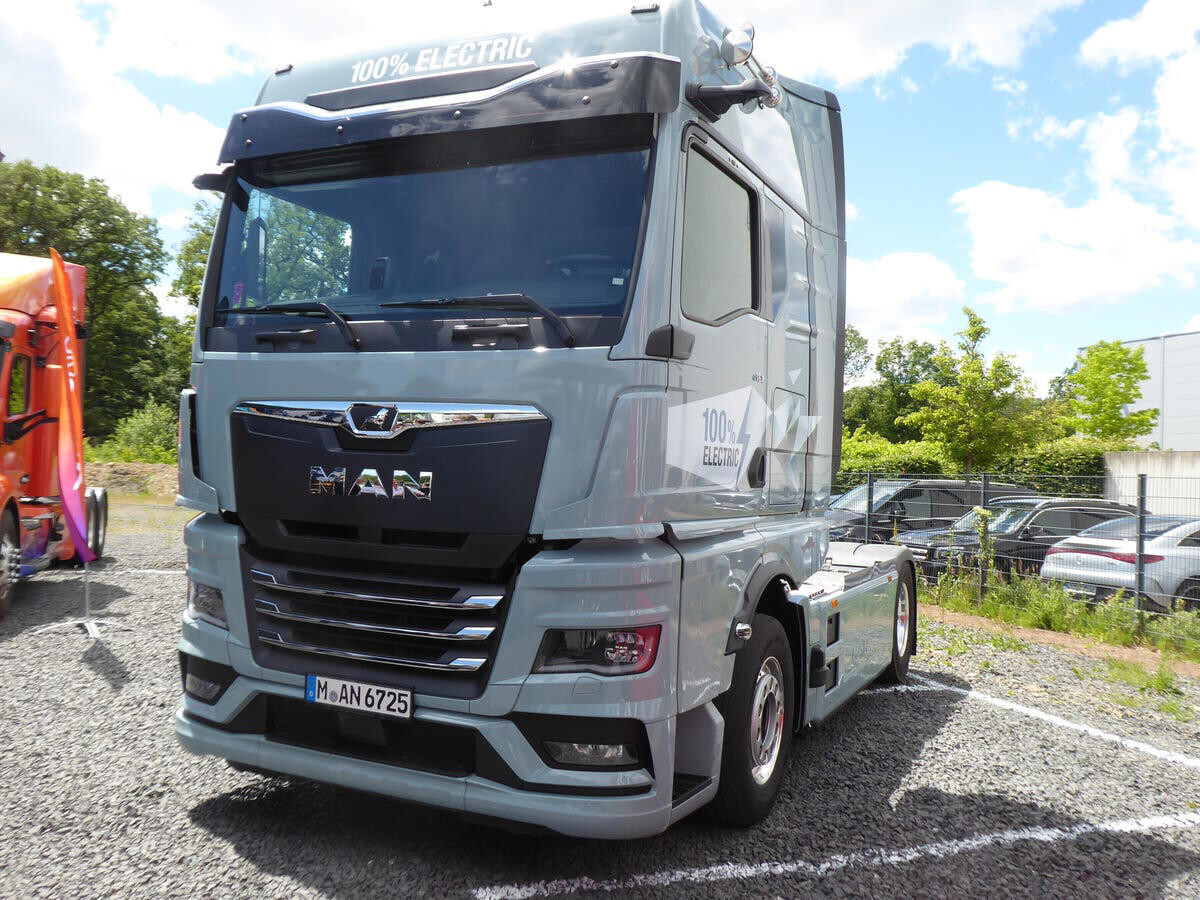
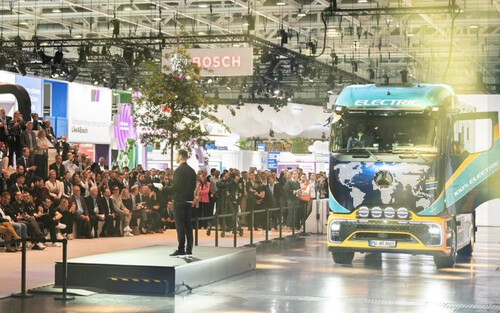
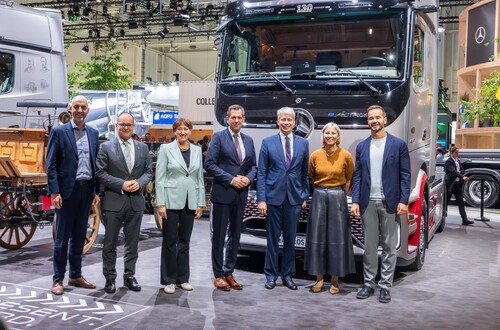
European truckmakers are making no secret of their growing dissatisfaction with EU regulators. They claim in near-lockstep that the Euro 7 regulations on carbon emissions—which require a 45 percent CO2 reduction by 2030, a 65 percent drop by 2035, and a 90 percent cut by 2049—will prove impossible to meet without a much faster rollout of critical charging and hydrogen refueling infrastructure. The EU goals are unlikely to be met with diesel trucks alone, though they’re getting cleaner, but basically will require a sharp increase in the number of zero-emission trucks on the road.The truck producers say they’ve done their job—and have fuel cell and battery-electric trucks ready to go—but the politicians need to be realistic about the situation on the ground. In addition to infrastructure, they blame EU red tape for the lead the U.S. has taken in rolling out fully autonomous trucks (which will deploy without drivers in Texas next year). The truck companies vented at the IAA Transportation Media Summit in Frankfurt June 8 and 9. The press event, with reporters from 33 countries, was intended to drum up excitement for the big September 15-20 IAA Transportation conference in Hannover, Germany, where many new green trucks will be shown. MAN’s BEV trucks come in various sizes, with up to 354-mile range.According to Dr. Manuel Kallweit, head of economic intelligence and economics at the German Association of the Automotive Industry (VDA), a perfect storm of economic conditions (including the Strait of Hormuz blockade, tariffs, high fuel/electricity prices and protectionism) has resulted in weak German demand for commercial vehicles, especially for BEV and hydrogen variants. In late 2025, the German government announced subsidies for 130 heavy-duty charging sites in the country, but Kallweit said 350 will be needed by 2030 to keep up with growing fleets. “Charging capacity is moving very slowly,” he said. “We’re still at the beginning.” Outside Germany, the charging infrastructure in the EU is mostly worse. “These times are challenging,” said Alexander Vlaskamp, CEO of MAN Truck. “It’s exciting that we are delivering decarbonization options, but to make it work we need the product, the infrastructure and the ability to meet total cost of ownership (TCO) goals. The infrastructure is just not there,” he said. “There’s not enough charging to make the TCO work.”Vlaskamp said in response to a question that to meet emissions targets for 2030 with a big rollout of BEVs, Europe would have to add 750 to 800 350-kilowatt truck chargers per month. Mercedes-Benz’ eActros Lowliner is a new BEV entry.According to Karin Rodström, CEO of Daimler Truck Holding AG, “Of course we need to drive to green energy in the European truck market, but we need to balance it with affordability. The EU Parliament and Commission have important meetings, but no important outcomes, and they introduced more new regulations in 2025 than in past years. There’s a lack of urgency, and the CO2 regulations are disconnected from TCO. We need radical solutions, not more talking.”Maximillian von Löbbecke, managing director of Renault Trucks in Germany, declared, “Electrifications without infrastructure is not an advance—it’s a disruption. The availability of the trucks is not the issue. We see operations where BEVs make sense, but 98 percent of the trucks on the road are still diesel because of TCO.”Dr. Roger Busch, a vice president for sales and engineering at supplier Mahle, called for “certainty in the planning process, with CO2 regulations linked to progress in building infrastructure. Being an auto supplier in Europe today is not a walk in the park. We had agreements on BEV and hydrogen truck volumes, but the sales are just not showing up. It’s still hard to beat diesel on a TCO basis. Brussels talks, but the actions aren’t there.”For its part, the European Commission views its Euro 7 goals as entirely achievable, and says that strict targets on decarbonization can co-exist with industry competitiveness. It has responded to requests for delays with policies that instead increase flexibility in meeting targets. This stance came under repeated attack in Frankfurt.Euro 7 goes beyond regulating tailpipes to include standards for particulate pollution from brakes and tires, as well as requirements for battery durability and performance. Regulators argue that the cost imposed by the regulations (roughly $173 per car) are vastly outweighed by the health benefits to consumers. The EU has made minor adjustments to its intended 2035 ban on internal-combustion cars, offering loopholes that would allow a small numbers of new tailpipes. “It was a symbolic move on the cars, but we’ve seen nothing comparable on the trucks,” Daimler’s Rodström told Autoweek. The push for zero-emission city buses, which are supposed to be 90 percent of the new fleet by 2030, is proving less controversial.Autoweek SOC EV Newsletter sign up“The industry takes its responsibility seriously,” said Hildegard Mũller, president of VDA. “We deliver. BEVs with 500-kilometer [310-mile] range are already on the road. The vehicles are ready—what’s needed is the right framework from the regulators.” She added that it’s not just charging stations—“thousands” of hydrogen fuelers are also needed to meet ambitious targets. There are currently only about 300 operational hydrogen stations in Europe, with a third of them in Germany. There are only 65 stations in France, 22 in the Netherlands, and 19 in Switzerland. Perhaps to prove its assertion that it has the product, the IAA media summit also included a visit to a group of electric trucks, from Mercedes-Benz, MAN and others. Renault’s truck was its new diesel, which a spokesman said was to prove that the company has across-the-spectrum solutions—and is being realistic about continued diesel dominance. Benz showed off a new Lowliner version of its eActros 400 and 600 trucks, with orders starting in the fourth quarter. Happy eActros operators are reporting much higher range than the announced 310 miles, a spokesman said. But company officials were reluctant to state a figure as to how many of these trucks have been sold.