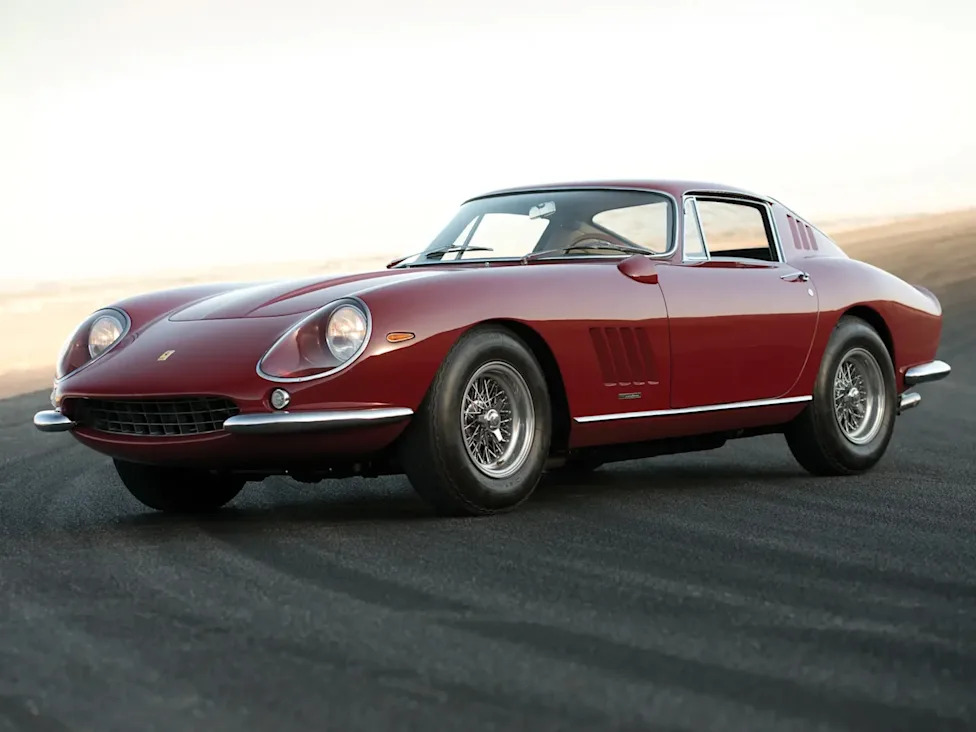
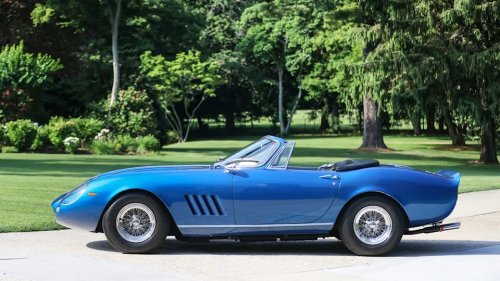
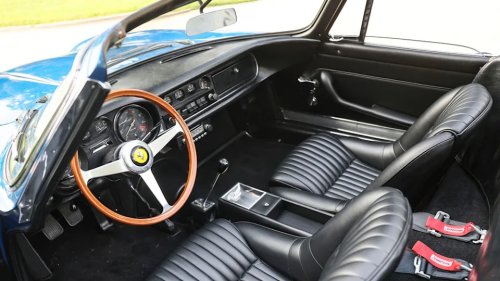
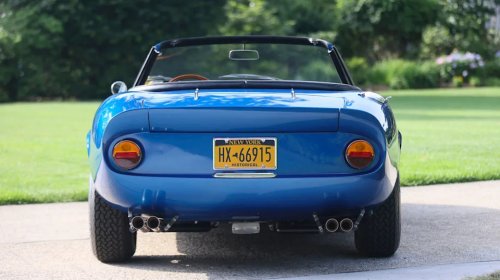
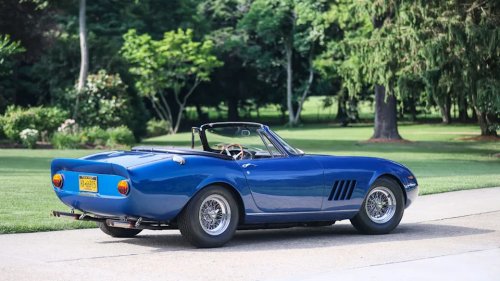
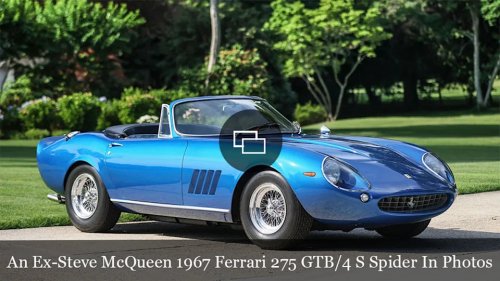
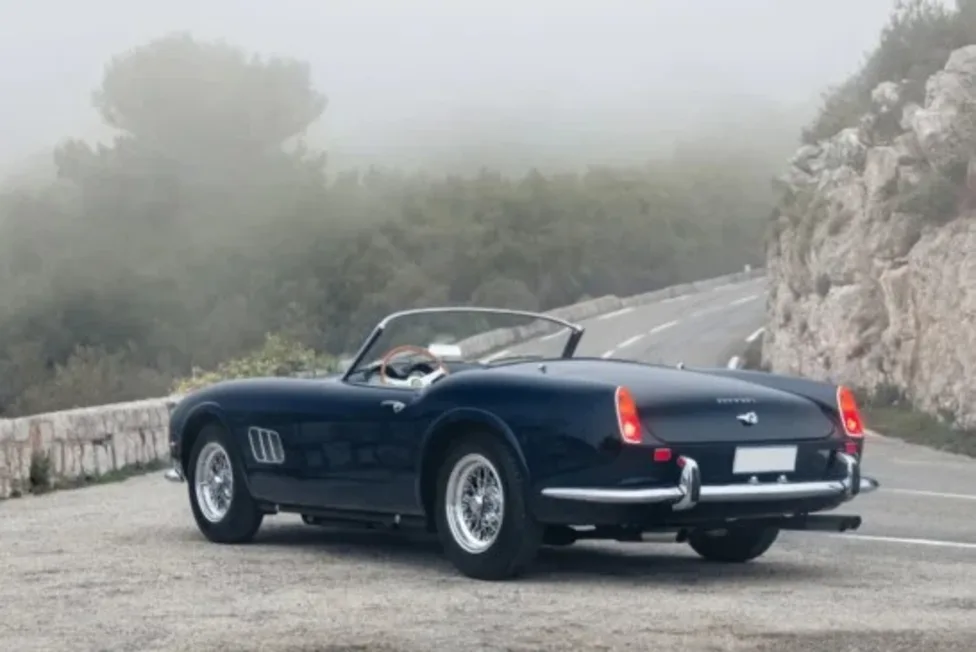
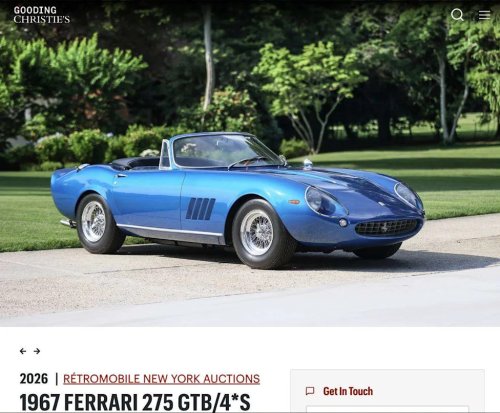
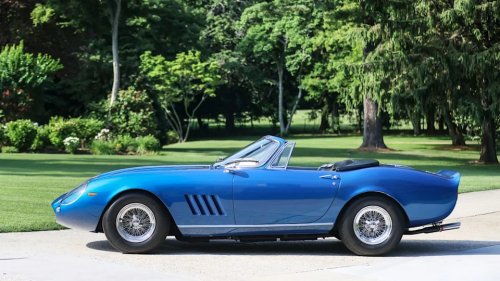
This NART Spider's Real Value Isn't Its Rarity. It's What Steve McQueen Did to It.Modern Car CollectorJohn LloydFri, September 11, 2026 at 2:00 PM UTCAdd us on GoogleGooding & Christie's confirmed today that the headlining lot at its inaugural New York sale this November is a 1967 Ferrari 275 GTB/4*S NART Spider delivered new to Steve McQueen — a car the actor modified within months of taking delivery and then kept largely out of public view for the rest of his life. Chassis 10453 carries a presale estimate of $15,000,000 to $20,000,000 and, after nearly six decades in private hands, will be offered at public auction for the first time this November 20 and 21 at the Javits Center, as part of Rétromobile New York, the first North American edition of the Paris institution.That McQueen owned it is remarkable enough. What he did to it afterward is the more interesting story.A Rarity Within a RarityFerrari never catalogued an open version of the 275 GTB/4. The four-cam berlinetta — the most serious mechanical evolution of the 275 line — was built as a coupe, full stop. The Spider exists because Luigi Chinetti, Ferrari's North American importer and the man behind the North American Racing Team, believed his customers wanted something the factory hadn't offered. Ferrari agreed to build it his way: Scaglietti reworked the coachwork, and just ten cars were completed for the 1967 and 1968 model years.AdvertisementAdvertisementChassis 10453, the sixth of those ten, was completed in September 1967 and invoiced to Luigi Chinetti Motors before selling new to McQueen through Hollywood Sport Cars. It was also one of only two NART Spiders finished from the factory in Blu Sera, a metallic evening blue — meaning it was already distinctive before its most famous owner ever touched it.The Repaint That Made It More Valuable, Not LessIn the collector world, an owner who deviates from factory-original color or trim almost always subtracts value. A repaint, in nearly every other context, is a mark against originality. McQueen's NART Spider inverts that logic. Almost as soon as he took delivery, he had the car repainted in a darker metallic blue and the seats retrimmed with a distinctive stitching pattern of his own choosing. He later had it repaired by Junior Conway following an accident on Pacific Coast Highway.None of that reads as damage to the car's history. It reads as the history. McQueen wasn't a collector maintaining a specimen; he was an owner living with a car he'd bought to drive and then changed to suit himself. That distinction matters to serious buyers evaluating this sale. A factory-correct restoration at any point over the last fifty years would have erased exactly the details that make chassis 10453 unrepeatable.Chassis 10453 photographed circa 1987, soon after joining the consignor's collection. Photo courtesy of Marcel Massini, via Gooding & Christie's.Nearly Forty Years With One CollectionBy 1971 the Ferrari had passed to J. David Kopf of Tujunga, California, and in 1986 it joined its current owner's collection through Long Island Ferrari dealer Grand Prix SSR — a home it has now occupied for four decades. Throughout that ownership, the car was preserved rather than restored: it retains its matching-numbers engine and transaxle, its original Scaglietti body, and the metallic blue finish and custom trim McQueen himself specified.AdvertisementAdvertisementThat preservation is arguably rarer than the model itself. Ten NART Spiders exist; very few collector Ferraris of this stature have gone sixty years without a restoration at some point along the way. A car with that kind of unbroken, documented history functions less like a restored replica of a period object and more like the object itself — which is precisely the standard serious collectors apply when weighing provenance against paperwork.The car has not been entirely hidden. It appeared at the 1996 Louis Vuitton Classic at Rockefeller Center and the 2003 exhibition La Bella Macchina: The Art of Ferrari at the Chrysler Museum of Art in Norfolk, Virginia. But Rétromobile New York marks the first time chassis 10453 has ever been offered publicly at auction. In a press release announcing the sale, Gooding & Christie's President David Gooding called it "the most elusive and mythical" of McQueen's cars — a fair description of a Ferrari that has spent most of six decades deliberately out of view.Why This Sale, Why New YorkEvery ambitious auction house eventually asks whether a market can be built somewhere it doesn't already exist. Gooding & Christie's is testing that question this November, serving as the official auction house of Rétromobile New York and using the Javits Center to stage the first North American edition of an exposition that has anchored the European season for decades. For context on what these half-billion-dollar auction weeks actually reveal about the broader market, the comparison to an established week like Monterey is instructive — and unflattering to almost any new venue attempting to match it in a single sale.Gooding & Christie's isn't attempting to match it with volume. The November catalogue also includes a 1965 Ferrari 275 GTB estimated at $2,250,000 to $2,500,000 and a 1963 Ferrari 250 GT Lusso estimated at $1,400,000 to $1,600,000, both wearing Scaglietti coachwork — a supporting cast, not a competing headline. The strategy is concentration: put one car in the room that most collectors assumed would never reach an auction podium, and let it do the work of convincing everyone else that the sale is worth attending.What Serious Buyers Should WatchThe $15,000,000 to $20,000,000 estimate is worth sitting with. In 2013, a factory-color NART Spider sold at auction for $27,500,000, at the time the highest price ever paid for a car at auction in the United States — a level of Ferrari benchmark pricing that still anchors how the model is discussed. Chassis 10453 is guided lower despite a more famous name attached to it and a documented ownership chain behind it, which says less about the car's importance than about how estimates get set conservatively ahead of an unproven venue. Where it actually finishes on November 20 will tell collectors more about current appetite for personal, non-factory provenance than the presale number does.AdvertisementAdvertisementBuyers doing diligence before then should confirm Ferrari Classiche certification status, review the full condition report once the October catalogue releases, and treat Gooding & Christie's account of the ownership chain as a starting point for independent verification rather than a substitute for it. That discipline doesn't change based on the size of the number involved — it's the same instinct that separates a genuinely important car from a merely expensive one, whether the buyer in question is chasing a factory prototype or, in this case, a Ferrari the factory built once and one man rebuilt in his own image.Collectors have long paid a premium for factory originality — the untouched color, the unmolested interior, the car exactly as it left Maranello. Chassis 10453 asks them to pay a premium for the opposite: a Ferrari whose most valuable modification was made by the man who owned it, not the factory that built it.Join our Newsletter, follow our Instagram page, and follow us on Facebook.



















 +8 others