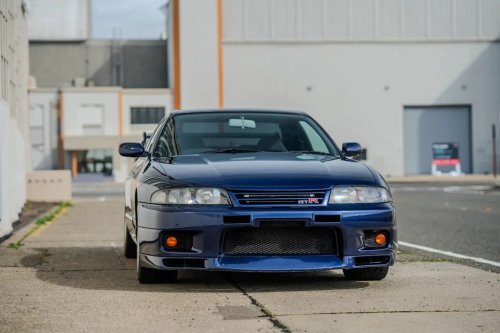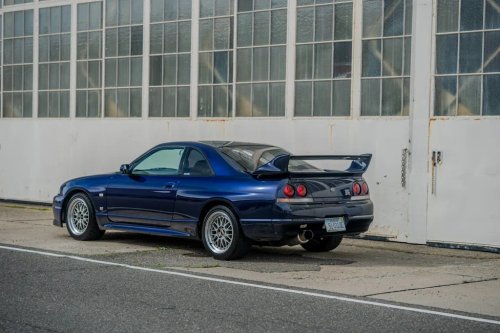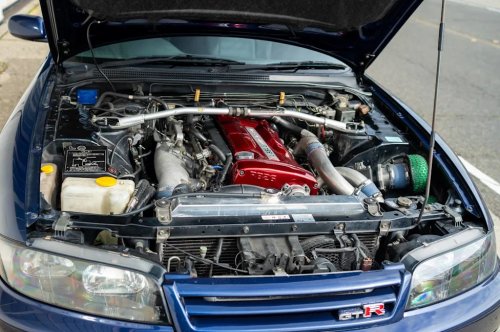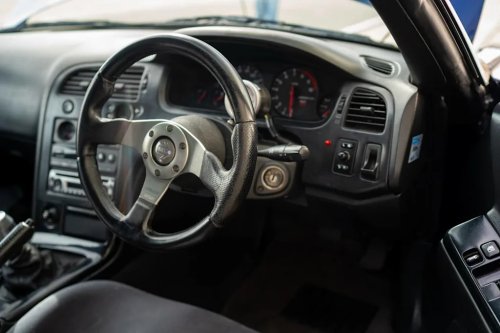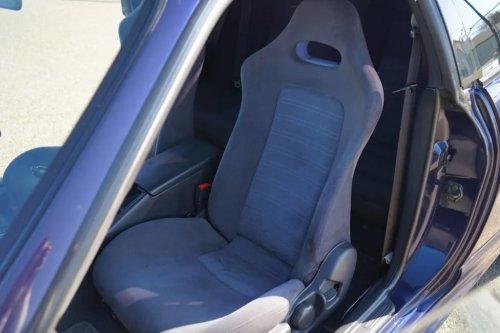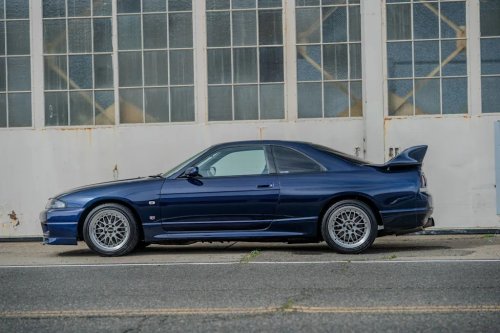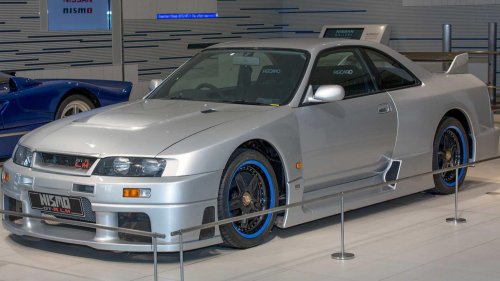
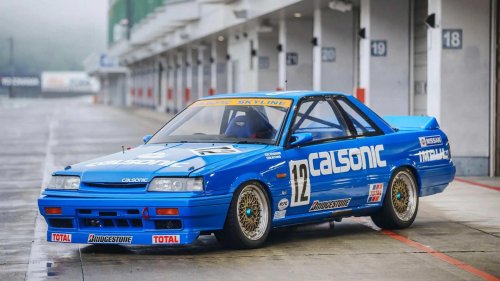
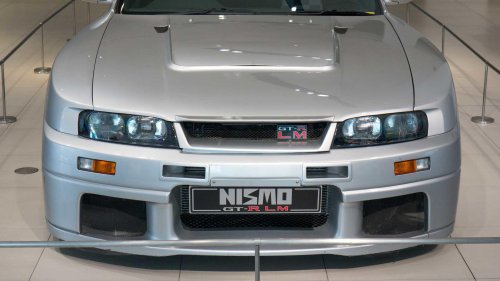
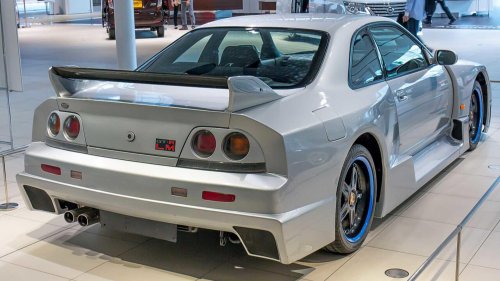
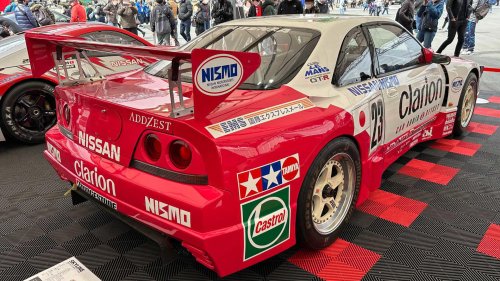



















Throughout automotive history, motorsport has been an integral part of allowing brands to strut their stuff. Of course, there are loads of different racing series' out there, and listing all of them would take up way too much space. Along with the slew of different types of racing comes different types of rules, many of which revolve around homologation, a practice wherein an automaker needs to produce a certain number of cars – or engines – that will be used in racing on the road.Because of fast-changing homologation rules in the early 1990s for Group C racing, several manufacturers pulled out of the series. However, Nissan decided to stick it out. In doing so, the Japanese automaker came up with the 1995 Skyline R33 GT-R LM race car. In order to meet the new rules, at least one road-going production model needed to be produced. In an exercise of "just enough" rule adherence, Nissan produced a single model: the Skyline R33 GT-R LM Road Car. What Paved The Way For The R33 GT-R LM Road Car Wikipedia Commons: Morio In 1995, a major shift in rules and regulations changed the scope of Group C racing drastically. Prior to that year, most of the Le Mans Group C entrants were prototype models, meaning no homologation requirements were in place. In addition, a previous rule change in 1990 required all Group C cars to have naturally-aspirated, 3.5-liter engines. However, this would prove disastrous for most brands involved in the series. Development costs skyrocketed, forcing many automakers to bow out of Group C entirely.In short, Group C was failing, and the prototype class had been whittled down to just a handful of contenders. Because of this, Group C shifted from prototype models to something called the GT1/GT2 class. With the class change came an all-new homologation requirement. The new rule stipulated that a single, road-worthy example of a race car needed to be produced. However, some automakers got crafty with finding loopholes in the rule, with some even claiming that the empty space in a drained fuel tank qualified as "luggage space."With all-new homolgation rules in place, and Group C undergoing a major shift in car type from Prototype class to GT1/GT2, NISMO decided to get smart with its new racer. However, the Japanese automaker wasn't interested in building an all-new car for the 1995 season, choosing instead to utilize an existing model. Naturally, the choice for its Group C entrant was the Skyline GT-R, which had already proven itself a competent racer, most notably in the early 1990s with the famous Calsonic GT-R. The fabled racer ended up winning 29 out of 29 races in its Group A class in 1990, earning it its "Godzilla" nickname.Bonhams However, the R32 was long-gone, and the newest iteration of the Skyline GT-R, the R33, had hit the streets in 1995. The R33 was longer, wider, and heavier than the old R32. At the same time, its chassis was much stiffer, and it enjoyed more stability than its predecessor thanks to its longer wheelbase. Some GT-R purists chastised the new model, as it was deemed "too easy" to drive, and was seen as too soft, squidgy, and mainstream. However, the GT-R's famous calling card, its RB26DETT engine, remained. Nissan's Road-Going Racer Wikimedia Commons: Morio Nissan set about designing the new racer, upon which the road car is based, once it was learned that Group C's rules were changing. The R33 GT-R LM race car focused its design largely on the existing R33 LM racecar, but with a few tweaks. For starters, its all-wheel drive system was removed, making it only rear-drive. In addition, its engine received the "N1-Spec" treatment, raising its horsepower output to 400 ponies. However, the road-going version of the engine was de-tuned.NISMO, Nissan's tuning arm, famously took the RB26DETT and gave it the aforementioned N1-Spec treatment. With it, the mill received a stronger block, stamped with the code "24U." It was a more robust casting than the sort seen on road-going iterations of the RB mill, with thicker cylinder walls, improved water passages, and upgraded turbochargers, courtesy of Garrett. Backing up the powerplant is a six-speed sequential manual transmission.On the outside, the road car received a huge body kit, which extended its hip size by about 50 millimeters on each side. The point of the new frock was to drastically increase its downforce. Being a road-legal model, it got a full set of turn signals. Inside, the road car, a standard R33 Skyline GT-R interior is seen, although its steering wheel got an Alcántara wrap, and the front seats were swapped out for a pair of racing buckets. What Happened To It? Wikimedia Commons: MorioOne of the many loopholes exploited by automakers throughout the 1990s Le Mans racing era, which included the Group C class, was just what happened to the road-going version(s) of the race cars once they were produced. Nowhere in the rules did it explicitly state that the car needed to be sold. So, instead of risking the GT-R LM road car getting into the wrong hands, it was immediately put away into storage upon completion. Legally, and for Le Mans homologation purposes, it was briefly registered for use in the United Kingdom.Since then, the R33 GT-R LM road car has made sporadic appearances at racing events throughout the world. It also attended an event commemorating the Nissan GT-R's 50th anniversary. However, for most of its life, it's spent its time in comfort at Nissan's Zama, Japan, storage facility. The R33 GT-R LM road car is such a closely-guarded piece of Nissan heritage that even Carlos Ghosn, Nissan's CEO, was denied the chance to drive it by his own company. How The Racing Version Got On Wikimedia Commons: TokumeigakarinoaoshimaWhile the road-going version of the R33 GT-R LM immediately entered a life of comfort upon its completion, the pair of race cars that were produced alongside it didn't.Both cars, numbered 22 and 23, debuted for the 1995 Le Mans season. However, a stout lineup of fierce competitors were ready to face them down. Entrants like the McLaren F1 GTR and the Ferrari F40 LM were top contenders for that season. The former was extremely successful, taking many of the top-10 spots, along with first place. The plucky Nissans, on the other hand, did not fare very well.The number 22 car managed to secure a 10th-place finish, well behind many of its more-formidable contenders. However disappointing, it was still considered a good finish. Number 23, though, was not so lucky. After a rather disappointing performance, the car was forced to retire after 157 laps due to transmission failure.The R33 GT-R LM race cars were discontinued for the 1996 season, and Nissan refrained from participation. This was partly due to their lukewarm performance, but the introduction of cars like the Porsche 911 GT1, which took advantage of several loopholes to gain entry, rendered the R33 GT-R LM somewhat obsolete. Come 1997, Nissan introduced the R390 GT1, which also sported a one-off road-going iteration.