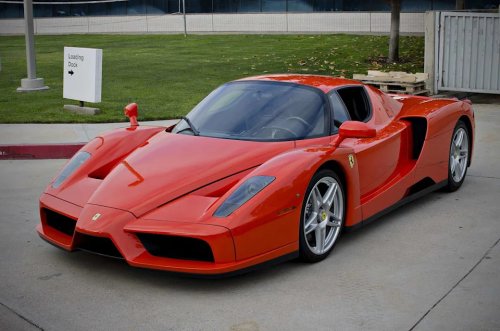
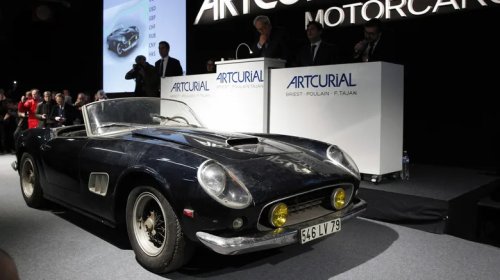
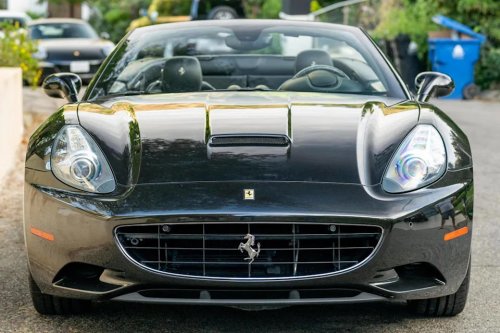
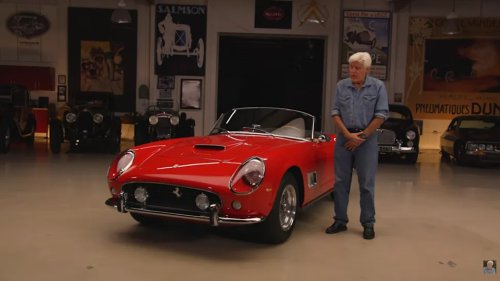
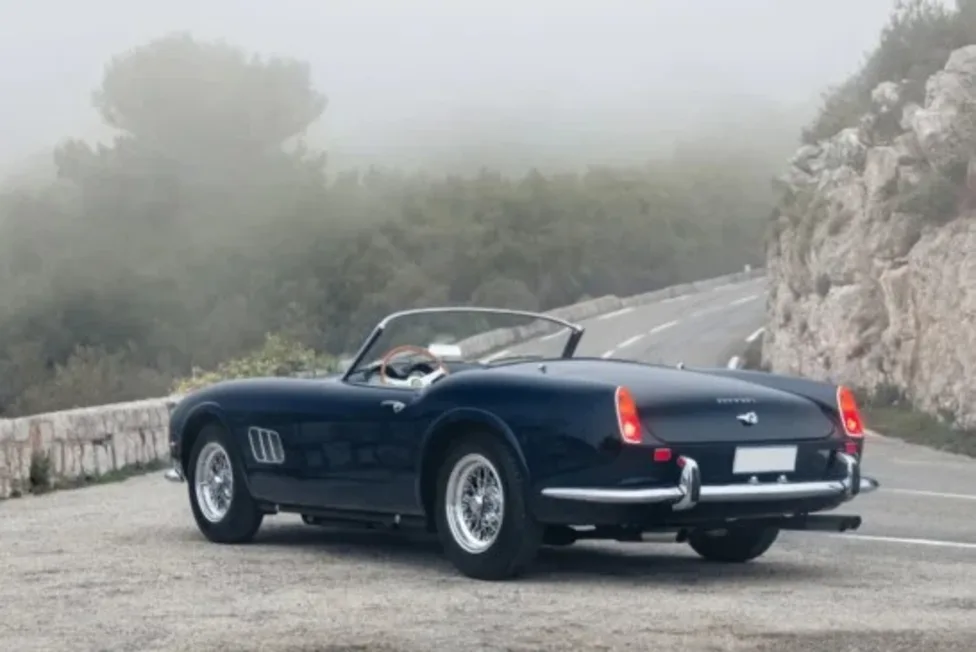
This Ferrari California Spider's Record Wasn't About Rarity. It Was About Certainty.On 25 April, at the Grimaldi Forum in Monte Carlo, RM Sotheby's closed its biennial Monaco sale at €87,967,385, with a 90 percent sell-through rate that made it the highest-grossing multi-car auction ever held in Europe, surpassing the €81 million the house achieved in Paris just three months earlier. We covered the headline number and the car that drove it when the results first came in. What deserves a second look, now that the dust has settled, is why one specific Ferrari, among fifty-six built to the same specification, was the car that got there.The car in question is chassis 2955 GT, a 1961 Ferrari 250 GT SWB California Spider by Scaglietti, and it sold for €16,655,000, a new world auction record for the model. Fifty-six SWB California Spiders left Maranello between 1960 and 1963. Several change hands every year without approaching eight figures. So the interesting question was never how rare this car is. It was rare the day it left the factory, and every surviving example is equally rare today. The interesting question is what separated this particular chassis from the rest of its own production run.The answer is documentation, not scarcity, and it is worth understanding in some depth. The same principle now governs pricing at every level of the Ferrari market, from a 1961 open-top GT to a Ferrari that left the factory in 2018.A Riviera Icon, Built for Two JobsThe California Spider exists because Ferrari's most important American dealer, Luigi Chinetti, wanted a car that could win at Sebring on Saturday and be seen on the Croisette on Sunday. The original long-wheelbase California, introduced in 1957 on the same underpinnings as the Tour de France and Testa Rossa within Ferrari's 250 GT family, delivered on both fronts almost immediately, taking a class win at the 1959 12 Hours of Sebring before finishing fifth overall at Le Mans that June. At the 1960 Geneva Salon, Maranello shortened the wheelbase to 2,400 millimetres, widened the track, added Koni telescopic shocks and four-wheel disc brakes, and fitted the latest evolution of its short-block V-12. The result, built in a run of just 56 cars through 1963, is generally regarded as the most complete expression of the California idea: a car that could be driven hard and still looked like nothing else on the road.AdvertisementAdvertisementThat reputation has held up commercially for decades. A comparable SWB California Spider set a widely reported benchmark for the model at $17.05 million in 2024, and the Monaco result, denominated in euros rather than dollars, extends that same trajectory rather than representing an isolated spike.Chassis 2955 GT: A Documented LifeAccording to research compiled by the independent marque historian Marcel Massini, chassis 2955 GT was the 26th of the 56 SWB California Spiders built, and one of only 39 fitted from new with covered headlamps rather than the open units used on the balance of the run. Finished in Bianco Saratoga over Nero Vaumol leather, the car was completed in September 1961 and delivered not to a private customer but to Auto Becker, Ferrari's longtime importer in Düsseldorf, which placed it on its stand at the 40th Frankfurt Motor Show. That gave the car a documented, factory-era public role before it was ever sold to a private owner a month later, to a Lebanese enthusiast, André Budi-Medawar, who kept it in Rome.What follows over the next six decades reads as an unbroken chain rather than a series of gaps. The car was exported in 1965 to Luigi Chinetti Motors in the United States, passed briefly through an Illinois owner who returned it to Chinetti, and then spent most of the 1960s in Ohio, where it won its class at the 1966 FCA National Concours in Indianapolis. From 1969, the Spider spent more than thirty years with the character actor Ken Mars, best remembered for supporting roles in What's Up, Doc? and Young Frankenstein, who repainted the car but did not sell it until the year 2000. Two further owners and two further restorations followed, culminating in a 2018 submission to Ferrari Classiche that resulted in a Red Book certifying the engine, gearbox, rear axle, and coachwork as original to the chassis. The current owner then commissioned a third restoration, completed in 2022 by Dino Cognolato's respected shop in Vigonza, returning the car to its present Blu Scuro over rosso leather and adding a correct-style hardtop. The work was strong enough to earn the car a place at the 2022 Pebble Beach Concours d'Elegance.Why Paperwork Outvalues ScarcityNone of this makes chassis 2955 GT rarer than any other surviving SWB California Spider. What it does is remove doubt. A Ferrari Classiche Red Book certifies, on the factory's own authority, that the numbers on the engine, gearbox, rear axle, and coachwork match the chassis plate, an assurance that matters enormously in a market where matching numbers is sometimes asserted rather than proven. Independent research from a historian such as Massini adds a second, external layer: a continuous ownership record with no unexplained years, no conflicting stories, and no gap where a car could have been swapped, rebodied, or misidentified. Buyers paying eight figures for a sixty-five-year-old automobile are not simply buying an engine and four wheels. They are buying certainty that the object in front of them is exactly what it claims to be, with nothing left to argue about.AdvertisementAdvertisementThat is the real currency at the top of the collector Ferrari market now, and it explains a pattern that shows up repeatedly at this level: two visually similar cars from the same production run, sold months apart, can finish tens of percent apart in price, with the gap explained almost entirely by paperwork rather than presentation.One Marque, Every EraThe Monaco sale made the same point outside the vintage classes. Ferrari accounted for eight of the auction's top ten results, spanning 1961 through 2018. A 2004 Enzo finished in the rare Argento Nürburgring, one of only five built in that color over a red interior, brought €6,530,000. A 2018 FXX-K Evo took €5,180,000. A 2014 LaFerrari, the only example finished in Verde Segnale, made €5,067,500. A 1989 F40 with 1,799 kilometres on its odometer sold for €4,336,250. None of these cars are sixty years old. All of them commanded records or near-records for reasons that mirror the California Spider's own: color rarity, documented low mileage, and an unambiguous history. Age is not the organizing principle of this market. Verified specificity is.What a Wristwatch and a Pair of Trousers ExplainThe same logic turned up in an unlikely place at the same sale: a group of personal effects consigned directly by the family of Juan Manuel Fangio. A 1955 Omega Trésor wristwatch estimated at €22,000 sold for €204,000. A pair of his 1950s Suixtil racing trousers, estimated at €8,500, brought €132,000. His 1950 international driving permit, estimated at €3,500, made €102,000. None of these objects carries mechanical merit. A watch is a watch. What buyers were underwriting was proximity to a specific, verifiable life, an argument that these objects belonged to Fangio and no one else, backed by a paper trail every bit as clean as the one behind chassis 2955 GT. Collectors at this level are rarely buying objects. They are buying certainty about whose hands an object passed through.A Selective Market, Not an Indiscriminate OneIt would be a mistake to read the €87.9 million total as evidence that anything wearing a Ferrari badge or attached to a famous name now sells regardless of merit. A 1984 Toleman TG183B, the car in which Ayrton Senna made his Formula 1 debut, failed to sell against a €2.8 to €3.8 million estimate. A 2020 Lamborghini Aventador SVJ and a numbers-matching 1973 Porsche 911 Carrera RS 2.7 Touring likewise went unsold. A 90 percent sell-through rate means one lot in ten did not clear its reserve, motorsport pedigree and modern-supercar desirability included. That discipline is arguably the more reassuring data point for anyone watching the European market: buyers are still drawing a line. They are simply drawing it around documentation and condition rather than around badge or backstory alone.What Serious Buyers Should Take From ThisFor collectors evaluating a California Spider, or any Ferrari from this competition-adjacent lineage, the Monaco result functions as a checklist as much as a headline. Confirm Ferrari Classiche status and read the Red Book closely, since certification of matching numbers is not identical to certification of every individual component. Ask for an independent history report from a recognized marque historian rather than relying on a seller's summary. Weigh restoration provenance: a refurbishment by a shop with a public track record, such as Cognolato or Bacchelli & Villa, carries more evidential weight than an unattributed restoration by unnamed marque specialists. And treat concours exhibition history, Pebble Beach, Villa d'Este, the Concorso d'Eleganza, as a form of third-party validation, since these events vet cars before they are ever accepted onto the lawn. Buyers weighing this kind of acquisition against the field of contenders should also keep an eye on where California Spiders sit among the most valuable cars ever sold at auction, a list that Ferrari's open-top GTs are joining with increasing regularity.AdvertisementAdvertisementThe headline out of Monte Carlo was a record price for a Ferrari California Spider. The more durable lesson is that the record had almost nothing to do with the fact that only 56 of these cars exist. It had everything to do with the fact that one of them arrived at auction with sixty-five years of its life fully accounted for. In a market maturing as quickly as this one, that kind of certainty is starting to look like the only scarcity that still matters.Join our Newsletter, follow our Instagram page, and follow us on Facebook.


















 +27 others