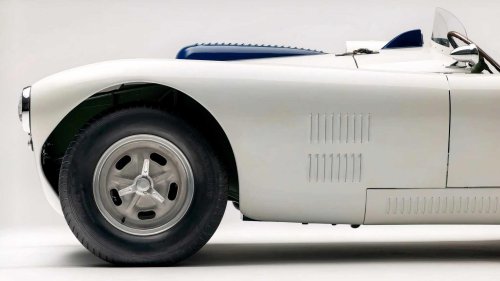
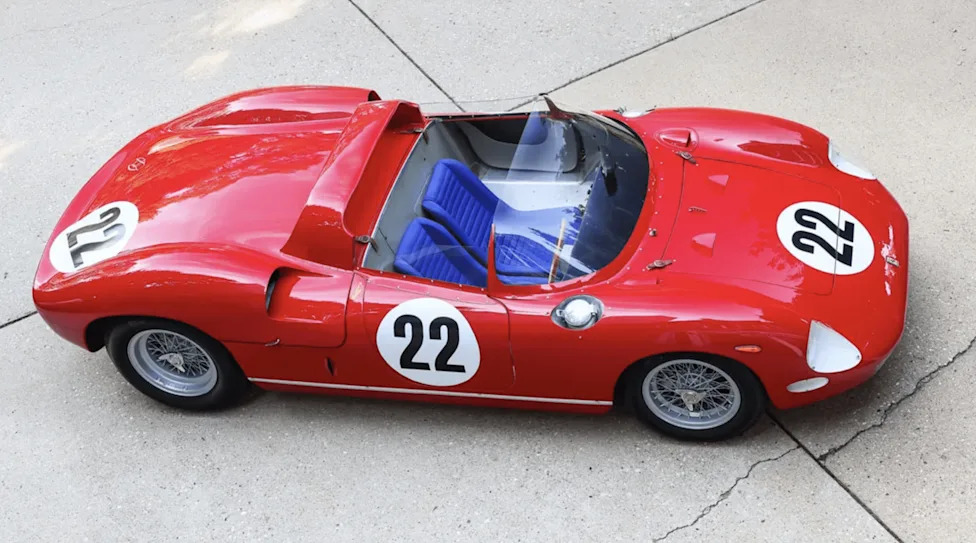
Chassis 0810: The Ferrari Prototype That Nearly Sold For Corvette MoneyIn 1966, this car was for sale for $12,000. That was Corvette money — a little over, actually. The car in question had already finished second overall at Sebring and third overall at Le Mans as a works Scuderia Ferrari entry, and nobody cared, because in 1966 a three-year-old prototype was just a slow racing car with expensive habits.On August 15, chassis 0810 crosses the block as Lot 26 at Gooding Christie's Pebble Beach sale with an estimate of $15 million to $20 million. The car hasn't changed. What changed is that somewhere between then and now, the market decided that being first at something was worth more than being fast.The bet Enzo didn't want to makeAdvertisementAdvertisementFerrari spent the 1950s winning sports car races with the engine in front of the driver, and Enzo saw no reason to stop. Formula 1 had already gone mid-engined — Ferrari's own Tipo 156 took the 1961 title that way — but a Grand Prix car runs light and short. An endurance car starts each stint with a full tank and has to stay predictable for twelve or twenty-four hours with all that mass swinging behind the rear axle.Mauro Forghieri, newly installed as chief engineer and not yet 30, got the job of arguing the other side. Gooding's catalogue quotes his recollection of the factory's response: "It can't work with all that weight in the back." His counterargument was a number rather than an opinion — a tubular chassis engineered so that no more than 55 percent of the car's mass sat over the rear axle. John Surtees, who had joined the team that same winter and understood chassis behavior better than most drivers of the era, helped sort it through the 1962-63 off-season.Related ArticlesFor Sale on BuyTheCar: This Award-Winning 1971 Plymouth 'Cuda 'Hell's HEMI' Is a Restomod KnockoutIconic Bentley and Mercedes-Benz Offerings are in the Spotlight at this year's Pebble Beach AuctionsUnderneath the Pininfarina shape and the aluminum panels Carrozzeria Fantuzzi hammered over it sat a longitudinally mounted three-liter Testa Rossa-derived V-12 with dry-sump lubrication, a rear transaxle, independent suspension all around, and inboard rear discs. Forghieri also talked the factory into full-scale wind tunnel work at the University of Stuttgart — a genuinely unusual expense for a sports-racer in 1963 — which produced the wraparound screen and the roll hoop that doubles as a wing. Ferrari's own description of the model still singles out that hoop-cum-wing as the defining element.AdvertisementAdvertisementThe inboard brakes are worth pausing on. Moving the rear discs inboard off the uprights strips unsprung weight and helps the suspension follow the road, but it dumps heat straight into the transaxle housing and makes pad changes a job rather than a pit stop. In a 12-hour race, that's a deliberate trade: better mechanical grip in exchange for a service headache. It's the same calculus that put inboard brakes on everything from the Jaguar E-Type to Alfa's Alfetta, and the same reason almost nobody uses them now that tire and damper technology moved on.Six months from doubted to vindicated0810 was shown to the press at Monza on March 4, 1963, alongside the 330 LMB, and was at Sebring less than three weeks later. Mairesse, Bandini, and Vaccarella ran it to second overall behind its own sister car, and Ferraris filled the top six. The layout half the factory had called madness had just gone 1-2 on debut.Retirements followed at the Targa Florio and the Nürburgring — accidents, not the mid-engine layout falling apart — before Parkes and Maglioli took 0810 to third overall and second in class at Le Mans while another 250 P won outright.AdvertisementAdvertisementThen came the second act. Ferrari moved to the larger 275 P for 1964 and handed 0810 to Luigi Chinetti's N.A.R.T., where Pedro Rodríguez finished second at the Bridgehampton Double 500, won the Canadian Grand Prix at Mosport outright, and took a pair of second-overall, first-in-class results at Nassau. Maranello kept updating the car in service, first to 3.3-liter 275 P specification and later to a full four-liter 330 P. It also picked up a white nose triangle and a central scoop along the way. Nobody was preserving anything. They were racing.Why the engine number is the whole storyHere's the part that actually justifies the estimate, and it isn't the podiums.The catalogue lists 0810 as retaining its Tipo 128 LM 63 engine — internal number 4 — and its Tipo 564/D transaxle, number 3. The lot's engine number is stamped 0810, matching the chassis, which was period Ferrari practice on works cars.AdvertisementAdvertisementFor a 1960s prototype, that is close to miraculous. These cars were consumables. They got crashed, rebodied into whatever the next season's rules wanted, fitted with larger engines and then never returned to original, or cannibalized outright. Most surviving P-cars carry replacement components and a paper trail that requires some faith. 0810 went through 3.3 and 4.0-liter specifications in period and still has the original three-liter unit and gearbox with it — which is the difference between a $15 million car and a $6 million car with an asterisk.The provenance chain does the rest. Gordon Tatum, Carl Bross, Kirk White, Ken Starbird, Don Fong, Wayne Sparling, Harley Cluxton, and the current owner since 1988: an unbroken, documented sequence through the exact decades when this stuff usually goes sideways. The car's history has been researched by Marcel Massini, whose files function as the de facto registry for pre-1974 Ferraris and whose sign-off is priced into cars at this level.What a bidder is actually signing up forGooding notes the car sells on a bill of sale, not a title. That's normal for a pure competition car that was never road-registered anywhere, and it's not a defect — but it does mean the documentation carries the weight a title normally would, and that any buyer planning to register it for road use in a US state is looking at a bonded-title process rather than a trip to the DMV. Realistically, nobody's daily-driving this.Related ArticlesEverything Modern Car Collector Covered Last WeekEnds 8/9: Award-Winning 1967 Corvette Convertible, $10,000 Cash Up for Grabs in Charity SweepstakesAdvertisementAdvertisementThe math on top of the hammer is public. Per the auction terms, the buyer's premium runs 12 percent on the first $250,000 and 10 percent on everything above. At the low estimate, that's about $1.5 million on top of $15 million. At the high end, roughly $2 million on top of $20 million. State and local sales or use taxes are the buyer's problem separately. Payment and removal are both due by 5 p.m. Pacific on Wednesday, August 19, with storage fees of up to $50 per day after that — a rounding error here, but a reminder that Gooding doesn't babysit.Insurance is where a car like this gets genuinely interesting. Agreed-value collector coverage is standard, but the exposures aren't garage fires — they're transit and event use. This car has run the Goodwood Festival of Speed, the Ferrari Historic Challenge, and the Monterey Historics, and a buyer who wants to keep doing that needs on-track coverage that most agreed-value policies specifically exclude. That's a separate binder, priced by an underwriter who knows exactly how many Tipo 128 engines exist.Where it landsThe benchmark is the 1962 Ferrari 330 LM/250 GTO chassis 3765, which sold for $51,705,000 in November 2023 — still the auction record for the marque. That car had works history and a GTO body. This one has works history and a bloodline: every mid-engined V-12 Ferrari racer that followed, from the 275 P through the 330 P4 and the 512 S to the 333 SP, descends from the layout 0810 proved.AdvertisementAdvertisementFifteen to twenty million for the first of a lineage that includes multiple Le Mans winners is either a bargain or exactly right, depending on whether you think collectors pay for results or for firsts. Recent history says both, but firsts age better.One last detail that says everything about this corner of the hobby: the very next lot is a Ferrari Tipo 163 V-12 engine, sold on its own. At Pebble Beach, even the leftovers have provenance.Images Via: GoodingcoJoin our Newsletter, follow our Instagram page, and follow us on Facebook.



















 +16 others