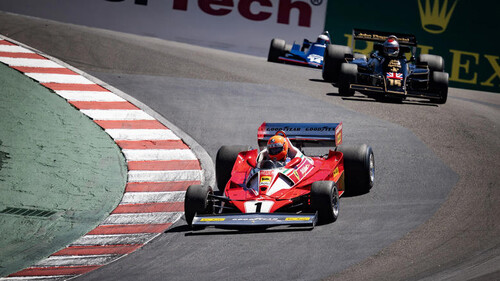
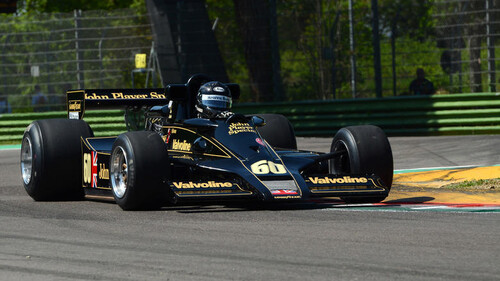
Shang Saal/Shutterstock The world of bicycles in 2026 is littered with lightweight carbon-fiber frames, but 40 years ago it was considered a space-age material beyond reach. Across the late 1980s, carbon-fiber-reinforced plastic was really only in use for military applications, aerospace projects and the most expensive of race cars in Formula 1. Carbon fiber has an extremely high strength-to-weight ratio, making it the perfect material to build with, especially because it's very stiff, and doesn't expand with heat. The only downside, really, is its expense, but if you want to be the boss, you have to pay the cost. Ernesto Colnago wanted his Cambiago, Italy-based bicycle company to be the boss when it came to pedal-powered racing. Much like its motorsport counterpart, Ferrari, Colnago became famous for its racing exploits, with one of its bikes first winning the Giro d'Italia in 1957. After experimenting with frame tube shapes across the 1970s and '80s, developing the Oval CX, the Super Profil, and the Colnago Master line of frames (which it still sells), it was clear that the company had gone as far as it could to develop steel, aluminum, and even titanium frames. Colnago had begun experimenting with carbon-fiber monocoque bikes at the beginning of the 1980s, introducing the CX Pista at the Milano Bike Show in 1981 to great fanfare, but it was little more than a showpiece at the time. That same year, carbon-fiber monocoque design hit Formula 1 like a sack of bricks when McLaren introduced John Barnard's MP4/1, the first entirely carbon-fiber monocoque to race in the sport. Because the full-carbon McLaren was fast but fragile, Ferrari stuck with its carbon-reinforced aluminum honeycomb chassis 126C through 1984 (with 10 wins and two constructors' championships in the process). Why Ferrari? Christian Liewig/Getty Images Signore Colnago recounted the story of the CX Pista to Cycling News: "... in the end, nothing came of it commercially. This was a bike for image, a bike that in effect could have been used for the 100km TTT. This was the first bike built as a monocoque carbon-fiber model. We did a lot of work to develop it: all the design, the moulds, everything ..." Five years after the CX Pista, Colnago gave it another go, this time with Ferrari's F1 engineering backing it up. Il commendatore himself, Enzo Ferrari, aware of the ungainly CX Pista, signed off on the project with the proviso that Colnago build a pretty bike. "I only want beautiful things," he said, per Colnago, "on a par with Ferrari". Mike King/Getty Ferrari had just introduced its carbon-Kevlar 156/85 chassis for the 1985 season, so the timing couldn't have been better. For 1986 the collaborative efforts produced the Colnago Concept, which once again didn't see production because it was too costly and didn't hit the team's weight targets. With the two-wheeled company's 35th anniversary coming up, it pulled out all the stops to introduce its first production carbon-fiber frame, the now-iconic C35, for 1989. Working with Ferrari, the anniversary-special C35 introduced innovative straight-bladed carbon forks — and aerodynamic directional blade wheels also of carbon fiber — to its halo bicycle. Ferrari supplier ATR worked with Colnago to produce the frames at scale, using carbon impregnated with resin layered and vacuum-molded into a single piece. Because it needed to mold everything at once, Colnago was forced to create multiple molds for different sizes of rider. Because of the anniversary, each was then painted in a thin layer of maroon and accented with gold. How carbon frames have become the norm Christian Liewig/Getty Images Around the same time as Colnago, other bike manufacturers were experimenting with carbon fiber, so it's difficult to say which bike was first to market. Colnago's 1981 concept was certainly the first to the punch, and the Ferrari-engineered C35 was the brand's first production carbon bike, but there's no record of the design winning much of anything in-era. Those early efforts, however, are responsible for the modern-day carbon boom. With the aid of computer design and ultra-fast Chinese manufacturing processes, it's no longer necessary to collaborate with Ferrari's F1 team to build a carbon frame, but it's pretty cool that Colnago did 40 years ago. With decades of effort in the carbon-fiber game, the process has become much more cost-effective and the material technology has trickled down from the highest of echelons to your local sporting goods stores. These days practically every sport has a carbon-fiber implement you can rely on to make yourself a better competitor. From hockey sticks and tennis rackets to structural-carbon superbikes, carbon fiber is now de rigueur. Colnago and Ferrari still work together on occasion, producing all-carbon-chassis race bikes for the street. The V1-R of a decade ago (top photo) is one of those fast bikes with aero and weight in mind. It seems likely that carbon fiber would have become what it is today even without Colnago and Ferrari collaborating, but this seems to have sped up the process a bit. In a day when innovation took simple trial and error, building frames and seeing what works, it took a real bullheaded group of Italians to stick with it and make it work. No bike will ever be all-carbon, as tires and chains are materially incompatible, but these are as close as you'll ever get.