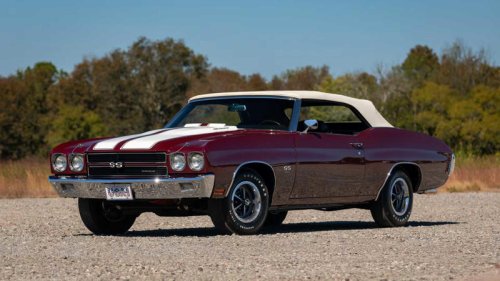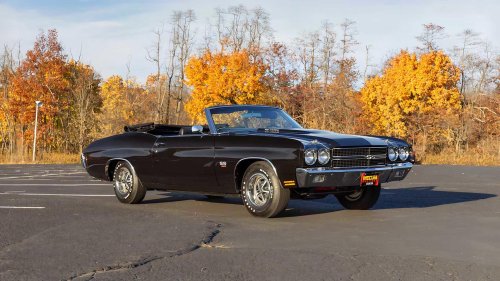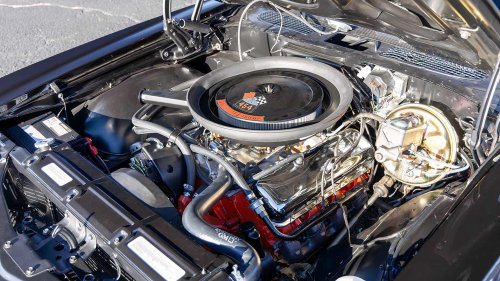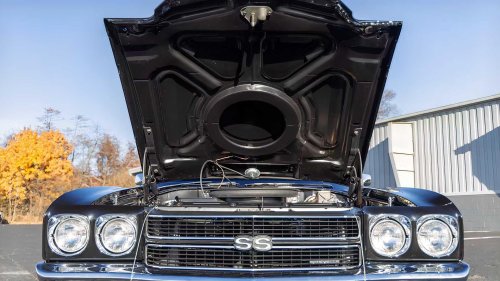
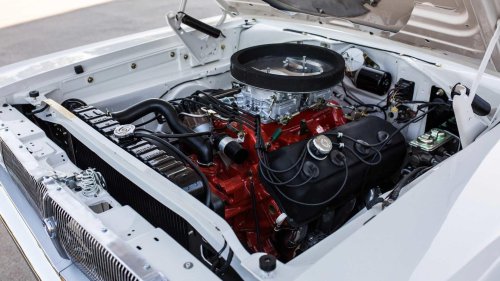
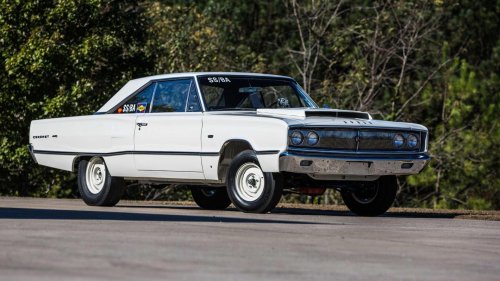
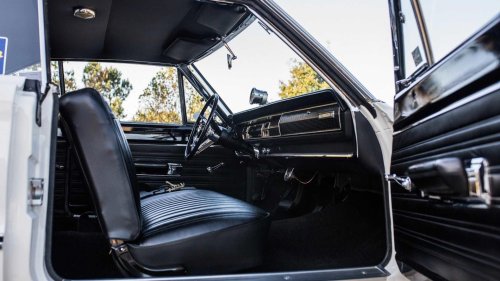
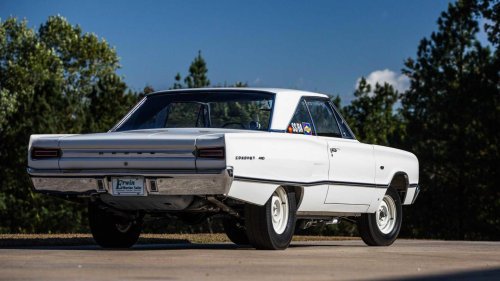
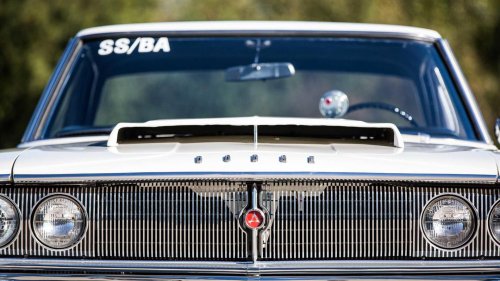



















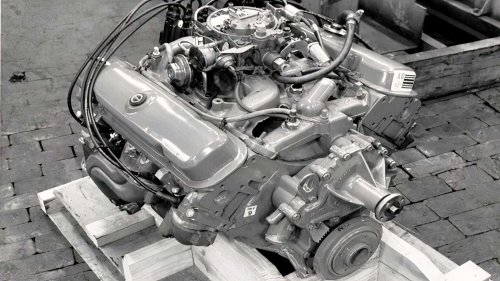
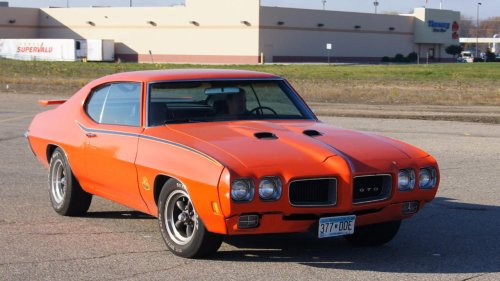

Today, high-performance special editions are downright tame on the highway. They offer full infotainment systems, air conditioning, and cruise control. But things weren’t always this way. In the 1960s, speed required sacrifice. The wildest muscle car-era special editions were bare-knuckle street bruisers.All the major Detroit automakers offered racing-ready special editions that buyers could almost drive straight from the dealership to the drag strip. But one company decided to pull out all the stops. It shut down its factory assembly line for an entire Sunday to carefully handcraft 55 speed machines. These wild special editions are still nearly impossible to catch on the drag strip. And it’s harder still to track down one for sale. Detroit Muscle-Era Special Editions Were Bonkers MecumDuring the Detroit muscle car wars of the 1960s and 1970s, there were several special editions that achieved near mythic status. For example, Chevrolet built the LS6 Chevelle to compete with Plymouth’s Hemi ‘Cuda and Ford’s Mustang Boss 429. Then it released a convertible version of the LS6 Chevelle. But so few customers ordered the configuration, experts still can’t agree on how many were built.On the Ford side, Carroll Shelby offered a race-prepped Mustang GT350. The resulting Ford Mustang GT350R even came with a roll cage, but between 34 and 36 were built.Finally, in Corvette land, one special edition stands above them all. Chevrolet only built 20 editions of its 1967 Corvette L88, with their 7.0-liter 427 V8. Today, only 16 are still on the road. While Ford and Chevrolet were building their own special editions, Dodge was cooking up one of the greatest factory-built drag racers of all time. Mopar Had A Big-Block Problem MecumDodge developed the 426 Hemi to dominate the 1964 NASCAR season. But only its largest cars could handle the “elephant” engine. And soon, that became a major marketing problem.The same year the Hemi dominated Daytona, Ford launched the Mustang. Buyers couldn’t get enough of the nimble, V8-powered Pony Car segment. Dodge realized it had been racing in the wrong direction. In 1966, Dodge debuted the “Street Hemi” at dealerships, but couldn’t fit its best engine in its lightest, nimblest cars.Some dealerships (i.e. Mr. Norms) pulled small-block V8s out of A-Body Darts and shoehorned big-block V8s into the engine bay. Meanwhile, Dodge corporate began developing the E-Body chassis (which would become the 1970 Challenger and Barracuda), just large enough to safely fit a 426 Hemi, but just small enough to compete with a Mustang or Camaro. The resulting car would sweep the 1970 NHRA Pro Stock World Championship. But in the meantime, Mopar needed something to offer street racers. Its solution was to put one of its biggest cars on a drastic diet. The result was an absolute unicorn. 1967 Dodge Coronet 440 Super Stock W023 A Muscle-Era Special Edition That’s Nearly Impossible To Track Down MecumThe Dodge Coronet 440 Super Stock car (also known as the WO23 package) and its Plymouth Brother, the Belvedere II Super Stock (RO23) are Mopar legends. As much for their incredible output and performance numbers as for their Holy Grail-like rarity. Mopar made just 55 of each car.The WO23 (and RO23) started life as stock coupes equipped with the new 426 cubic-inch “Street Hemi.” This was Dodge’s NASCAR engine with a street-friendly tune and cost-effective components which dropped its compression from 12.25:1 down to 10.25:1. The regular Street Hemi was rated at 425 horsepower and 490 lb-ft. But the Mopar engineers behind the WO23 didn’t leave the V8 stock alone.MecumThe WO23 also got larger 750-cfm Carter AFB carburetors and a modified intake (complete with huge hood scoop), likely pushing its factory output much higher. But that’s not all. Mopar also included a Prestolite transistorized ignition setup and short Hooker headers, which dumped the exhaust out just behind the first row of seats. These last two components were tossed in the trunk for buyers to install later. Mopar never published a revised horsepower or torque rating for its W023 cars. But there are some telltale signs that it was a gnarly build.Dodge did offer 1967 Coronet Super Stock cars with either a built-up 727 TorqueFlite automatic or a four-speed manual. The latter was an iron-case A864 that was by far the less popular transmission. Some sources say there were only 11 manual Dodge WO23s built in 1967.With all the extra torque on tap, Mopar was worried about aggressive shifting destroying drivetrain components. So worried, in fact, that it upgraded stick shift cars to the Dana 60 rear end. The result was 50 pounds heavier than the automatics’ built 8-3/4 axle, but much beefier. Both configurations came with a Sure Grip differential set up with 4.88 gears. The WO23 Was A Sunday-Built Drag Race Special MecumIf you’d been at Chrysler’s Lynch Road Detroit plant on Sunday, February 12th, 1967, you would have noticed something odd. The line slowed down while the weekend shift assembled just 110 full-size cars. Each one was a coupe, each one painted white, with basic white steel rims. If you looked closer, you might have thought the workers were sleeping on the job: they were leaving out many of the things that make a car a “car.” But the Mopar factory was actually firing on all cylinders. It was assembling the WO23 and RO23.One dead giveaway of a fake 1967 Dodge WO23 or Plymouth RO23 is the date on its fender-mounted trim tag. All 110 genuine cars rolled off the line on February 12th. Another dead giveaway would be any basic creature comforts. They didn’t have a radio, or even a heater. These cars had a thinner carpet than normal with no sound deadeners beneath. Inside was a black vinyl bench seat, the lightest interior available.The rest of the build was even more bizarre, everything optimized to plant weight firmly over the rear wheels, while keeping it off the front. The drag-race-oriented cars had no sway bar. The full-size car torsion bars up front were tossed and replaced with lightweight units from Dodge’s compact Dart. Other Mopars with the Street Hemi got big police-grade brakes. But not this Super Stock. The WO23’s front drums were downsized to little 10-inch units. This was not a car you wanted to take on a road course.The rear end of the W023 was a completely different story. The rear wheels got bigger 11-inch brake drums, adding 10 pounds over each tire. In the trunk was a massive 90-pound “performance” battery. The entire car was engineered to put its 425+ horsepower down to whatever racing slicks the buyer installed. Tracking Down A 1967 Dodge Coronet W023 Or Plymouth Belvedere II RO23 Super Stock MecumToday, genuine Dodge Coronet Super Stock WO23s are as rare as hen’s teeth. But when they do pop up for sale, they don’t command the multi-million-dollar price tags that other special edition muscle cars do.In January 2015, VIN W023J71207508 sold at auction for $102,000. VIN W023J71201848 crossed the Mecum auction block in 2018 and 2019, receiving a high bid of $85,00 and not selling. In 2024, VIN W023J71201089 sold at auction for $125,00. In 2025, VIN W023J71202773 received a $75,000 high bid but didn’t sell.The R023 1967 Plymouth Belvedere II Super Stock is equally rare, but worth even less. In 2016, VIN R023J71202505 sold for $84,700 and VIN R023J71206035 went for $80,000. VIN R023J71206021 sold for $93,500 in 2026.