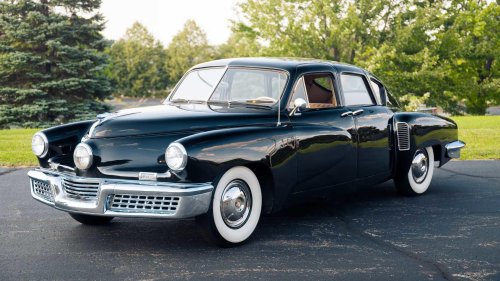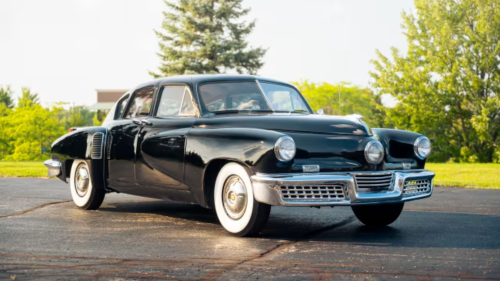
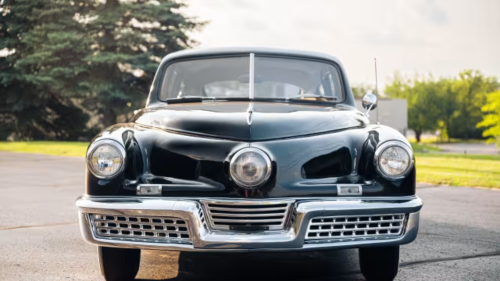
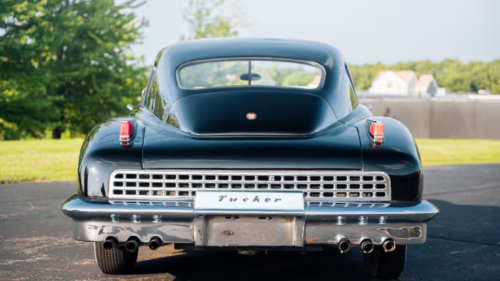
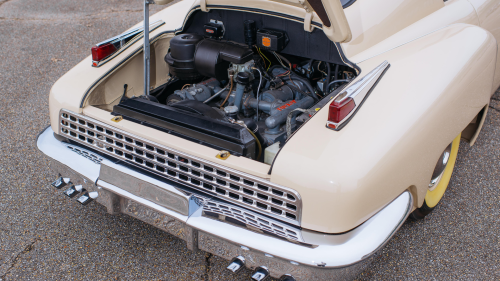
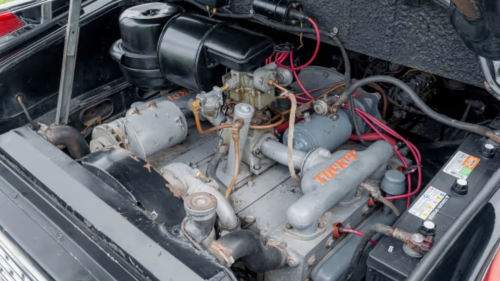
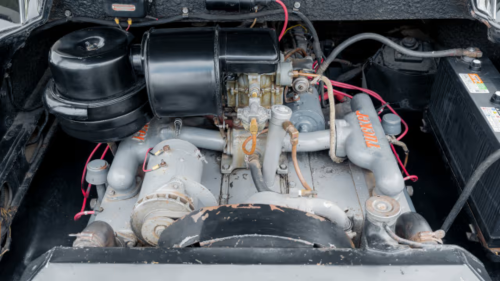
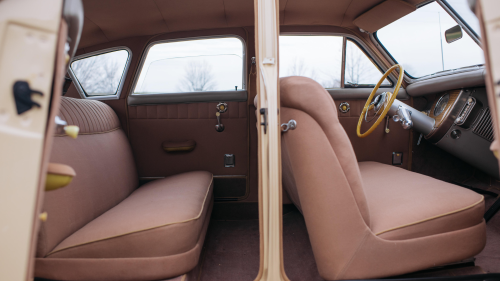
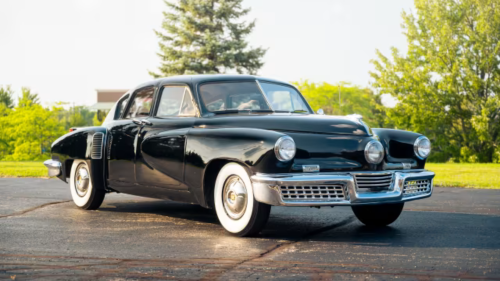
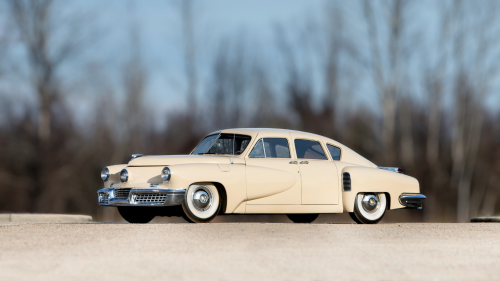
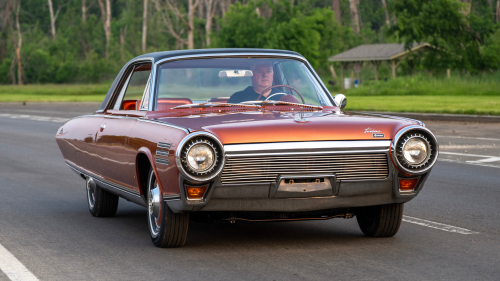
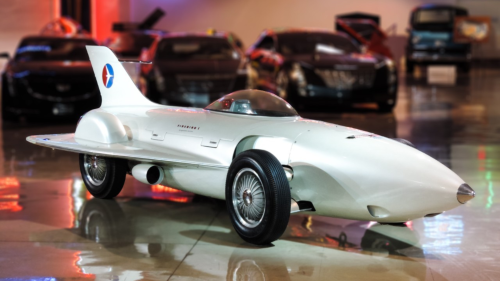


















In the years after World War II, America's auto industry was booming and car culture was growing, but innovation was scarce. Detroit's Big Three were content to churn out reheated prewar designs while the public craved something fresh.Into that stale atmosphere stepped a visionary who refused to play by their rules. His creation wasn't just another automobile. No, it was a machine born from aviation, packing technology more at home in an aircraft than a family sedan.This aircraft-inspired automobile promised safety, speed, and a future unlike anything Detroit dared to imagine. However, when you threaten giants, the backlash comes hard. What followed was a saga of ambition, innovation, and betrayal that left behind one of the rarest American cars ever built. Here's the full story of the machine that Detroit just couldn't let win. Meet The Car Detroit Didn’t Want To Exist via Mecum Americans were hungry for innovation in the post‑World War II era, and maybe none more so than Preston Tucker. An automotive entrepreneur, Tucker unveiled his audacious dream to revolutionize the nation's roads in 1946. Originally nicknamed the Tucker Torpedo, this car was so radically advanced that it highlighted the complacency of the more conservative Big Three.With his innovative nature, Tucker wasn't content to tweak the familiar. No, he wanted to spin the automotive scene on its head. Tucker planned to do this through a rear‑engine layout, pop‑out safety windshield, padded dash, perimeter frame with integrated roll bar, and a swiveling "Cyclops Eye" headlight that turned with the steering. So, no, this was no cookie-cutter design.via Mecum Ford, GM, and Chrysler, the giants of Detroit, were asleep at the wheel, churning out pre‑war models while the public craved something new. The concept of the Tucker Torpedo alone threatened their mindset.While the concept of the Tucker Torpedo was designed in Michigan, Tucker launched full production of the Tucker 48 in Chicago. According to TuckerClub.org, the Tucker 48 was only called the "Tucker Torpedo" during the design and promotion stage. Therefore, no Tucker Torpedos were ever built, only the Tucker 48, named for its model year.via Mecum Interestingly enough, according to Collectors Auto Supply, Tucker raised over $20 million before a single car rolled off the line. Tucker's strategy was to win the war for public enthusiasm before mass production even began. While he did garner quite the following, he also faced immediate backlash. According to Wired, Tucker and his "Car of Tomorrow" design were up against not only the big three, but they also faced media skepticism, SEC investigations, and whispers of conspiracy.The Tucker 48 was more than a car. It was a statement. A visionary challenge to Detroit's hegemony. And that's why Detroit didn't want it built. The Helicopter Heart Of The Tucker 48 via BonhamsWhile the Tucker 48 was plenty innovative, with many of its key features becoming standards in modern cars, nothing was more innovative than its engine.In the creation of his "Car of Tomorrow," Preston Tucker turned to a helicopter engine. According to The Drive, the Franklin O‑335 was built by Air Cooled Motors and intended for the Bell 47 Helicopter. Tucker had it converted to a water-cooled setup for the Tucker 48.via Mecum Tucker 48 Specs Tucker’s engineers stripped the O-335 aero engine down and left almost nothing stock on the block. The team of Tucker engineers swapped the magneto for a conventional distributor, ditched fuel injection for a carburetor, and revamped it with a water‑cooling setup. The result was a flat-six that produced 166 horsepower and 372 lb-ft of torque for the Tucker 48.via MecumThis engine setup also allowed the Tucker 48 to sprint from 0 to 60 mph in about 10 seconds. And, with the ability to reach a top speed of 120 mph, it slapped the Big Three’s torpid 100‑horse sedans right off their tailpipes.But such brilliance made Detroit see red. According to Hagerty, the FBI raided Tucker’s Chicago plant. The SEC dragged the company through legal hell, and though Tucker was eventually acquitted of all charges, the damage was done. He never recovered financially, and only 51 Tucker 48 models ever emerged from that dream factory.This wasn’t just a car. It was a flying-car hybrid, a safety manifesto, and, for Detroit, a threat they just had to railroad into history. How Much Does A Tucker 48 Cost Today? via BonhamsPreston Tucker probably never dreamed his "Car of Tomorrow" would someday fetch seven figures. Or maybe he did. He was always one to dream big. Regardless, the Tucker 48 routinely racks up over a million dollars whenever one graces the auction block today.According to Classic.com, the lowest sale recorded for a Tucker 48 in the last five years was $1.4 million, while the top sale recorded was $1.7 million. These figures are a far cry from the Tucker 48's original MSRP. Per J.D. Power, a Tucker 48 sold for just $2,450 in 1948, which is equivalent to around $33,000 in 2025. Market Prices: Here's How Much A Tucker 48 Costs Today Source: Classic.com With only 51 ever built, scarcity remains a driving factor among collectors. Not to mention the Tucker 48 isn't just a classic, it's a rolling manifesto of innovation that was well ahead of its time. While not too many Tucker 48's roll across the auction block, when they do, they certainly demand respect.Just take a look at this stunning Tucker 48 finished in black. With only 35,575 miles on the clock, this 1948 model sold for $1,700,000 via Mecum in January 2024.via Mecum Another stunner is this beige Tucker 48 with just 2,931 miles on the odometer. This 1948 model sold for a staggering $1,985,000 via Bonhams in April 2019.via Bonhams For collectors and gearheads alike, the Tucker 48 isn’t just a car. No, it’s a million-dollar symbol of the dream Detroit tried to bury. Other Cars That Borrowed Aircraft Technology When it comes to audacious automotive innovation, the Tucker 48 wasn't the only rebel. Two other standout beauties were prototypes, both designed to harness the roar of aircraft engines to push the boundaries of what a car could be. Meet The Chrysler Turbine Car via Stellantis MediaBuilt from 1963 to 1964, Chrysler's Turbine Car was the golden child of the jet age. This innovative automobile was a two-door coupe that featured an Italian-styled body. However, its most magnificent feature was its truly exotic heart: a gas turbine engine originally born from aircraft engineering.The Chrysler Turbine Car was built in chassis workshops and assembled in Detroit. According to Hagerty, only 55 were ever made, including five prototypes and a public test fleet. This turbine-powered beast could run on almost anything, from gasoline to kerosene to peanut oil. Plus, it required far fewer moving parts than piston engines, offering silky smooth operation and remarkable durability.However, the Chrysler Turbine Car wasn't all glory. The turbine's sluggish acceleration, noisy hum, and poor fuel economy ultimately became its downfall. Thus, the mass production of this aircraft-inspired automobile never materialized. Meet The GMC Firebird I via the GM Heritage Collection Built in 1954, the GMC Firebird I was far less of a car than it was a speedy science experiment. It featured a fiberglass-reinforced body styled like a sleek fighter jet. According to the GM Heritage Collection, its aircraft-derived engine stemmed from a Whirlfire gas turbine engine that could produce a staggering 370 horsepower.Unlike the Chrysler Turbine Car or the Tucker 48, this aircraft-inspired automobile was never meant for dealerships. Conceived by GM styling legend Harley Earl, the Firebird I was simply a rolling concept nailed together in the name of what could be.These turbine-powered legends didn't just borrow aircraft parts. They were unyielding statements, showcasing that the future belonged to the bold. And while they never became mainstream, their echoes can still be heard every engine bay that dares to dream beyond the piston.At the end of the day, the Tucker 48 stands as more than a quirky postwar experiment. It serves as a reminder of what happens when the bold dare to out-dream the establishment. Preston Tucker borrowed from the skies, bolted a helicopter engine into a family sedan, and in doing so built a car that terrified Detroit's giants.There's no denying that the Big Three buried it. However, they couldn't erase its legacy. Today, every million-dollar Tucker 48 that crosses the auction block showcases that the future has always belonged to the boldest ideas, even if the world wasn't quite ready for them yet.Sources: Classic.com, Collectors Auto Supply, GM Heritage Collection, Hagerty, J.D. Power, MotorCities National Heritage Area.