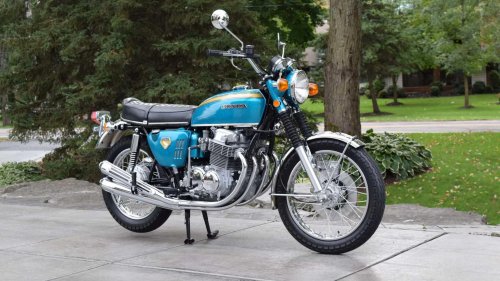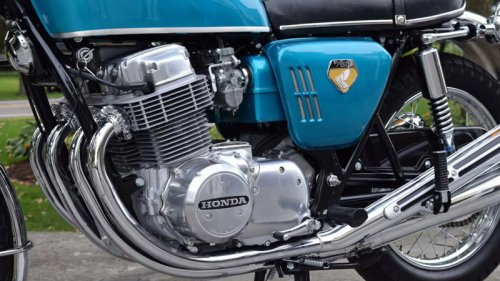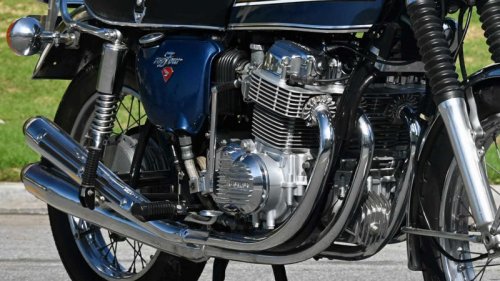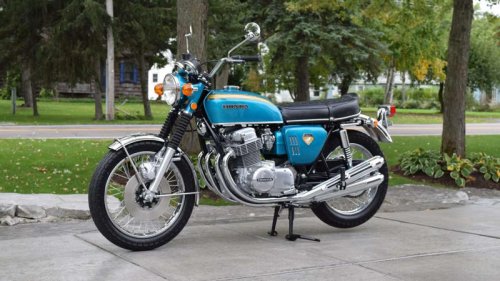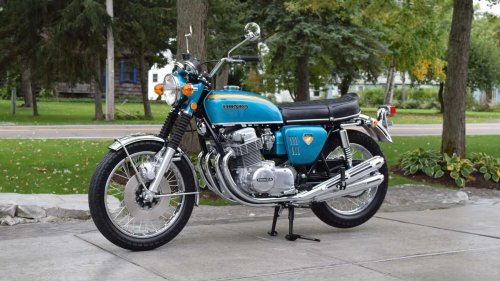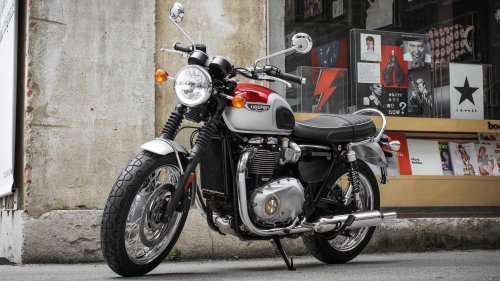
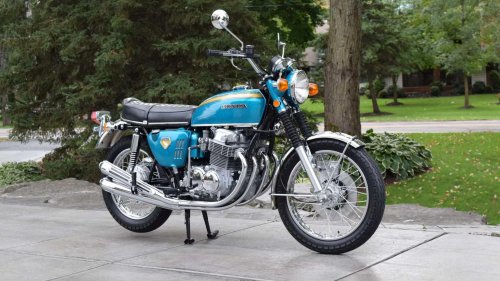
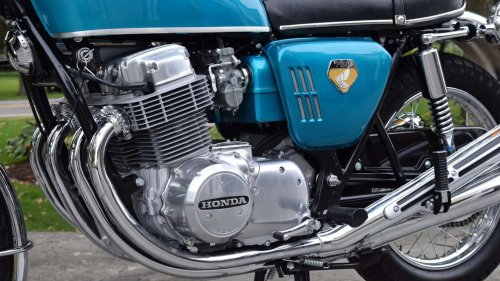
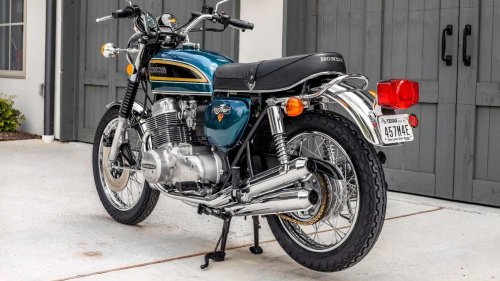
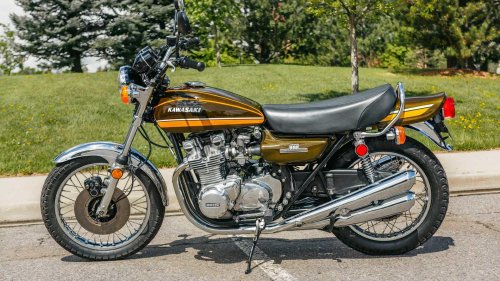
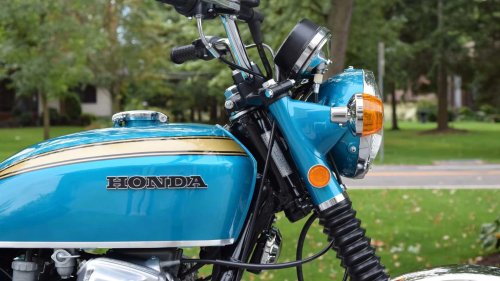

















By the late 1960s, the motorcycle world had settled into a comfortable order. Britain built fast bikes. America built the big ones. Germany built the dependable ones. Japan built small, practical commuters that nobody in the serious riding community took particularly seriously. Then a machine arrived from Honda that invalidated almost every assumption the industry had made, in one product, at a price that made the British look almost absurd. It was not the fastest thing available on paper. It was not the most powerful. But it packaged things together in a way that had never been attempted on a mainstream production motorcycle, and when riders got on one for the first time, the reaction was consistently the same: nothing had prepared them for it. When The British Ruled The Road Triumph Motorcycles In 1969, if you wanted a serious motorcycle, you bought British. Triumph's Bonneville T120 was the benchmark twin, a 649cc parallel-twin producing around 46 hp that could push its rider past 110 mph. BSA and Triumph had just jointly launched their 750cc triple, the Rocket 3 and Trident, producing 58 hp and recording 117 mph in period testing by Cycle World. Norton's Commando 750 had just won Motor Cycle News Machine of the Year. These were fast, capable motorcycles, ridden by people who genuinely knew what they were doing, and the British industry had held the performance crown for decades.The problem was that all of these machines shared certain characteristics. They vibrated. They leaked oil. They required constant fettling to stay on song. Their electrical systems were famously unreliable. Kick-starting was the only option on almost all of them. And every single one ran on a parallel-twin or triple configuration that, however characterful, had a ceiling on smoothness that the laws of physics made difficult to overcome. Riders accepted this as the cost of performance. They assumed it was simply the nature of the thing. Nobody seriously expected that to change.Something was coming that would challenge every one of those assumptions simultaneously, and it arrived with four carburetors and a button on the right handlebar that started the engine without any effort at all. The Honda CB750 Four: What It Costs To Own a Revolution MecumThe motorcycle that ended British dominance was the Honda CB750 Four, launched in the US in January 1969 at $1,495. For context, that was less than Triumph was charging for its 650cc twin.As the table shows, the K0 Sandcast is the clear collector premium at the top of the market. Honda, uncertain about demand, initially used a less expensive gravity-cast process for the first 7,414 bikes, producing the rough-textured engine cases that collectors now call "sandcast." When demand exploded, Honda switched to smooth die-cast molds. Those early sandcasts are now the holy grail. A numbers-matching example in concours condition can reach $44,500, and a prototype sold at Mecum's Las Vegas auction in early 2025 for $313,500, setting the record for any Japanese motorcycle ever sold at auction.For riders rather than collectors, the K1 through K3 models (1970 to 1973) represent the practical sweet spot. Mechanically near-identical to the K0, they are significantly cheaper to buy, parts availability is strong, and the diecast engines are generally considered more robust than some of the early sandcast examples. A good K2 or K3 in the $8,000 to $13,000 range gives you the full CB750 experience without the collector anxiety that comes with owning a sandcast.Values across the entire CB750 range have more than doubled since the mid-2010s, according to market data. What was once a $2,500 runner can now cost $6,000 or more. The market has recognized what riders figured out in 1969: this machine was genuinely important. Performance: Numbers That Rewrote the Rules MecumThe CB750's 67 hp figure looks modest against modern standards, but in 1969 it was 15 percent more power than the BSA Rocket 3 at the same 750cc displacement, delivered in a package that weighed roughly the same. More significantly, it achieved that output through an inline-four configuration that ran to 8,500 rpm, against the pushrod British engines that felt ragged above 7,000. The four's power delivery was progressive and linear in a way that a twin or triple simply could not replicate.The 0-60 figure of 7.5 seconds placed the CB750 at the front of the class. The BSA/Triumph triple was actually quicker off the line in some period tests, reaching 60 mph in around 5.6 seconds, but the Honda's power band meant it caught and passed the British machines before the quarter-mile ended, with Cycle World recording 125 mph flat out against 117 mph for the Rocket 3. The Norton Commando's 13.4-second 0-60 time illustrates just how much ground the British parallel twin had lost.Then there was the braking. The CB750 was the first mass-produced motorcycle to come with a hydraulic disc brake at the front as standard equipment. On a machine capable of 125 mph, that mattered. The British bikes were still running drum brakes on both ends, and while the Norton's drums were competent, the Honda's disc set a standard the entire industry eventually had to follow. Why Four Cylinders Won Mecum Honda's engineers approached the CB750 with a specific mandate from Soichiro Honda himself: build an engine producing one more horsepower than Harley-Davidson's 1,300cc flagship. The result was 67 hp from 736cc, using technology derived directly from Honda's GP racing program, including a single overhead cam and four individual Keihin carburetors. That racing lineage matters because it explains why the inline-four had such a clear technical ceiling above what the British could manage.A parallel twin or triple at 750cc has combustion chambers that are necessarily large relative to a four-cylinder layout at the same displacement. Larger chambers mean slower, less complete combustion. Smaller chambers, as found in a four, allow for faster ignition of the fuel charge, more complete combustion, and consequently higher efficiency at a given rpm. The British engineers knew this. What they lacked was the manufacturing scale to produce an inline-four at a price the market would accept.Honda had that scale. The company was already the world's largest motorcycle manufacturer by volume, with the profits from millions of Cubs and Super Hawks funding development. It could tool up for a complex four-cylinder engine where Triumph and BSA, facing financial difficulties throughout the late 1960s, simply could not. The British triples were an attempt to bridge the gap, adding a cylinder to existing twin architecture, but the BSA Rocket 3's prototype had been ready by 1965 and was delayed for years awaiting cosmetic redesigns. By the time it reached market in 1969, it was already competing against the CB750 rather than arriving ahead of it.The smoothness differential was equally significant. The CB750's inline-four had inherently better primary balance than any parallel twin, and its higher-revving nature meant power was delivered with a consistency that British engines could not match. Cycle Magazine called it "the most sophisticated production bike ever" at its introduction. That verdict was not hyperbole. What the CB750 Started: and What to Look For Today Bring A Trailer The CB750 created the term "superbike". It did not inherit the term from somewhere else, and no marketing department invented it to sell something average. When journalists and dealers needed language for what Honda had built, they reached for a new word because the existing vocabulary was not adequate. Every inline-four performance motorcycle produced since 1969 traces a direct line back to what Honda proved was possible. The first and most important of those successors arrived just three years later. The Kawasaki Z1: The Student Becomes the Teacher Bring A Trailer Kawasaki had been working on its own 750cc four-cylinder since the late 1960s, internally codenamed "New York Steak," when Honda announced the CB750 at the 1968 Tokyo Motor Show. Rather than rush to market with something smaller, Kawasaki shelved the project and spent three years enlarging the engine to 903cc so it could arrive as the more powerful machine. The strategy worked. When the Kawasaki Z1 went on sale in 1972, it produced 82 hp at 8,500 rpm and topped out at 130 mph, making it the fastest production motorcycle in the world. It was also the first large-displacement production bike to use a double-overhead-camshaft layout, a configuration the CB750's single-cam engine could not match for ultimate output.The Z1 won Motor Cycle News Machine of the Year four years running from 1973 to 1976, and set a 24-hour FIM and AMA endurance record at Daytona in 1972, covering 2,631 miles at an average of 109.64 mph. At $1,895 it cost $400 more than the CB750, but contemporary road tests put it clearly ahead on outright performance. Where the CB750 had proven the inline-four concept, the Z1 showed how far it could be pushed. The two machines are inseparable in the history of the format: one opened the door, the other walked through it and kept going. The CB750 Today: Legacy, Track Record, and What to Look For Mecum On the track, the CB750's reputation was established fast. Dick Mann won the 1970 Daytona 200 on a factory-prepared CR750, the race version of the production bike, in front of the manufacturers whose lunch Honda had just eaten. Honda's production targets tell the rest of the story: initial forecasts of 1,500 units per year became a monthly figure within months of launch, and even 3,000 units per month was not enough to satisfy demand.For buyers today, a few things are worth knowing. Original four-into-four exhausts are a key value indicator; they rusted at the header-muffler weld and many were discarded, so a bike with intact, correct pipes is worth more. Sandcast cases carry the greatest premium but are also the most inspected at purchase, so have the engine numbers and case features verified by a marque specialist before paying sandcast money for what might be an early diecast. The sandcast's unique markers include rough-textured cases, ten clutch cover bolts (not eleven), and straight-cut fender edges.The K7 and K8 models from 1977 to 1978 are often overlooked and trade at around 35 percent less than equivalent K0 to K6 examples, despite having some of the lowest production numbers in the run. They also gained a dual front disc setup and Comstar alloy wheels, making them arguably the most capable riders in the original SOHC family. For anyone who wants to actually use a CB750 rather than display it, they remain one of the better-value entries into classic Japanese motorcycle ownership.Sources: Hagerty, Motorcycle Classics, Cycle World, Bring a Trailer, Honda Global, Mecum.