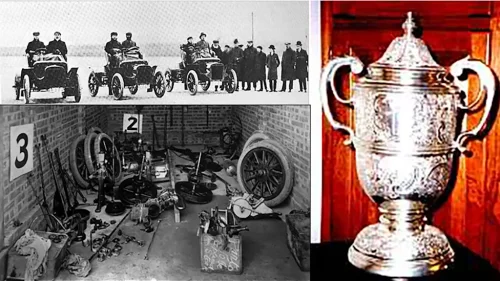
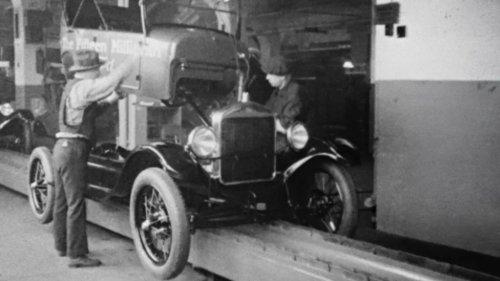
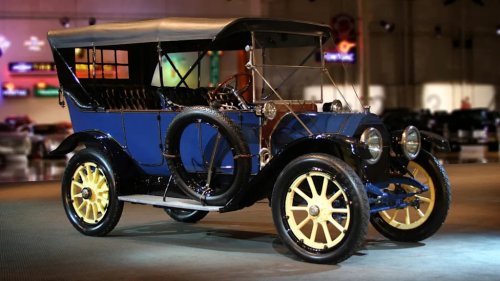
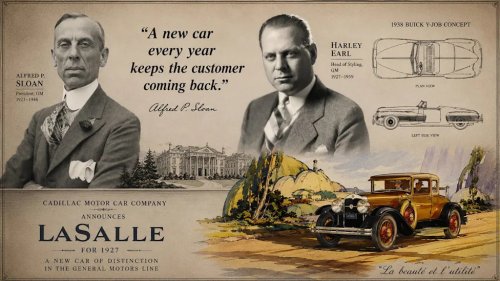
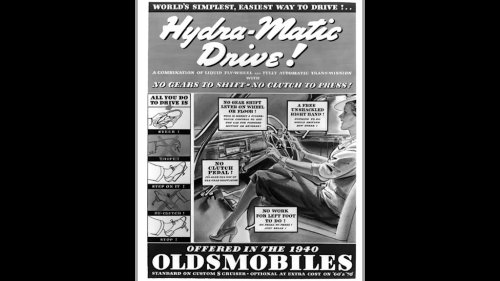
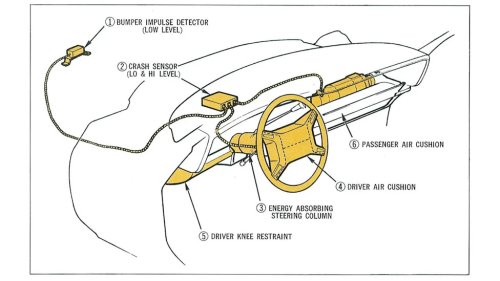
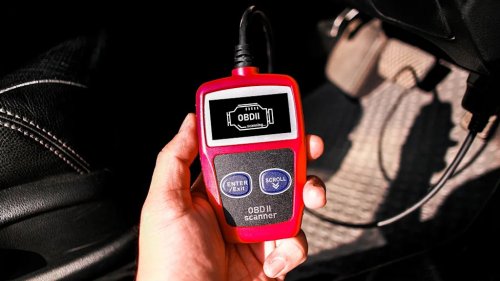
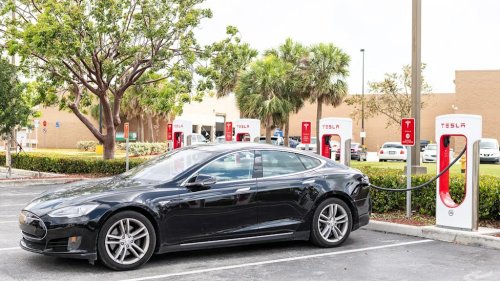



















12 of the Greatest American Automotive InnovationsMotorTrend - MotorTrendAmerica may not have invented the car—Nicolas-Joseph Cugnot was steaming around France in 1769, and Karl Benz first chugged around Manheim Germany in his one-banger Patent Motorwagen in 1886. But American ingenuity has certainly helped perfect the concept of automobility in the years since. Herewith we present a grossly incomplete list of 12 of the greatest American automotive innovations.1) Precision Interchangeable PartsPhoto credit: General MotorsCadillac did much to earn its early Standard of the World tagline in early 1908, all the way over in England. It was there that the Royal Automobile Club plucked three identical, stock Model K cars from the London Cadillac dealer, along with some 89 service repair parts. The three were driven to the then brand-new Brooklands racetrack, where they did 10 laps. They were then disassembled and reassembled using stock parts intermingled with the replacement parts. Miraculously (for the day), the reassembled cars lapped the track again. One even survived a reliability run, earning Cadillac the Dewar trophy (given by the lord of the Scotch brand). Advertising touted tolerances as close as 1/1,000 of an inch (a manufacturing habit founder Henry Leland picked up in his earlier career manufacturing machine tools and firearms).2) Moving Assembly LinePhoto credit: getty images - Getty ImagesBelieve it or not, the "disassembly" of animal carcasses hanging from overhead trolleys in Chicago's meat-packing plants helped inspire the moving assembly line, which Henry Ford first tried out with magnetos in April 1913—dropping the assembly time of that part from 20 to 13 minutes. By that October, a 150-foot line was opened with workers towing car chassis via rope. This was upgraded to a chain in January 1914, and eventually vehicle assembly time dropped from 12.5 hours to 93 minutes. But each job on that line became repetitive and grueling, which led to high turnover. The fixes for that were two more great automotive innovations: the $5/day wage and the eight-hour workday. Between manufacturing cost savings (which dropped the price from $850 in 1908 to $360 in 1916) and the increased wages, workers could finally afford to buy the cars they were building.3) Electric Self-StarterPhoto credit: General MotorsDriving was a manly pursuit in the early days, as crank-starting an engine required serious muscle. It was dangerous, too. When a personal friend of Cadillac founder Henry Leland's died from injuries sustained trying to start a Cadillac, Leland approached electrical engineering inventor and the founder of what became Delco, Charles Kettering, to develop an electric starter. His invention connected to the flywheel via a planetary reduction gear, and after starting, the same armature served as the engine's generator, powering the ignition and a much-improved lighting system. In that way, it presaged both the modern mild hybrid starter/alternator and those funny-sounding gear-reduction starters Chrysler used in the '60s and '70s. It also opened motoring up to women (dooming the nascent electric car niche) and won Cadillac its second Dewar trophy.4) Annual Model ChangePhoto credit: MotorTrend - MotorTrendAdvertisementAdvertisementNot all automotive innovations are mechanical. The industry used to work like modern-day Tesla: New ideas were implemented whenever they became available, and the looks seldom changed unless needed for an engineering upgrade. When Alfred P. Sloan took over GM in the 1920s, Ford had saturated the market. Fewer folks were buying cars out of need, so he needed to make them want a new car. He started with the "car for every purse and purpose" price ladder branding concept, and then in 1927 hired Harley Earl to start an Art & Colour Section with a mandate to generate annual noticeable alterations to grilles, hood lines, trim, and colors that might motivate buyers to get what looks newer. The 1927 LaSalle is often regarded as having started this trend. By turning automobiles into fashion goods with regularly changing styles, GM may have introduced the most economically significant automotive innovation ever conceived.5) The Automatic TransmissionPhoto credit: General MotorsThe self-starter removed one major pain point of driving, but GM set out to eliminate the other big one: manual clutching and shifting. In the early 1920s it tested an electric transmission where the engine drives a generator that powers an electric drive motor, but expensive copper and inefficiency doomed this "series hybrid" approach. Then it tried transferring power through rollers squeezed between two facing toroidal discs (picture the halves of a donut mold). Metallurgy and lubricant tech wouldn't make this practical until the 1990s (Nissan Extroid). Finally, in 1940 GM figured out a way to automatically shift constant-mesh planetary gearsets similar in principle to those operated by Model T drivers with pedals. Putting a fluid coupling ahead of it allowed the engine to keep spinning at a stop, and bam: Hydra-Matic. The first ones were four-speeds because a fluid coupling can't multiply torque. Meanwhile, Buick developed the Dynaflow, which relied primarily on a torque converter for seamless acceleration, rarely shifting its two-speed planetary gearbox. Marrying the torque converter with multi-speed planetary gearsets gave us Powerglide in 1950 and the thoroughly modern Turbo-Hydramatic in 1964. Ford-O-Matic and Chrysler PowerFlite arrived in 1951 and 1954, and Chicago-based Borg6) High-Compression OHV V-8 ArchitecturePhoto credit: MotorTrend - MotorTrendIt's hard to overstate the engineering might of General Motors. Between experience gained arming the arsenal of Democracy and Charles Kettering's GM Research organization feeding the divisions cutting-edge research results in fuels, lubricants, combustion, and metallurgy, GM got out in front of the world on affordable high-performance engines. Cadillac's 331-cubic-inch entry was first up in 1949, featuring high compression (for the day, 7.5:1), overhead valves, and a short stroke with bore spacing to permit enlarging displacement. Weighing roughly the same as the flathead, it was vastly more powerful.The 1949 Oldsmobile 303's independent design optimized for medium-priced cars and high performance featured different bore spacing, combustion chamber design, and its own crankshaft. It instantly dominated NASCAR. After helping design Cadillac's V-8, Ed Cole got transferred to Chevrolet in 1952, where lessons learned helped him make the 1955 265-cubic-inch small-block lighter, cheaper, sturdier, smaller, easier to manufacture, and more scalable. His concept of stamped steel rockers mounted to ball studs and lubricated via hollow pushrods slashed parts, assembly, and maintenance costs while preserving durability. Stamping the valve covers and timing chain cover set precedents Chevy's competitors quickly copied. No wonder the small-block architecture is still in production.7) Passenger-Car Power SteeringPhoto credit: MotorTrend - MotorTrendChrysler beat GM to the punch on one significant labor-saver—power steering—but the feature wasn't invented in house. Pierce-Arrow engineer Francis W. Davis first developed and patented a practical hydraulic power-steering system. Then GM hired him, but the war effort redirected his efforts toward heavy military equipment. After the war, Chrysler partnered with Gemmer Manufacturing, a Detroit steering-gear supplier that had worked with Davis and licensed his patents. From there, Chrysler engineers refined the concept from its mil-spec incarnation into a reliable, affordable, and manufacturable product, which the company dubbed Hydraguide, on the 1951 Chrysler Imperial. Cadillac, Buick, and Oldsmobile all offered power steering for 1952. Lincoln and Mercury matched them that same year, while Ford and Pontiac followed in 1953 and Chevrolet shortly thereafter. Soon the feature spread worldwide, helped along by suppliers such as Saginaw, Gemmer, and ZF.8) Cruise ControlPhoto credit: National Inventors Hall of FameAdvertisementAdvertisementThat terminology has become generic, but the father of the modern automotive cruise-control system, Ralph R. Teetor, originally called it Speedostat (makes sense—set and forget, like a thermostat). Others, including Frank Riley and Harold Exline, had pursued speed-governing devices, but it was the blind mechanical engineer, former SAE president, and president of piston-ring giant Perfect Circle who developed the first commercially successful version and secured the key patents. As a passenger, he's said to have noticed his attorney speeding up while talking, then slowing down while listening. Setting a car to travel at a constant speed would, he reckoned, improve safety, driver comfort, and fuel economy. But the companies adopting his invention all renamed it, starting with Chrysler Auto-Pilot in 1958, Cadillac Cruise Control in 1959, Ford's Speed Control in the early 1960s, and AMC's Cruise Command in 1965. The innovation spread more slowly in Europe and Japan, where few drivers enjoyed America's combination of long, straight expressways and road-tripping families eager to explore them.9) Catalytic Converter Implementation at ScalePhoto credit: getty images - Getty ImagesWe have the Los Angeles basin to thank for the catalytic converter. It was in this sunny, car-choked, mountain-fenced metropolis that photochemical smog was first recognized, studied, and chemically explained as the product of sunlight driving reactions between the cars' HC and NOx emissions—not chemical plants, refineries, incinerators, etc. California demanded change, Congress instituted the Clean Air Act in 1970, and by 1975, the first oxidation catalytic converter hit the road, developed by John Mooney and Carl Keith, working at Engelhard Minerals & Chemicals.It eliminated carbon monoxide and hydrocarbons but was poisoned by lead, meaning catalyst-equipped cars required unleaded fuel. NOx was addressed by the three-way catalyst, which entered limited production around 1979 and became the industry standard by 1981. This catalyst doesn't work on exhaust from lean or rich air-fuel mixtures, which drove the need for precise fuel injection and exhaust oxygen sensing systems to permit closed-loop fuel/emissions controls. America implemented this integrated emissions-control system well ahead of Europe and Japan.10) Airbag Commercialization and StandardizationPhoto credit: General MotorsPatents for automotive inflatable crash cushions were filed on opposite sides of the Atlantic in the early 1950s (Walter Linderer filed in Germany in 1951, John Hetrick in the USA in 1952). Neither was viable, because A) no effective crash sensor existed; and B) no compressed-gas system then available could inflate the bag quickly enough. Allen Breed solved the first problem in the mid-'60s, then GM took up the development torch, further developing the sensing, inflators, bag folding techniques, and integration into steering wheels and instrument panels.AdvertisementAdvertisementThe Air Cushion Restraint System was offered starting in 1974 as an option on selected full-size Cadillacs, Buicks, and Oldsmobiles, priced at just $225 ($1,620 today). Interestingly, the option eliminated both the shoulder belts (lap belts remained) and the unpopular seatbelt-starter interlock—a fact GM touted. But just over 10,000 were produced in three model years. Eventually, Americans' reluctance to wear seat belts led regulators to require passive restraints, initially allowing either automatic seat belts or airbags. By the late 1990s, airbags had become effectively universal in U.S. passenger cars, years before they achieved similar penetration in most global markets.11) The Self-Diagnosing AutomobilePhoto credit: getty images - Getty ImagesGetting cars to run clean (see catalytic converters above) was one engineering challenge. Getting them to do so, as California eventually demanded, for 50,000 or 100,000 miles was quite another. Mechanical systems struggle to maintain calibration over that interval, so electronic diagnostics were imperative. GM's Computer Command Control monitored the O2 sensor, electronic carburetor, spark timing, exhaust-gas recirculation, and torque-converter lockup, illuminating a check-engine light if anything went wrong. Into the 1980s car companies developed different ways to diagnose various electronics, but when California's OBD-I regulations took effect in 1991, vehicles had to monitor various systems and report errors by lighting a check-engine light and retaining a code, but no common diagnostic connector, communication protocols, etc. were specified.OBD-II then came along in 1996, standardizing all of that while adding an O2 sensor, evaporative-emission system, catalyst-efficiency monitoring, and misfire detection. This American standard became the foundation for global automotive diagnostics. Europe's EOBD and Japan's JOBD adopted the same connector, communication protocols, and generic diagnostic codes, allowing one scan tool to communicate with vehicles from virtually every major automaker.12) Modern Long-Range EV ArchitecturePhoto credit: getty images - Getty ImagesCars like the GM EV1, Nissan Leaf, Renault Zoe, and even the Tesla Roadster have long since proven that EVs were possible. The Tesla Model S proved they could be aspirational and mainstream. And that car established so many paradigms we now take for granted: a large structural floor battery inside a long wheelbase providing a low center of gravity; software-defined features with frequent over-the-air updates allowing the car to be continuously improved after purchase; and remarkable performance. Credit Elon Musk for the vision, but JB Straubel drove development of the battery pack, which proved commodity lithium-ion cells could propel a luxury sedan hundreds of miles, given proper thermal management, cell balancing, and power electronics. Of course, Musk's Supercharger-network solution to customer range anxiety deserves much of the credit for the company's success, as well.AdvertisementAdvertisementMotorTrend is proud to have bookended this list by awarding our Car of the Year calipers to both the 1949 Cadillac in recognition of its industry-changing new V-8 and to the 2013 Tesla Model S for revolutionizing electric mobility. Long may we continue to honor such innovation.