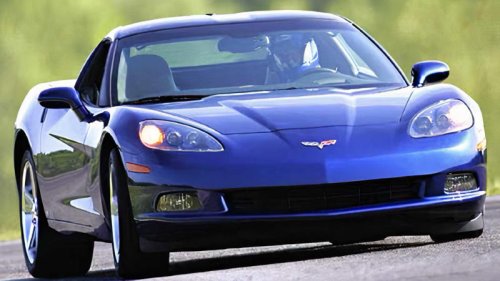
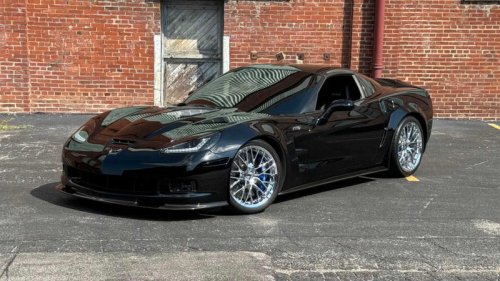
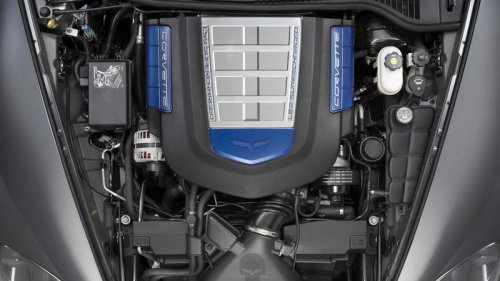
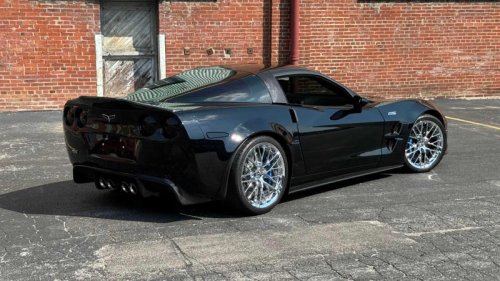
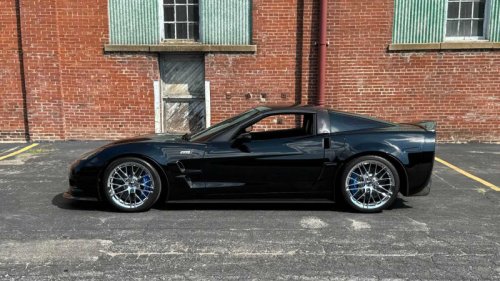
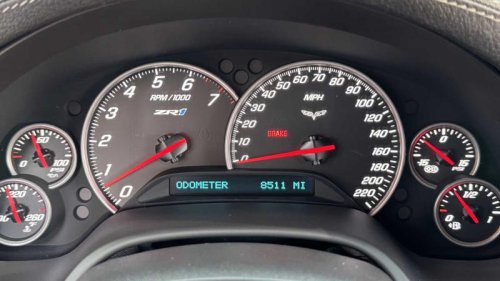
For most of the 20th century, American performance engineering operated on a simple principle: more cubic inches, more power. Displacement was the currency. The muscle car era ran on 7.0-liter V8s. Even by the 2000s, the benchmark Corvette Z06 made its 505 hp from a 7.0-liter LS7, a genuinely impressive engine but one that got there the traditional way. Europe and Japan had been chasing a different metric entirely: horsepower per liter of displacement, a measure of how efficiently an engine converts its swept volume into output. Ferrari, BMW, and Porsche had been operating above 100 hp per liter for years. Chevrolet had never been close.The car that changed it was announced at the Detroit Auto Show in January 2008, internally nicknamed the Blue Devil. GM engineers made the 100 hp per liter target public before the SAE-certified figures were available, which was a statement of confidence from a manufacturer that rarely made promises it could not keep. When the official numbers came back from certification three months later, they had not just hit the target. They had exceeded it. When Detroit Measured Power in Cubic Inches Chevrolet The 2006 C6 Corvette Z06 was the car Chevrolet built when it was trying to beat Ferrari and Porsche on the track. Its 7.0-liter LS7 produced 505 hp through a naturally aspirated pushrod V8 with titanium intake valves, a flat-plane crank, and dry-sump lubrication. It was a serious piece of engineering. At 72 hp per liter, however, it was still operating comfortably within the traditional American playbook.The European cars the Z06 competed against were doing more with less. A 2006 Ferrari 599 GTB made 620 hp from 6.0 liters, over 103 hp per liter. A Porsche 911 GT2 of the same era was over 100 hp per liter from a 3.6-liter flat-six. These were high-revving, purpose-built exotic engines that cost multiples of what GM charged for the Z06.The argument from Detroit was always that displacement made more sense at the price point. Achieving those specific output ratios in a pushrod V8 from an American manufacturer at a price below $110,000 had never been done. The engineering required to close that gap meant abandoning displacement-first thinking entirely and asking what a supercharger could do to a well-engineered small-block architecture. The 2009 Chevrolet C6 Corvette ZR1 and the 100 hp Per Liter Milestone MecumThe 2009 Chevrolet C6 Corvette ZR1 was the answer. GM's SAE-certified figures put the LS9 at 638 hp and 604 lb-ft from 6.2 liters, working out to nearly 103 hp per liter from a pushrod V8. That had never been done by an American manufacturer in a production car. GM announced the 100 hp per liter target publicly before certification, confident enough in the result to make it a headline figure. The certified number beat it by a margin.At $103,300, the ZR1 matched the Ferrari 599 GTB's specific output while priced less than a third of what that car cost. The Porsche 911 Turbo exceeded 100 hp per liter through its turbocharged flat-six, but at a smaller displacement and considerably higher price. The ZR1 did it from a 6.2-liter pushrod V8 that shared its fundamental architecture with engines sold in Chevrolet pickup trucks.The quarter-mile went in 11.3 seconds at 131 mph. Top speed was 205 mph. The Z06, which had been the performance benchmark in the Corvette range for three years, ran 11.2 seconds in the same test and topped out around 198 mph. The ZR1 was categorically quicker, and it did it through forced induction applied intelligently to a proven platform rather than by scaling displacement further. Period reviewers noted that it was the most fuel-efficient 600 hp car in production at the time, which is perhaps the most American-sounding European achievement in automotive history. Inside the LS9 Engine ChevroletThe LS9 is a 6.2-liter pushrod V8 with a 2.3-liter Eaton four-lobe Roots-type supercharger producing 10.5 psi of boost. The supercharger used a new four-rotor design that Chevrolet described as the first production application of this specific geometry, chosen for quieter and more efficient operation across a broad rpm range. An integrated charge cooling system reduces inlet air temperature before it reaches the combustion chambers. The block is aluminum with iron cylinder liners. The rotating assembly uses a forged steel crankshaft with a nine-bolt flange, titanium connecting rods, and forged aluminum pistons. Cylinder heads are stronger rotocast units with 2.16-inch titanium intake valves and hollow-stem sodium-filled exhaust valves for thermal management.The dry-sump oiling system runs a higher-capacity pump than the Z06's LS7 to handle the ZR1's additional cornering loads. Each engine was hand-built by a dedicated team at GM's Performance Build Center in Wixom, Michigan, the same facility that assembles the LS7. Engineers set a target of 100 hp per liter at the project's outset, which informed every specification decision from supercharger sizing to valve material. The LS9 was not a performance upgrade applied to an existing engine. It was a purpose-designed unit built around a specific output objective, and it achieved that objective with room to spare. Why the Number Mattered MecumBefore the ZR1, 100 hp per liter from a production engine was associated with European exotics and Japanese inline-fours. It required either high revving naturally aspirated architectures, forced induction, or both. The idea that a pushrod American V8, a configuration critics had described as outdated for decades, could reach that threshold was not taken seriously until the ZR1 proved it. The engine architecture that powered half of GM's truck lineup was capable of matching Ferrari's specific output when properly developed.The broader significance was competitive. A 2009 Ferrari 599 GTB cost approximately $310,000 and produced the same 103 hp per liter from its naturally aspirated V12. The ZR1's arrival confirmed that specific output was no longer a European exclusive, and it shifted how American performance engineering was discussed by the industry. GM did not need to apologize for the pushrod V8 after 2009. The architecture had simply needed the right application. The C6 Corvette ZR1 and What It Is Worth Today MecumThe C6 ZR1 is beginning to move. Current valuations place excellent-condition examples at $86,000, with concours cars reaching $123,000. Only around 4,700 C6 ZR1s were built across all model years from 2009 to 2013, making it genuinely rare relative to the base C6 Corvette.Of that number, a meaningful proportion were modified or tracked, which reduces the pool of clean, unmolested examples further. The 2009 model year carries the added significance of being the first, which matters to collectors. A low-mileage 2009 with documented service history and no modifications is the one the market will pay a premium for. C6 ZR1 Buying Considerations Mecum The LS9 is a well-engineered unit, but it is not maintenance-free at this age. The supercharger drive belt and associated components require inspection at established intervals. Carbon ceramic brake rotors, standard equipment on the ZR1, are expensive to replace and wear differently from conventional iron rotors. So, service history on this item specifically is worth investigating before purchase. The ZR1's magnetic ride control suspension uses dampers that can deteriorate with age and require specialist attention rather than straightforward replacement. Body panels are a mix of carbon fiber and fiberglass, and carbon parts are expensive to source correctly.The strongest buying guidance is to prioritize provenance over price. A ZR1 with complete dealer service records, original paint, and under 15,000 miles commands a premium that is justified by the difficulty of finding another one at the same standard. Market analysis suggests the C6 ZR1 is still in the early stages of collector recognition, which means the window to buy at current values may not remain open indefinitely. The car that broke a number nobody expected an American manufacturer to reach deserves more attention than it currently receives.Sources: Hagerty, Corvette Blogger, Classic.com, Mecum.



















 +81 others