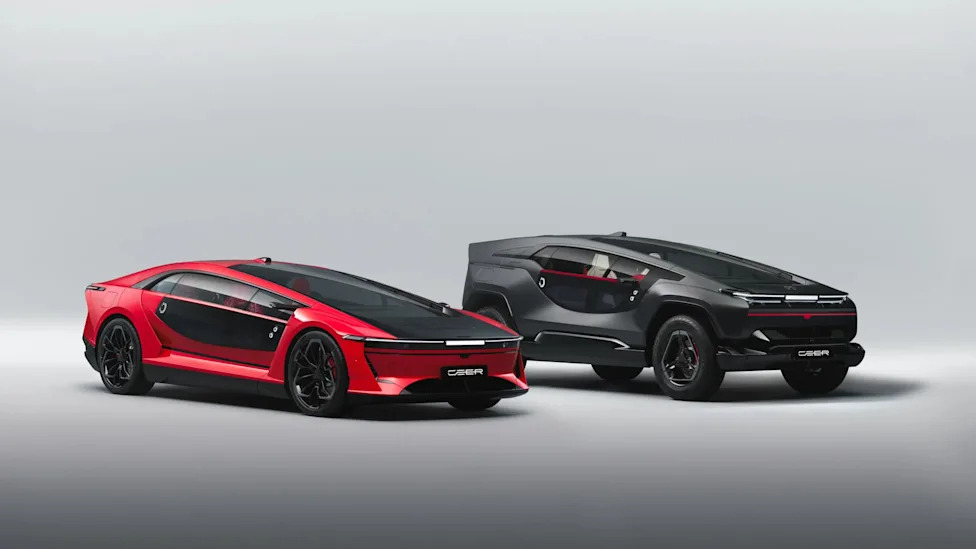
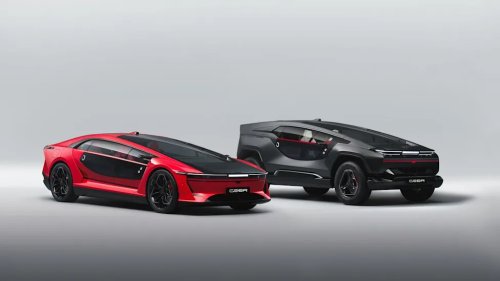
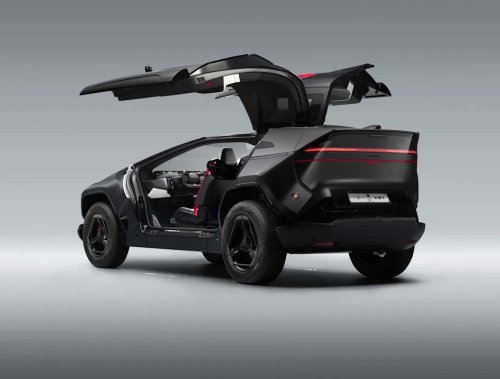
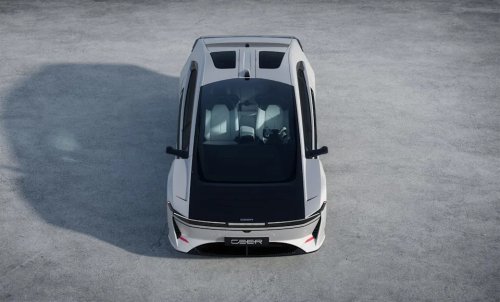
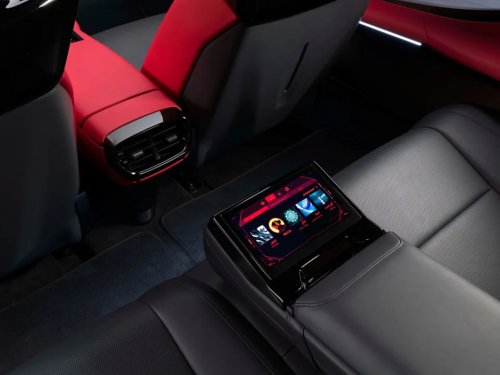
Saudi Arabia's First Car Has Falcon Doors and 1,111 HP, But the Real Engineering Is in the Air ConditioningBackfire NewsShawn HenrySat, September 26, 2026 at 6:25 PM UTCAdd us on GoogleSaudi Arabia's First Car Has Falcon Doors and 1,111 HP, But the Real Engineering Is in the Air ConditioningCEER staged the debut of Saudi Arabia's first homegrown car inside its own factory, which is either supreme confidence or a very deliberate reminder that the hard part was never the styling. On September 21 at the CEER Manufacturing Complex in King Abdullah Economic City, Crown Prince Mohammed bin Salman pulled the covers off two cars wearing the same name: the EXOBOT sedan and the EXOBOT SUV. Both are electric. Both have doors that swing up like a bird of prey stretching. And both are quoted, at their highest specification, at 1,111 horsepower and 1,500 Nm — about 1,106 lb-ft — of torque.That number is the one built for headlines. It is not the number attached to the car you can actually order.Two horsepower figures, one launch carRead CEER's own launch material closely and the lineup splits in two. The top-spec EXOBOT claims 1,111 hp with a 2.1-second 0-100 km/h run for the sedan and 2.4 seconds for the SUV, plus a governed top end of 250 km/h (155 mph) and 210 km/h (130 mph) respectively. The car that opens the order books, the limited EXOBOT First Edition, is rated at 850 hp and 1,000 Nm (738 lb-ft), with 2.6 seconds for the sedan and 2.9 for the SUV.AdvertisementAdvertisementThat is a 261-hp gap between the brochure hero and the launch trim, and it tells you something useful about how the car was built. All EXOBOTs use the same tri-motor all-wheel-drive layout — one unit at the front axle, two at the rear, or some variation on that theme — so a spread that large almost always comes from calibration and pack discharge limits rather than different hardware. Peak output on a modern 800-volt EV is a software permission slip more than a mechanical property. Expect the 1,111-hp version to arrive later as a higher trim, and expect it to be thermally limited to short bursts, because 625 kW is the number CEER lists for the 850-hp car and physics does not hand out the rest for free.Worth noting too: every acceleration claim on CEER's site carries an "IVM" asterisk. These are in-house measurements, not independently timed runs. Manufacturer launch figures in this part of the market have a habit of being generous, something we have poked at before when a Gulf-market horsepower claim didn't survive contact with the spec sheet. CEER's own SUV page also lists 2.6 seconds where its comparison chart says 2.9. Somebody will fix that; until then, treat the small print as provisional.The range figure needs an asterisk the size of the windshieldCEER quotes up to 670 km (416 miles) for the sedan and 560 km (348 miles) for the SUV from a 112-kWh NCM pack. Both figures are NEDC.If you have not had to care about test cycles in a while, here is why that matters. The New European Driving Cycle was retired in Europe years ago because it was a laboratory fantasy — low average speeds, gentle acceleration, no climate-control load, short duration. It flattered every car it ever touched, and it flatters EVs most of all, because EVs love exactly the slow, low-load driving NEDC rewards. WLTP typically knocks 10 to 20 percent off an NEDC number. The EPA cycle is harsher still, and real-world use in 45-degree heat with the air conditioning fighting for its life is harsher than that.AdvertisementAdvertisementPractically, a buyer should mentally pencil the sedan in somewhere around 290 to 320 miles of usable range and the SUV rather less, then reduce it again for sustained highway speeds. Range expectations are the single biggest source of EV buyer's remorse, and we have watched that play out in public, from high-profile owners trading vehicles purely over usable miles to long-term reviewers souring on cars they initially praised. Publishing an NEDC figure in 2026 is a choice, and not a reassuring one.Strip away the wing doors and this is a thermal-management projectHere is the part of the EXOBOT that deserves more attention than its horsepower: almost every interesting engineering decision on this car exists to fight heat.CEER calls the system Halo Cooling and claims it can drag a cabin from 65 degrees C to 32 degrees C — 149 F to 90 F — in ten minutes, with separate front and rear air-conditioning circuits. The glass does structural work in that fight. The windshield is 2.4 meters (7.9 feet) long, raked at 15 degrees, which CEER says makes it the largest and most inclined in its class, and it is ultra-thin laminated glass with a triple silver coating to reflect solar load. Roof airflow is shaped to prevent heat building up in the first place, and solar-gain foils handle what gets through. The battery is a structural cell-to-pack design that CEER says was specified for this environment rather than adapted to it.None of that is decoration. Heat is the primary enemy of a lithium-ion pack: elevated cell temperatures accelerate calendar aging, and a hot pack forces the battery management system to taper DC fast charging hard, which is how a "30 minutes to 80 percent" claim quietly becomes 45 minutes in August. An EV engineered around Gulf ambient temperatures rather than European ones is genuinely novel, and it is the strongest technical argument CEER has made. It is also the claim most worth independently verifying, because a cabin-cooldown figure measured in a controlled soak is not the same as one measured in a parking structure in Riyadh in July.What those doors will cost youThe Shahin Wing Doors — named for the falcon, and CEER leans into it — are close to three meters long each and cover both front and rear openings in one panel. They swing through a 60-centimeter (about 23.6-inch) arc and can be triggered from the key fob or a touch control on the door itself.AdvertisementAdvertisementThey are also the single largest ownership risk on the car. One-piece doors that span two rows mean any door damage is a full-panel repair, not a corner. Powered hinges and struts sized to lift that much aluminum and glass are a wear item with a real replacement cost. The 2.4-meter windshield is a bespoke piece of coated laminated glass, which means stone-chip replacement will be expensive, slow, and almost certainly bundled with ADAS camera recalibration. Insurers price exotic glass and single-source body panels accordingly, and on a car with no claims history and no aftermarket, expect early premiums to reflect pure uncertainty.The practical stuff is worth thinking about too. Vertical doors need vertical clearance, and the SUV's opening height is listed at 2,510 mm — 2,603 mm with the camera mirrors deployed. That is taller than plenty of parking garage entrances, and the doors cannot open in one.No steering column at allThe EXOBOT uses steer-by-wire with the mechanical column deleted entirely, paired with a yoke rather than a wheel. CEER says total steering input drops from 400 degrees to 160 degrees lock to lock, and rear-wheel steering adds up to 6.5 degrees of articulation.Two things follow. First, 160 degrees is aggressive — roughly 0.44 turns lock to lock, which is quicker than most race cars and only livable because a by-wire system can vary its ratio with speed. Done well it makes a 5.26-meter sedan feel like something much smaller. Done badly it feels nervous at motorway speed. Second, removing the column is a homologation exercise as much as an engineering one. By-wire steering requires redundant power, redundant sensors, and redundant actuation to satisfy regulators, and markets have moved at different speeds on approving it. That is one more reason CEER's stated plan to sell in the GCC first and consider other markets later is the sensible order of operations, rather than a limitation.Big outside, and not always big insideThe sedan measures 5,260 mm long, 2,102 mm wide and 1,428 mm tall (207.1 x 82.8 x 56.2 inches) on a 3,200 mm (126-inch) wheelbase, with 155 mm of ground clearance rising to 165 mm on the air suspension. That is long-wheelbase limousine footprint with a coupe's roofline and a supercar's ride height.AdvertisementAdvertisementThe SUV is shorter at 5,016 mm but stands 1,693 mm tall, shares the 3,200 mm wheelbase, and rides on adjustable air suspension between 280 and 300 mm (11 to 11.8 inches) of clearance. Both cars run adaptive dual-chamber air springs. The SUV's quoted trunk volume, though, is 402 liters — about 14.2 cubic feet — which is compact-crossover luggage space in a vehicle nearly 16.5 feet long. That is the tax you pay for a dramatically tapered tail and a battery-first floor.Inside, both get a 48-inch pillar-to-pillar curved display running at 8K, a 10.4-inch center screen, an 8-inch rear occupant display, camera-based mirrors, a bilingual Arabic and English voice assistant, switchable tinting on the lower door glass, and a three-scent fragrance system. The audio uses surface exciters to turn cabin panels into speakers, which saves weight and packaging space versus a conventional array of cones.The ownership package is the most competitive thing hereCEER is doing what every new brand has to do, which is buy trust with warranty. First Edition buyers get a six-year or 200,000-km (124,000-mile) vehicle warranty, an eight-year or 200,000-km battery warranty, six years of scheduled servicing, six years of roadside assistance, and a home charger with an installation allowance up to SAR 2,000 (roughly $530). Every First Edition also carries a numbered plaque matched to its VIN, which is the sort of thing that either does nothing for values or does quite a lot, depending entirely on whether CEER still exists in fifteen years.The company also says it is targeting order-to-delivery measured in weeks rather than months because the cars are built locally, and commits to 45 percent local content by 2034 with a domestic supplier network for parts. For a first-generation vehicle from a first-generation automaker, parts availability matters more than acceleration. No prices have been announced.Why the state is paying for thisCEER is a joint venture between Saudi Arabia's Public Investment Fund and Foxconn, with BMW licensing component technology into the program. PIF set the company up in 2022; the name means "drive" or "go" in Arabic. Foxconn's involvement is the tell — the company that assembles the world's consumer electronics has spent years trying to convert contract-manufacturing scale into cars, and a sovereign wealth fund willing to underwrite an entirely new OEM is close to the ideal customer for that pitch.AdvertisementAdvertisementThe stated payoff is industrial rather than automotive. PIF projects CEER will contribute $8 billion to Saudi GDP and $21 billion in trade balance improvement by 2034, and the EXOBOT is the first of seven models planned by 2030, including mid-size and compact vehicles. That plan is quietly interesting for one phrase in CEER's own release: those future models will offer "various propulsion options." Saudi Arabia's first car brand launched as an EV brand, in a country with a 2060 net-zero target and the world's cheapest gasoline, and it is already leaving the door open to something that isn't a battery.Design is where the outside expertise shows most. CEER's chief design officer is Robert Melville, previously responsible for McLaren's design language, and the EXOBOT's wedge profile and machined front and rear volumes read like someone applying mid-engine supercar proportions to a three-box sedan. The cultural detailing is more original than the silhouette: 32 light bars referencing 1932, the year the Kingdom was unified, and wheel spokes drawn from Al-Lahuj architectural openings. It is a more considered piece of brand storytelling than most startups manage, and it arrives while Melville's former employer is busy mapping out its own SUV future.What to actually watchProduction is meant to begin at the CEER Manufacturing Complex, which the company describes as the largest automotive plant in the Middle East. Saudi Arabia is the priority market, with GCC expansion after that and everything else described as optional. Launching a premium EV brand into the Gulf rather than Europe or China is a defensible read of where the money and the charging infrastructure actually are, and CEER is not alone in that thinking — other brands are choosing Abu Dhabi over Britain or Beijing for exactly the same reasons. Whether a brand-new OEM can absorb the cost of a first product this ambitious is the open question; even established manufacturers have launched flagship EVs straight into a balance-sheet crisis.If you are considering one, the checklist is short and unglamorous. Wait for a WLTP or EPA range number before believing the 670-km figure. Ask what the 1,111-hp calibration costs and whether it is thermally sustainable or a launch-control party trick. Get a written quote on a windshield and a single door skin before signing anything. And treat CEER's claim that its safety systems "go beyond global safety standards" as marketing until an independent body crash-tests one, because even five-star ratings from established programs leave a surprising amount untested.AdvertisementAdvertisementThe EXOBOT is a genuinely bold first attempt, and the heat engineering is the part the rest of the industry should be taking notes on. Just buy it for the cooling system, not the spec sheet.Primary sources: CEER technical release and vehicle specifications; Public Investment Fund launch announcement.