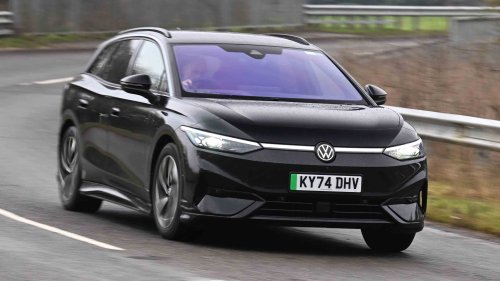
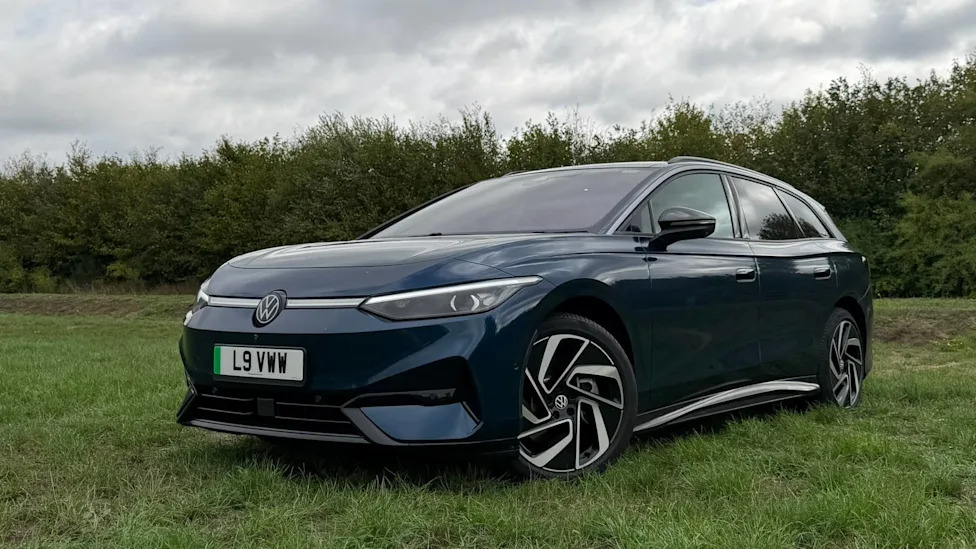
I Drove the VW ID.7 Tourer: It Shows What America Is MissingThere was a point during my week with the Volkswagen ID.7 Tourer when the car made its case better than any specification sheet could. My son was heading to university, which meant loading the car with the slightly ridiculous amount of stuff one person apparently needs to move away from home. Bags, boxes and everything else disappeared into the rear of the ID.7 without much effort, and then we set off on a roughly 400-mile round trip.This was exactly the sort of journey that is supposed to expose an electric car's compromises: lots of highway miles, a heavily loaded trunk and the need to recharge away from home. Instead, the Volkswagen made the whole trip feel surprisingly ordinary. Somewhere along the way I kept coming back to the same thought: why can't Americans buy something like this?The Wagon Is the Right ID.7"Tourer" is Volkswagen's name for the wagon version of the ID.7, and my UK-market Pro S Match Plus came with the larger 86-kWh usable battery, or 91 kWh gross. A single rear-mounted motor produces 282 horsepower, and Volkswagen quotes 0-62 mph in 6.7 seconds. Volkswagen rates my exact specification at 422 miles on the WLTP cycle, with DC charging at up to 200 kW and a quoted rapid-charge time of around 26 minutes to 80% under the right conditions. American readers need to put an immediate asterisk next to that range figure because WLTP and EPA testing aren't interchangeable, and the ID.7 Tourer has never been EPA-certified. This isn't secretly a 422-mile EPA EV that Volkswagen refuses to sell Americans.What I can say is that during my week with it I was comfortably seeing more than 300 miles of usable range, and the 400-mile trip never became an exercise in staring nervously at the battery percentage. I also put a large amount of energy back into the car in roughly half an hour at a public fast charger. I didn't record the starting percentage, finishing percentage or trip-computer efficiency closely enough to turn that stop into a controlled charging test, so I'm not going to manufacture numbers after the fact. From the driver's seat, what mattered was that neither range nor charging dominated the journey.Related: I Drove the 2026 Volkswagen ID.3 for a Week: Here's My Honest Review of the Electric Hatchback America Will Never GetIt Did Everything I Needed an SUV to DoThe university run was also a useful reminder that practicality doesn't automatically require extra ride height. Volkswagen gives the ID.7 Tourer about 21.4 cubic feet of cargo capacity behind the rear seats, and I tested that with something considerably less convenient than standardized luggage blocks. It swallowed an impressive amount of my son's university belongings without making me wish I'd brought an SUV.Rear legroom is generous, too, while the long and relatively low body gives the ID.7 proportions I find much more attractive than most family crossovers. My car's Stonewashed Blue metallic paint helped. It's an unusually accurate color name because it genuinely reminded me of blue denim jeans, and it suited the shape brilliantly.I'm not suddenly anti-SUV. I recently drove the latest Volkswagen Tiguan and liked it. The ID.7 Tourer simply reminded me that an SUV doesn't automatically become the best answer just because somebody wants space, range and family practicality.Volkswagen Has Mostly Fixed the ID InteriorThe cabin feels like Volkswagen learned quite a lot from the criticism aimed at its earlier ID models. A huge 15-inch touchscreen dominates the dashboard while the driver's display is tiny by comparison, and the contrast looks almost comical when you first get in. I expected to miss having a larger conventional gauge cluster, but I didn't. An augmented-reality head-up display is standard on this specification, so much of the information I wanted was already directly in my line of sight.I had no meaningful problems with the infotainment system during the week, which is worth mentioning given the reputation some earlier Volkswagen EV software earned. Unfortunately, VW still has a habit of making simple functions unnecessarily clever. The electronically controlled air vents are the perfect example. Instead of reaching out and pointing one where you want it, you adjust its direction electronically, and I found that genuinely annoying.I'm also unconvinced by the touch-sensitive temperature controls and capacitive steering-wheel buttons. Proper switches remain easier to operate without looking, while the glossy black surfaces around the cabin seemed capable of collecting fingerprints almost immediately. Oddly enough, the driver's door arrangement didn't bother me at all. There are only two main window switches, with a touch control to toggle them between the front and rear windows, and I actually thought it was a smart solution.Related: I Lived With the Volkswagen ID.4 for a Week. Here's the Honest Reality of VW's Electric SUVThis Is a Car Built for DistanceMy test car was particularly well equipped, with ventilated massage seats, adaptive DCC suspension, additional sound insulation, a Harman Kardon audio system and an electronically darkening panoramic roof. Those options pushed the price to £60,995 (just over $80,000) as tested, from £55,315 (around $73,000) before options, but they also played directly to the ID.7's greatest strength: covering distance in comfort.It is quiet at highway speeds, the ride remains supple and the adaptive suspension does a good job of keeping the body settled over rougher roads. The 282 hp is more than enough for merging and passing, but the ID.7 isn't constantly trying to persuade you it's a performance EV. Most of the time it simply feels smooth, relaxed and composed.There are moments when you notice what the batteries weigh. This specification tips the scales at about 4,930 pounds, so we're still talking about a heavy car despite its sleek appearance. Most of the time it disguises that mass impressively well, although you occasionally feel it when changing direction or asking more from the chassis.The Audi Comparison Surprised MeLast summer, I drove the Audi A6 Avant e-tron Performance Launch Edition, which gave me an unusually useful comparison. The Audi carries an even bigger battery pack, with 100 kWh gross and 94.9 kWh usable, compared with 91 kWh gross and 86 kWh usable in the Volkswagen.Related: Why The 2025 Audi A6 e-tron Avant Is Exactly the Electric Wagon We Need In AmericaThe Audi feels more premium inside, but it should. It's an Audi, and Volkswagen isn't pretending the ID.7 is a luxury car. What surprised me was how close the VW sometimes felt in the areas that matter on a long trip. The Audi has richer materials and more sense of occasion, but the ID.7 wasn't miles behind when it came to seat comfort, refinement and ride quality.The price difference makes that more impressive. The A6 Avant e-tron Performance Launch Edition had a UK list price of £86,585, compared with £60,995 for this option-loaded Volkswagen. That's a gap of about £25,600, or 42%, although the specifications aren't perfectly equivalent. American buyers don't get that electric Audi wagon either: Audi's current U.S. A6 e-tron range consists of the A6 Sportback e-tron and S6 Sportback e-tron, with no Avant listed.Volkswagen Already Asked the America QuestionThis points to the broader problem facing cars like the ID.7 Tourer. Volkswagen originally planned to sell the regular ID.7 liftback in North America. It delayed that launch in May 2024 because of changing market dynamics and ultimately confirmed in January 2025 that the car wouldn't come to the U.S. or Canada. Dealers had already expressed doubts, expecting the ID.7 to be a $50,000 to $60,000 car, and questioned whether it could be competitive. Volkswagen has never announced plans to sell the Tourer here.The latest broad market figures don't make the wagon argument much easier. The Alliance for Automotive Innovation says EVs represented 7.9% of new U.S. light-duty vehicle sales in Q2 2026, while light trucks accounted for 81% of EV sales. "Light truck" is a regulatory category covering SUVs, crossovers, pickups and some vans rather than a direct body-style count, but it still shows where most American EV demand is concentrated.Even Porsche's electric-wagon experiment is ending here. Porsche's U.S. configurator currently shows eight 2027 Taycan variants, all Sport Sedans, with no Sport Turismo or Cross Turismo. The wagon body styles end their U.S. run after the 2026 model year, with Porsche's American operation saying they had played a "minor role" in the market.Verdict: America Is Missing the ChoiceThe ID.7 Tourer gave me practically everything I would have wanted from an electric family SUV without actually being one. It swallowed a university move, handled a 400-mile round trip without turning charging into the main event, offered plenty of rear-seat space, rode beautifully and had more performance than it really needed.It isn't perfect. The electronically controlled air vents irritated me, capacitive controls still feel like a solution looking for a problem, the glossy black trim becomes a fingerprint collection surprisingly quickly, and occasionally you can feel the car's considerable weight. None of those things came close to spoiling the experience.After a week with it, I understand why Volkswagen doesn't want to gamble on an electric wagon in America. The ID.7 Tourer doesn't prove American buyers would suddenly abandon their crossovers if Volkswagen put one in every showroom, and the pricing and market data give the company legitimate reasons to be cautious.What it does show is something America's EV market never really received in the first place: a mainstream electric wagon that can carry a family and its luggage, cover serious distances in comfort and do it all without becoming another tall crossover.That's what America is missing.



















 +11 others










![Volkswagen, Volkswagen ID.4, Volkswagen ID.5, Volkswagen's best-seller is going electric in 2027 to replace the ID.4 and ID.5 [Images]](https://cdn.topcarnews.net/thumb/id/aHR0cHM6Ly9pMC53cC5jb20vZWxlY3Ry-ZWsuY28vd3AtY29udGVudC91cGxvYWRz-L3NpdGVzLzMvMjAyNi8wOS9Wb2xrc3dh-Z2VuLUlELVRpZ3Vhbi1JRC00LmpwZWc_-dz0xNTAwJmFtcDtxdWFsaXR5PTgyJmFt-cDtzdHJpcD1hbGwmYW1wO3NzbD0x/aed2aa2870791850c8e69c5fc3a0ed85.jpeg?t=20261008&post_id=66267)
![Volkswagen, Volkswagen ID.4, Volkswagen ID.5, Volkswagen's best-seller is going electric in 2027 to replace the ID.4 and ID.5 [Images]](https://cdn.topcarnews.net/thumb/id/aHR0cHM6Ly9lbGVjdHJlay5jby93cC1j-b250ZW50L3VwbG9hZHMvc2l0ZXMvMy8y-MDI2LzA5L1ZvbGtzd2FnZW4tSUQtVGln-dWFuLUlELTQtZnJvbnQtcXVhcnRlci5q-cGc_c3RyaXA9aW5mbyZhbXA7dz0xMDI0/97fb00cd3919b8d0dc36440715039e6e.jpg?t=20261008&post_id=66267)
![Volkswagen, Volkswagen ID.4, Volkswagen ID.5, Volkswagen's best-seller is going electric in 2027 to replace the ID.4 and ID.5 [Images]](https://cdn.topcarnews.net/thumb/id/aHR0cHM6Ly9lbGVjdHJlay5jby93cC1j-b250ZW50L3VwbG9hZHMvc2l0ZXMvMy8y-MDI2LzA5L1ZvbGtzd2FnZW4tSUQtVGln-dWFuLUlELTQtc2lkZS5qcGc_c3RyaXA9-aW5mbyZhbXA7dz0xMDI0/ed240b20e8275f3af4b904f46ebb5fb3.jpg?t=20261008&post_id=66267)
![Volkswagen, Volkswagen ID.4, Volkswagen ID.5, Volkswagen's best-seller is going electric in 2027 to replace the ID.4 and ID.5 [Images]](https://cdn.topcarnews.net/thumb/id/aHR0cHM6Ly9lbGVjdHJlay5jby93cC1j-b250ZW50L3VwbG9hZHMvc2l0ZXMvMy8y-MDI2LzA5L1ZvbGtzd2FnZW4tSUQtVGln-dWFuLUlELTQtcmVhci1xdWFydGVyLmpw-Zz9zdHJpcD1pbmZvJmFtcDt3PTEwMjQ/436c7979cf5b947053f7f0bf39ff94bc.jpg?t=20261008&post_id=66267)
![Volkswagen, Volkswagen ID.4, Volkswagen ID.5, Volkswagen's best-seller is going electric in 2027 to replace the ID.4 and ID.5 [Images]](https://cdn.topcarnews.net/thumb/id/aHR0cHM6Ly9lbGVjdHJlay5jby93cC1j-b250ZW50L3VwbG9hZHMvc2l0ZXMvMy8y-MDI2LzA5L1ZvbGtzd2FnZW4tSUQtVGln-dWFuLUlELTQtZnJvbnQuanBnP3N0cmlw-PWluZm8mYW1wO3c9MTAyNA/ec2e4ca027ccbfb42942abe523f3acf7.jpg?t=20261008&post_id=66267)
![Volkswagen, Volkswagen ID.4, Volkswagen ID.5, Volkswagen's best-seller is going electric in 2027 to replace the ID.4 and ID.5 [Images]](https://cdn.topcarnews.net/thumb/id/aHR0cHM6Ly9lbGVjdHJlay5jby93cC1j-b250ZW50L3VwbG9hZHMvc2l0ZXMvMy8y-MDI2LzA5L1ZvbGtzd2FnZW4tSUQtVGln-dWFuLUlELTQtcmVhci5qcGc_c3RyaXA9-aW5mbyZhbXA7dz0xMDI0/668525889dc433b0fd0e166fd5bd8366.jpg?t=20261008&post_id=66267)