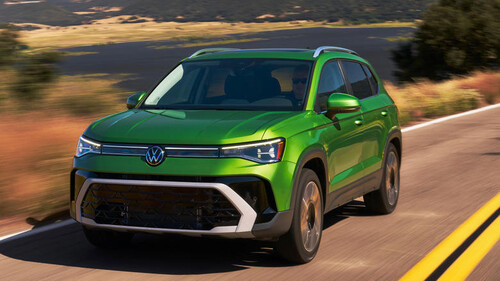
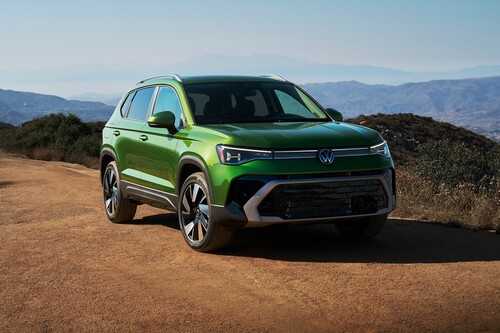
Volkswagen sold 29,002 Tiguans in the United States between April and June, more than any other model it offers here and 152.5% more than in the same quarter of 2025, according to the company's second-quarter sales report. The Tiguan sold in North America is the long-wheelbase version that Volkswagen de México builds in Puebla, alongside the Jetta and the Taos. On Aug. 28, the company told workers it would eliminate one of the three shifts on the segment of that plant that builds the Tiguan and the Jetta.A month later, the union there, the Sindicato Independiente de Trabajadores de la Industria Automotriz Volkswagen, or SITIAVW, has a strike deadline of 11 a.m. this Friday, Oct. 2. Workers rejected Volkswagen's wage offer on Sept. 11, and the deadline has now been pushed back four times. The fight is over how many people Volkswagen pays to build its best-selling American vehicle, how long they work, and how often they get to reopen their wages, all before the Golf moves into the same plant in 2027.American buyers have a direct stake. The Tiguan, Jetta and Taos together accounted for 52,745 of the 89,158 Volkswagen-brand vehicles sold in the U.S. in the second quarter, or 59%, by The Auto Wire's count from the company's own sales table. Under Mexican labor law, a legal strike stops that plant entirely.A 10.04% offer, an 18-month clock and 4,327 no votesVolkswagen de México described the shift cut as a difficult but necessary response to current conditions in its key markets, according to a company statement reported by Expansión. It said the Jetta and Tiguan would keep being built in Puebla and that the change covered only one of the three shifts in that segment. The statement, as reported, did not mention U.S. tariffs.The cut took 786 people off the payroll: 611 workers separated by seniority and 175 voluntary retirements. SITIAVW general secretary Hugo Tlalpan Luna told Puebla reporters that the 611 would be rehired, with their seniority respected, when Golf assembly starts in April 2027, according to Ángulo 7. He also said the Puebla reductions were not part of the global cuts the Volkswagen Group had just approved.The tentative agreement that followed offered a combined 10.04% increase: 4.30% on direct wages and 5.74% in benefits, with the next revision set 18 months out instead of the usual 12. On Sept. 11, La Jornada de Oriente reported, 4,327 workers voted against it and 1,580 voted for it, out of 5,907 valid ballots. That is a 73% rejection from a membership of 6,440.Talks moved to the Federal Center for Conciliation and Labor Registration in Mexico City. On Sept. 28, Quadratín Puebla reported, citing people involved in the negotiation, that Volkswagen had nudged its offer slightly above 10.04%, on the condition that the next contract revision wait 24 months. Volkswagen has not published a new figure. The same report said the union had refused a management request to lengthen hours on the second shift of the Jetta-Tiguan segment, arguing it would likely violate labor law.The U.S. sales table does not show a line in trouble. In the second quarter, Tiguan sales more than doubled and Jetta sedan sales rose 9.7%, to 15,949. The model that fell was the Taos, down 43.9% to 7,794, and the shift cut Volkswagen announced was on the Jetta-Tiguan segment, not the Taos. Running one fewer shift and asking the remaining crews to work longer on a line whose products are selling better points to a cost decision more than a demand collapse. Volkswagen may have forecasts it hasn't shared, and third-quarter numbers could look different. But the company's own published figures do not show the Tiguan running out of buyers.The Jetta, built in Puebla, sold 15,949 units in the U.S. in the second quarter of 2026. Photo: Cutlass via Wikimedia Commons, CC0Why the length of the contract matters as much as the raiseMexico's Federal Labor Law treats wages and the rest of a collective contract on different clocks. Article 399 Bis makes cash daily wages revisable every year. The broader contract is revised every two years, and Article 400 Bis requires that the two-year revision agreement be submitted to a vote of the workers it covers. In Puebla, 5,925 union members turned out for the Sept. 11 vote on this year's deal.An 18-month or 24-month wage term gives up the annual reopener. For Volkswagen, a 24-month deal signed this fall would keep wages settled until roughly the fall of 2028, through the Golf launch and its first full year of production. For workers, it means one fewer chance to use the strike threat that the law attaches to each wage revision. Workers voted on the raise and the calendar as a single package.What a strike stops under Mexican lawAn American plant manager facing a walkout can put salaried staff on the line, and since the Supreme Court's 1938 decision in NLRB v. Mackay Radio & Telegraph Co., U.S. employers have been allowed to permanently replace workers striking over economic issues. Mexico's law works differently. Article 443 limits a strike to "the mere act of suspending work" (my translation), Article 447 suspends the employment relationship for as long as it lasts, and Article 449 requires the labor court and civil authorities to respect the strike and help workers stop production if they ask. Under Article 935, the court sets only the minimum crew needed to protect the safety and preservation of the premises, machinery and raw materials, or to allow work to restart. That crew keeps the plant from deteriorating; it does not build cars.The same law gives Volkswagen a counterweight. Article 434 lists the incosteabilidad notoria y manifiesta, or obvious and demonstrable unprofitability, of an operation as grounds for terminating employment, and Article 435 requires an employer to get prior authorization from the labor court before using it. A long strike that produces months of losses would give Volkswagen material for that kind of filing. SITIAVW's four extensions reflect that risk as much as any progress at the table.Puebla gains the Golf while Volkswagen shrinks elsewhereThe plant produced 335,716 vehicles in 2025, according to Volkswagen. Its position inside the company is changing fast. In the December 2024 agreement with German unions that committed to cutting more than 35,000 jobs at Volkswagen's German sites by 2030, the company said production of the Golf and Golf Estate would be relocated to Puebla from 2027, and Wolfsburg would drop from four assembly lines to two. Tlalpan told La Jornada de Oriente that Golf assembly will need 924 workers. Volkswagen de México has not said how many Golfs it plans to build or which versions.Then, in a press release dated Sept. 3, the Volkswagen Group said its supervisory board had approved the Future Plan 2030, which calls for a Group-wide workforce adjustment of approximately 50,000 positions, including management. The same plan says the group will cut its model portfolio by around 50% by 2035, a goal we covered when it was first presented, and that in North America it will focus on the most profitable segments. Three weeks later, the company cut its profit forecast after another Porsche write-down.Tariffs add to the pressure. Since April 3, 2025, cars imported into the U.S. have carried a 25% Section 232 tariff; for vehicles that qualify under the USMCA, that tariff applies only to the value of their non-U.S. content, according to the U.S. Trade Representative's July 1, 2026 report to Congress. The same report says 92.9% of U.S. vehicle imports from Mexico received USMCA preferences in 2025, against 99.0% from Canada. Volkswagen has been lobbying for relief on its Mexico-built cars. Labor is one of the few costs on a Puebla-built Tiguan that Volkswagen can negotiate down on its own, which helps explain why it is pressing on hours and contract length at the same time. Mercedes-Benz made a similar demand of its German workers last week, tying two factories' futures to longer hours without extra pay.What Tiguan, Jetta and Taos shoppers should watchThe first date is Friday at 11 a.m. in Puebla, which is 1 p.m. Eastern. Another extension is possible; SITIAVW has used four. If workers do walk out, every Jetta, Tiguan and Taos bound for U.S. dealers stops at the source, and how long dealers could keep selling from stock depends on inventory levels Volkswagen has not disclosed by model. Shoppers negotiating on one of those three would likely find less room on price if a strike drags on, and anyone waiting on a factory order should ask the dealer whether the car has been built yet.The second is Volkswagen of America's third-quarter sales report, expected in October. It will be the first to include weeks after the shift cut. If Tiguan sales hold near second-quarter levels on two shifts, Volkswagen will have shown the line can carry the volume with fewer people, and its case for keeping the Jetta-Tiguan segment at two shifts gets stronger.The third is April 2027, when the Golf is due and the 611 laid-off workers are supposed to return. Volkswagen ended production of the regular Golf for the U.S. market years ago, and U.S. dealers now sell only the GTI and Golf R versions. Volkswagen hasn't said whether any Golfs built in Puebla will be headed to American showrooms, which would put even more of the brand's U.S. lineup on this one contract.Should Volkswagen raise its offer to keep Puebla running, or is a longer wait between raises a fair price for workers to pay for the Golf jobs coming in 2027?The post Volkswagen Cut a Shift on the Line That Builds Its Best-Selling U.S. Model. Puebla's Strike Deadline Is Friday. appeared first on The Auto Wire.