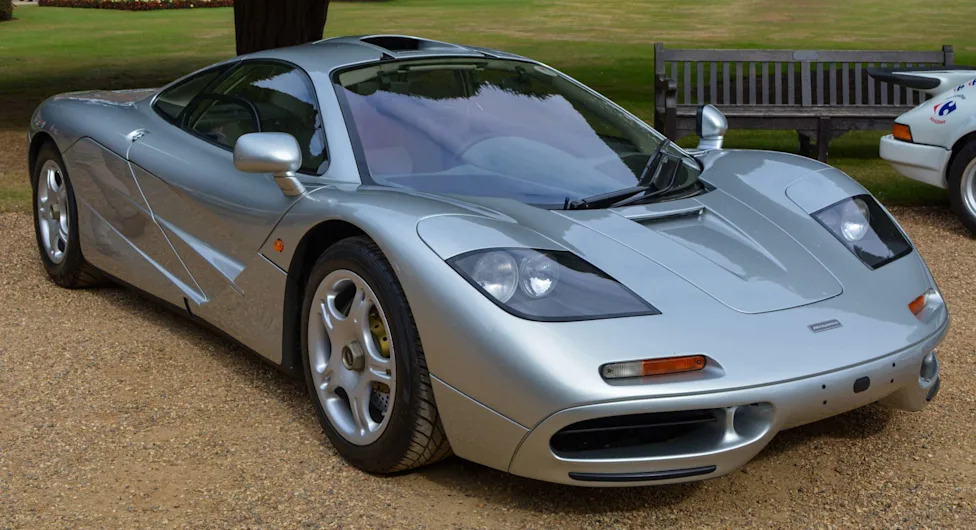

















Hong Kong's Two McLaren F1s: What a Chance Sighting Reveals About Collector PrioritiesModern Car CollectorShawn HenryFri, September 11, 2026 at 6:00 PM UTCAdd us on GoogleHong Kong's Two McLaren F1s: What a Chance Sighting Reveals About Collector PrioritiesA video clip circulating this week shows a Magnesium Silver McLaren F1 turning off a Hong Kong street and into a private parking structure, prompting the sort of reaction reserved for genuine automotive royalty: a spotter sprinting alongside with a phone raised, while the driver simply carries on. For the owner, that reaction is evidently routine. Hong Kong is reportedly home to just two McLaren F1s, and this one has spent the years since its factory restoration being driven rather than merely displayed.The clip itself is a curiosity. The story underneath it is not. Hong Kong's two F1s appear to represent opposite instincts that define the collector-car market at its highest level. One car, chassis #016, finished in Aubergine, reportedly changed hands earlier this year after roughly eighteen years in single ownership, having first been sent back to Europe for servicing. The other, believed to be chassis #063, has stayed with a private collector who, following a comprehensive rebuild by McLaren Special Operations, simply uses it. Two nearly identical multi-million-dollar objects, two entirely different philosophies of ownership.A Car Built to Be the ExceptionContext matters here, because rarity alone has never been the reason the McLaren F1 commands the reverence it does. Gordon Murray's design, built around a central driving position, a fully carbon-fibre monocoque chassis, and a naturally aspirated BMW-built V12 wrapped in gold foil for heat management, remains the last road-legal, series-produced sports car to win the 24 Hours of Le Mans outright, a feat accomplished by its GTR racing sibling in 1995. It also still holds the record for the fastest naturally aspirated production car ever built, a mark it has defended for nearly three decades against machines with far greater displacement and, in almost every case, turbochargers Murray refused to use. Murray has since warned that the modern car industry is chasing numbers at the expense of driving feel, a philosophy the F1 was engineered around before it was fashionable to say so.AdvertisementAdvertisementOnly 64 road-going examples of the F1 were ever sold, out of 106 total chassis built across every variant, including racing GTRs and the five Le Mans tribute LMs. That is a smaller run than most limited-edition hypercars announced this decade, and it was reached without a single unit built to be flipped; McLaren built the F1 as an engineering statement, not a limited-run marketing exercise. Hong Kong's allocation of exactly two cars is less a reflection of local demand than of who McLaren happened to sell to in the mid-1990s, long before Asia's collector market existed in anything like its current form. Their survival there, undamaged and largely unmodified, is itself a quiet form of provenance.Two Philosophies, One CityThe eighteen years of single ownership attached to chassis #016, if the reports are accurate, is the kind of stewardship collectors quietly prize far more than any headline hammer price. A long, well-documented chain of custody does more for a car's authenticity and value than almost anything else in the hobby; we made a similar point examining a $40,000 Steve McQueen motocrosser bound for auction at Bonhams, where the paperwork mattered nearly as much as the machine. Chassis #063's story runs on a different track. A ground-up rebuild by McLaren Special Operations, the factory's in-house restoration and heritage division, is about as close as an F1 owner can get to a matching-numbers guarantee. MSO has access to original build sheets, factory tooling, and the people who assembled these cars by hand in Woking three decades ago. A car returned from MSO does not just look correct; it is verified correct, in a way no independent restoration shop, however skilled, can fully replicate.What the Market SaysThe market has rewarded that kind of certainty. Publicly reported F1 sale prices have climbed steadily over the past decade: one well-known example changed hands for roughly $12.2 million in 2015, a US-market car sold for $16.55 million in 2021, another chassis reached $20.465 million later that same year, and a Brunei royal family car fitted with McLaren's High Downforce Kit set a reported record of $25.3 million in 2025. That trajectory places the F1 among the small handful of cars capable of setting outright records across the entire collector market, a company that has recently included Michael Schumacher's Monaco-winning Ferrari F2001, though the F1's climb has been driven by pure engineering pedigree rather than any single driver or race result.There is a generational story here too. The newest wave of hypercar buyers, the kind recently seen touring Monterey Car Week alongside Christian von Koenigsegg in a caravan of modern hypercars, tend to collect and display as much through social media as through concours lawns. Hong Kong's F1 custodian belongs to an older, quieter tradition: buy the most significant car of its era, restore it correctly, and drive it in ordinary traffic without fanfare. The spotter chasing the car on foot is a 2026 phenomenon. The owner ignoring him is a 1998 one.The Real StoryStrip away the video, the spotter, and the word "rare," and what remains is a more useful lesson for serious buyers: originality and documented stewardship now separate merely expensive McLaren F1s from historically important ones, and the market has begun pricing that difference explicitly rather than assuming rarity alone will do the work. Collectors rarely pay a premium for horsepower alone. They pay for certainty about a car's past, and for the rare privilege of watching one of the most significant road cars ever built do exactly what Gordon Murray intended when he first sketched it in 1988: get driven.Join our Newsletter, follow our Instagram page, and follow us on Facebook.