





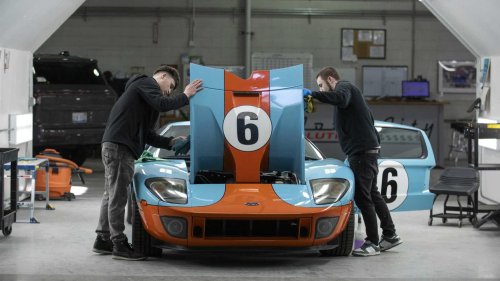



















The Ford GT40 is the most American race car story of all time. It’s red, white, and V8 thunder, built out of vengeance, rivalry, and more cash than sense. It’s the car that dethroned Ferrari at Le Mans. It’s the car that cemented Carroll Shelby’s legacy. It’s a hero. A legend. A movie star.And yet, when you fold yourself into the driver’s seat of the original GT40 race car, something feels... off. The steering wheel? On the right. The gear shifter? On the left. For the car that defined American endurance racing, it’s a layout straight out of London. So, what gives? Why was this Yankee rocket ship built like a British car?The answer, like most things in motorsport, lies in a twisted path of engineering practicality, racing regulations, and a little dash of old-school arrogance. But to really get it, you’ve got to go back to the very beginning—before Le Mans, before Shelby, before Ken Miles ever buckled in.To provide the most accurate and up-to-date information, this article uses data sourced from various manufacturers and authoritative sources. The GT40’s British Bloodline Ford Motor Company Archives Here’s the thing: despite being a revenge project by Ford after Enzo Ferrari humiliated them in a failed buyout deal, the GT40 wasn’t born in Detroit. It was born in Slough, England. Back in 1963, Ford acquired the services of Eric Broadley, founder of Lola Cars, after being impressed with his Lola Mk6 GT. The GT40’s chassis and basic design were heavily inspired by the Mk6, which was also—you guessed it—right-hand drive.To accelerate the project, Ford set up Ford Advanced Vehicles (FAV) in the UK and staffed it with mostly British engineers and drivers. And in the world of British motorsport, right-hand drive was standard. So, while the badge said Ford, the hands building the thing drank tea, drove on the left, and didn’t think twice about sticking the steering wheel on the “wrong” side. Why Right-Hand Drive Made Sense For Le Mans Racing Logic > National Pride Superformance GT40 MkII profile Beyond heritage, there’s a practical reason the GT40 was built with right-hand drive: Le Mans. In the 1960s, the Le Mans Circuit de la Sarthe featured a majority of right-hand corners—particularly the infamous Tertre Rouge, Arnage, and Indianapolis. Having the driver on the inside line of these corners provided better visibility and control during entry and exit, which mattered when you were diving into a 100-mph bend in the dark on skinny tires and no traction control.Right-hand drive also offered better pit stop efficiency in some European layouts, depending on how the pit lane was arranged. And remember—Le Mans drivers weren’t just sitting there. They were running across the track in the Le Mans-style start. Some teams configured their cars for faster access based on which side of the car the driver entered from. And if there was ever a place to squeeze out a few seconds on entry or exit, it was 24 hours of Le Mans. So these wins weren't a fluke. The GT40 didn’t just beat Ferraris—it crushed the entire field, year after year. The Gear Shifter Was On The Left, Too—And That Wasn’t An Accident RM Sotheby's Here’s where it gets weird. Most right-hand drive cars have the gear lever on the left, sure. But the GT40’s shift placement was about more than convention—it was about speed. When Ford brought in Carroll Shelby to rework the GT40 after a string of embarrassing failures in 1964, the Texan didn’t mess with the seating arrangement. But he did want drivers to keep their right hands on the wheel as much as possible.Think about it: if you’re shifting with your left hand, your dominant right hand (assuming most drivers were right-handed) stays on the wheel through cornering. That was the thinking. And it worked. From 1966 onwards, with Shelby American managing the program, the GT40 didn’t just finish Le Mans—it dominated it. Major Race Wins For The Ford GT40 RM Sotheby's This wasn't a fluke. The GT40 stomped all over the competition for years. When it comes to motorsport pedigree, the GT40 is a certified hall-of-famer. Here's a look at its biggest W’s: 1966 24 Hours of Le Mans – 1st, 2nd, and 3rd place sweep (GT40 Mk II) 1967 24 Hours of Le Mans – 1st place (GT40 Mk IV, driven by Gurney and Foyt) 1968 24 Hours of Le Mans – 1st place (GT40 Mk I, privateer entry by John Wyer) 1969 24 Hours of Le Mans – 1st place (GT40 Mk I, driven by Jacky Ickx and Jackie Oliver) 1966 Daytona 24 Hours – 1st place 1966 Sebring 12 Hours – 1st place Multiple wins in the FIA World Sportscar Championship (1966–1969) The GT40 Mk I Through Mk IV: A Quick Overview Mecum The original GT40 evolved fast. The British-designed Mk I gave way to the Shelby-overhauled Mk II, which packed a monstrous 7.0-liter V8. Then came the Mk III, a more road-friendly variant. And finally, the Mk IV, a radically redesigned American-built car that won Le Mans in 1967. But despite these changes, the seating layout stayed the same across most variants. Right-hand drive. Left-hand shifter. That’s how they won. Full Ford GT40 Specs (Mk II Le Mans Version) When Did Ford Finally Switch To Left-Hand Drive? Mecum Here’s the kicker: they didn’t really need to. All four Le Mans-winning GT40s from 1966 to 1969 ran with the original right-hand drive setup. Even the ultra-American Mk IV, built in Michigan with a brand-new chassis, retained right-hand drive. Why? Because it worked. The engineers knew the car’s balance, the drivers were used to it, and the results spoke for themselves.It wasn’t until Ford rebooted the GT40 in 2005—as the Ford GT—that the layout was flipped for U.S. road use. The 2005 and 2017 Ford GT supercars were both left-hand drive, but that was for compliance and consumer familiarity, not because it was better for racing. The Right-Hand Drive Legacy Mecum Today, original GT40s fetch tens of millions at auction. And almost all of them still wear their right-hand drive roots proudly. It’s part of what makes them authentic—part Le Mans racer, part British bruiser, part American muscle. Even many continuation GT40s built by Superformance and other licensed builders retain the RHD layout, because real GT40 fans know: that’s how it was meant to be. An American Legend With British Quirks Ford The GT40 was America’s cannonball across the bow of European motorsport. It was fast, loud, and engineered to win by any means necessary. But underneath the chest-thumping patriotism was a carefully calculated machine, born from British design, optimized for European circuits, and refined by a team that understood one truth: winning requires making the right decisions—even if that means putting the wheel on the right side.