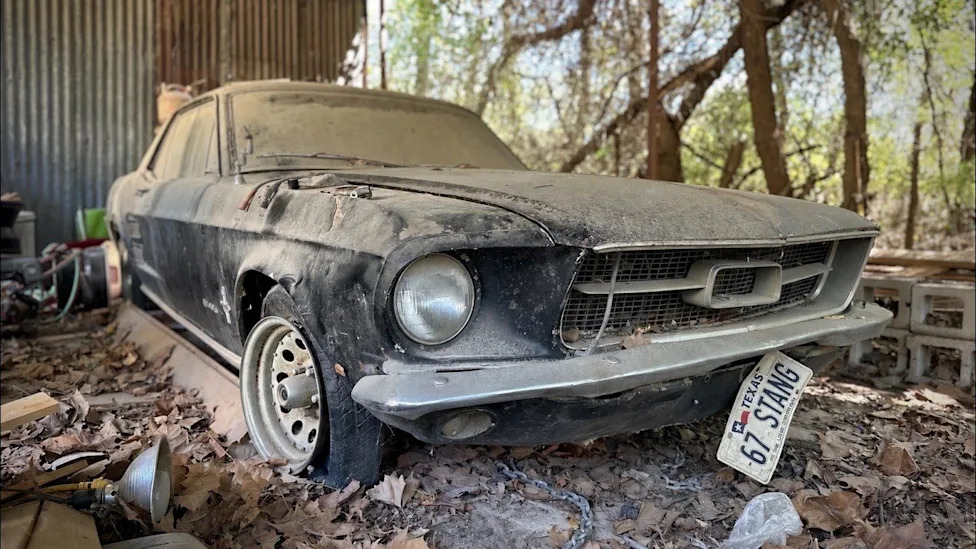
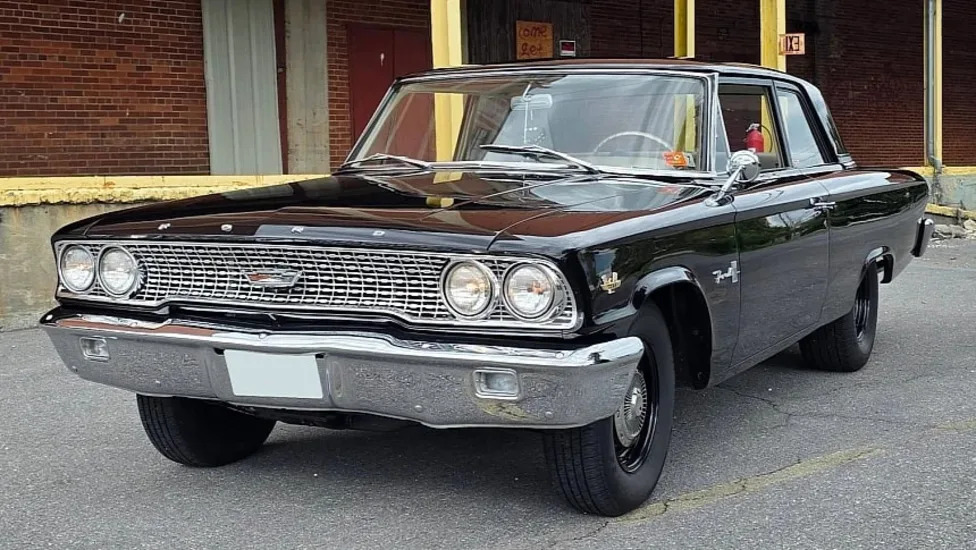
Ford Let You Order a 425-HP 427 in Its Cheapest Car for 1963 — Only Three Are Known to SurviveBackfire NewsJohn LloydSat, September 12, 2026 at 12:00 PM UTCAdd us on GoogleFord Let You Order a 425-HP 427 in Its Cheapest Car for 1963 — Only Three Are Known to SurviveFord's product planners built the 300 for 1963 with one goal: get people into a full-size Ford for as little money as possible. No chrome side trim, no fancy hubcaps, cloth-and-vinyl seats, and a model name that was just a number. Then, almost as an afterthought, Ford let buyers check a box that dropped its meanest engine into that same stripped-down sedan: the 425-horsepower, dual-quad 427. That odd pairing of poverty-spec sheet metal and top-shelf horsepower produced one of the great sleepers of the early muscle car era, and a surviving example is about to prove just how rare that combination turned out to be.The car, a black two-door sedan restored to its original no-frills appearance, is consigned to Mecum's Nashville sale as Lot S287, scheduled to cross the block on Saturday, September 26. According to Mecum's own listing, it is one of an estimated 50 factory R-code 300s built, and one of just three examples currently logged in the R-Code Registry, the enthusiast-run database collectors use to track surviving cars by VIN, casting numbers, and paperwork.Ford's Cheapest Full-Size Car Was a One-Year WonderThe 300 existed for a single model year, wedged in below the Galaxie, Galaxie 500, and Galaxie 500 XL in Ford's 1963 full-size lineup. It came only as a two-door or four-door sedan, no hardtops, no wagons, no convertibles, and skipped almost every appearance option Ford offered elsewhere in the range. Factory production records show 26,010 two-door 300 sedans and 44,142 four-door versions built that year, a combined run that dwarfs the handful ordered with the 427. Priced meaningfully below even the base Galaxie, the 300 became a favorite of taxi companies and police departments looking for basic transportation, not a car anyone expected to see lined up at a stoplight with a big-block rumble under the hood.What Made the R-Code Option Worth ChasingFord's engine-code letters in the VIN told you exactly what was under the hood, and "R" meant the top of the food chain for 1963: a 427-cubic-inch FE-series big block fed by two Holley four-barrel carburetors on a factory dual-quad intake, officially rated at 425 horsepower. It replaced the 406 as Ford's flagship engine that year and represented the company's clearest shot yet at NASCAR and NHRA competitors running big-inch Mopars and Chevys. Ordering it meant living with a mandatory four-speed manual transmission, since Ford didn't trust anything else to handle that kind of torque, along with a stiffer chassis and rear end to survive what the engine could do to it.AdvertisementAdvertisementBolting that engine into the 300 rather than a Galaxie wasn't just about saving money. Every pound Ford left out of the 300, the extra brightwork, the sound-deadening, the padded dash options, came off the nose of a car about to carry the heaviest engine in the catalog. For anyone planning to run at the strip on a Sunday afternoon, a lighter body with the same 425-horsepower engine as the flashier cars was the obvious move, which is exactly why so few of these plain sedans survived the decade that followed.Why Only Three Are LeftCars built for racing tend to get used for racing, and used-up big-block sedans from the early 1960s had little collector value for decades after they stopped being competitive. Many were crashed, rusted away as unloved daily drivers, or simply parted out once their engines became more valuable than the rest of the car. An estimated 50 factory R-code 300s is already a tiny number against the model's total production; a documented survival rate of just three is the kind of attrition that turns a niche option into a genuine unicorn. It's the same dynamic that makes a barn-find muscle car worth chasing regardless of badge, and that scarcity is exactly why registries like this one matter so much to buyers, since cross-referencing a VIN against casting numbers, broadcast sheets, and prior ownership records is the only real way to separate a genuine survivor from a clone built around a warmed-over 427.What's Actually Under This Particular CarThis example wears its original-style black paint, color-matched steel wheels, and small-diameter hubcaps, the same understated look it would have had rolling off the assembly line. Inside, it keeps the basic split-bench seat and tan vinyl trim, dressed up only by a Sun Super Tach II perched on the column. The car has previously been featured in Modified Mustangs and Fords magazine, according to Mecum's listing.Under the hood, the story is more complicated than factory original. The 427 has been professionally bored and stroked out to 482 cubic inches, wearing a Medium Riser FE intake manifold and the correct-style dual four-barrel carburetors. Backing it is the original-spec Toploader four-speed manual and a Ford 9-inch rear axle fitted with a nodular case, a Detroit Locker, and 31-spline Moser axles, all upgrades aimed at surviving repeated hard launches rather than staying period-correct down to the last bolt.Why the Engine Work Matters to a BuyerThat 482-cubic-inch stroker build is a smart way to build a stronger, more reliable FE big block, and it's a common path for FE-engine specialists working on 427s that need fresh internals anyway. But it also means this car isn't a numbers-matching survivor in the strictest sense collectors use that phrase, since the displacement alone rules that out. Appraisers and insurers draw a real distinction between an original, unmolested drivetrain and a period-style performance rebuild, even when the rebuild is done well and stays faithful to the car's factory character. Expect this 300 to sell as a documented, well-built R-code car rather than command the kind of numbers-matching premium a completely stock survivor would bring.AdvertisementAdvertisementAnyone bidding on a car like this should ask for the engine builder's paperwork, receipts for the rotating assembly, and whatever documentation ties the block back to its original casting numbers, the same due diligence that turned a documentation-heavy Chevelle LS6 into a headline lot at Mecum's Harrisburg sale earlier this year. It's also worth having a conversation with a specialty insurer before the sale closes rather than after: a car like this typically gets written on an agreed-value collector policy, where the insurer and owner settle on a fixed value up front instead of relying on standard depreciation schedules, usually paired with mileage limits and covered storage requirements.Where a Car Like This Sits in Today's MarketBlue-chip 1963 Fords, Galaxie 500 XL fastbacks, factory lightweights, anything wearing a Cammer, get most of the attention and most of the money at auction. A stripped 300 sedan was never going to be the star of that conversation, which is exactly why cars like this one have room to appreciate as FE big-block collectors look for interesting, honestly rarer alternatives to the usual suspects. It's far from the only significant lot crossing a Mecum stage this year either, from a dirt-caked, Paul Newman-driven Mustang to whatever six-figure surprise shows up next. Mecum's Nashville sale runs September 22 through 26 in Lebanon, Tennessee, and this 300 crosses the block on the final day. Whatever it brings will say something real about how much a documented factory R-code car is worth once the numbers-matching premium comes off the table.


















 +13 others