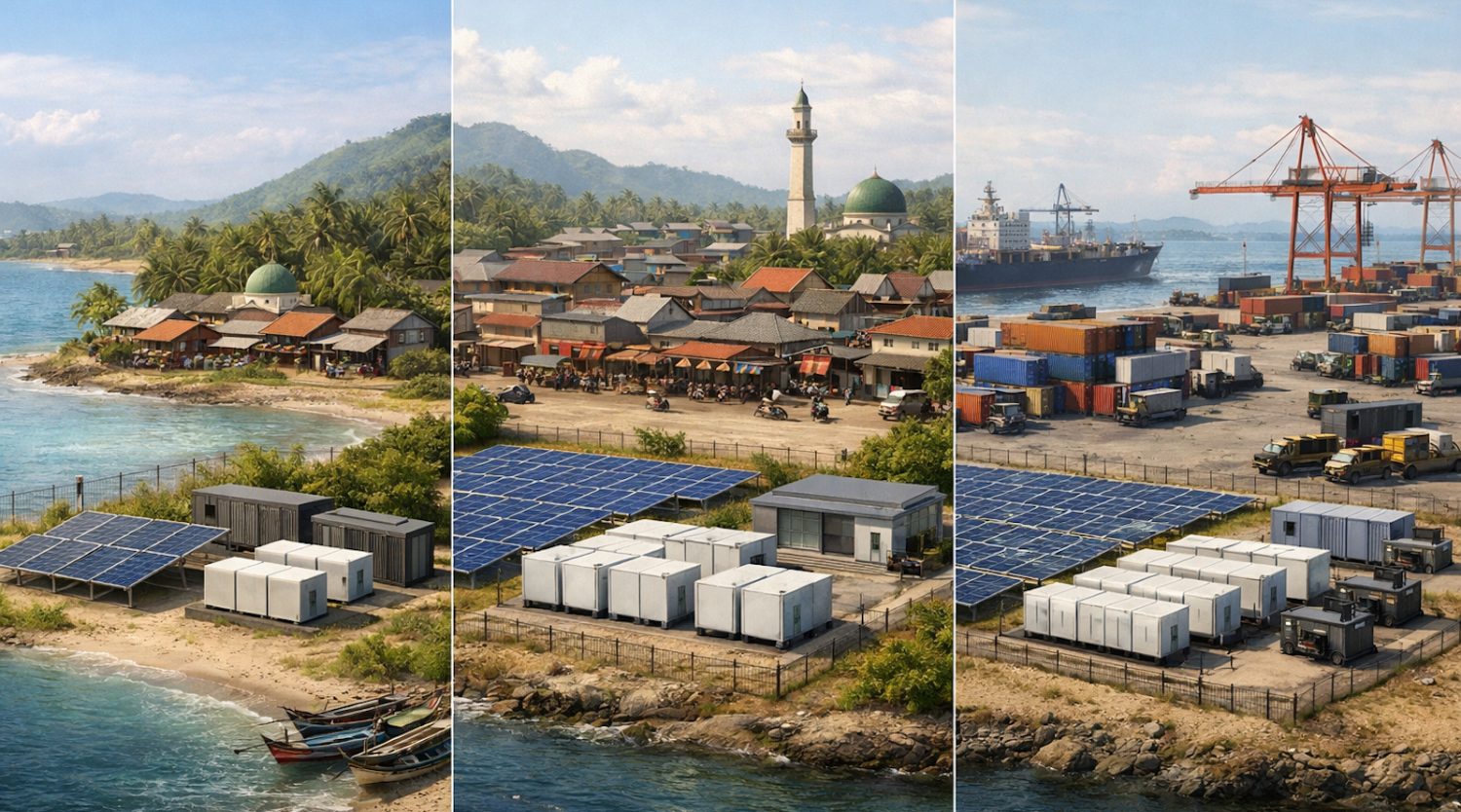



















Indonesia has reached the point where replacing remote diesel generation with solar and batteries is no longer a speculative clean energy idea. It is an economic and strategic proposition, and the timing of PT Perusahaan Listrik Negara’s (PLN), Indonesia’s state electricity company, latest announcement matters. While the utility’s April statement was framed in terms of reducing dependence on imported fuel and cutting the cost of diesel generation across 741 locations, it also lands in the middle of a wider energy security shock tied to disruption around the Strait of Hormuz, through which a large share of globally traded oil normally moves toward Asia. That does not mean the current de-dieselization push was invented because of the Gulf crisis. Indonesia was already moving in this direction. But it does mean that a program which once looked like prudent long-term transition planning now also looks like a near-term hedge against fuel import risk, price spikes, and maritime vulnerability across an archipelagic state. The basic economics are not hard to sketch. Public PLN data and reporting imply that the targeted diesel fleet is likely generating something in the range of 2.2 to 2.5 TWh of electricity annually. Using reasonable engineering assumptions for isolated diesel generation, that suggests fuel consumption of roughly 0.6 to 0.8 billion litres of diesel-equivalent fuel per year. At about 2.72 kg of CO2 per litre for direct combustion, that points to approximately 1.7 to 2.2 million tons of CO2 annually from the diesel currently being displaced. On the cost side, PLN’s published diesel generation costs imply annual operating costs in the range of Rp12 trillion to Rp14 trillion, which at recent exchange rates is about $700 million to $820 million per year. That is not a small side pocket of inefficiency. It is a material national cost burden tied to imported fuel, fragile logistics, and high local electricity costs. Once the capital cost of solar and batteries is brought into the frame, the picture becomes sharper. A reasonable 2026 estimate for Chinese utility-scale solar delivered and installed into Indonesia is around $500 to $650 per kW. For four-hour LFP battery storage, a fair delivered and installed range is roughly $125 to $175 per kWh, with the high end reflecting remote-site logistics and smaller installations. Using the commonly cited conversion from earlier Indonesian analyses that 225 MW of diesel replacement might require about 600 MW of solar and 1.8 GWh of storage, scaling that to 1.076 GW of diesel points to something like 2.9 GW of solar and 8.6 GWh of batteries. That yields a rough capital range of about $2.5 billion to $3.4 billion. Against diesel operating costs of about $0.7 billion to $0.82 billion annually, the simple payback lands in the range of about 3 to 5 years on optimistic assumptions and about 4 to 6 years as a more practical planning range once logistics, backup retention, and program overhead are included. Few energy transition stories offer that kind of payback in public infrastructure. That should have triggered a much faster buildout than Indonesia has seen so far. But that assumption confuses good asset economics with good institutional economics. Diesel is embedded in the system as an operating expense. The state utility knows how to buy it, move it, burn it, account for it, and support it politically. Solar plus batteries are cheaper over time, but they require up-front capital, standardized procurement, bankable contracts, good controls, dependable logistics, and operating models that many utilities and ministries have not had to master at scale. A diesel system can be bad and familiar. A solar plus storage system can be better and harder to institutionalize. For years, Indonesia has been caught in that gap. The geography of the country makes the challenge both more urgent and more complicated. Indonesia has about 285 million people, making it the fourth most populous country in the world. It is also spread across roughly 17,000 islands, with population and economic activity concentrated heavily on Java and Bali but meaningful communities distributed across a vast maritime space. That geography is exactly why diesel survived for so long. For many sites, long-distance grid expansion or submarine cable connections are difficult to justify. A few generators, a fuel supply chain, and a set of maintenance routines were the simplest answer for decades, even if they were not the cheapest answer in the long run. The country’s electrification rate is now very high, which changes the problem from first access to better service. Indonesia is no longer trying to electrify tens of millions from scratch. It is trying to replace expensive and dirty legacy generation in the last difficult systems. The demographic side of the story matters as well, and in a useful way. Indonesia’s population is not evenly spread across the archipelago. Java and Bali dominate economically and demographically, and that concentration gives the country deeper labor pools, ports, engineering capacity, manufacturing links, and financial resources than a smaller or poorer archipelagic country would have. Urbanization and a large working-age population are advantages when building supply chains, training operators, and supporting regional deployment hubs. But those same advantages thin out as the systems get smaller and more remote. The national economy provides the muscle for de-dieselization. The remaining diesel fleets sit where that muscle is hardest to apply. Having lived in Singapore and spent time in Bali, I have at least seen enough of Southeast Asia’s maritime logic to know that distance, logistics, and infrastructure land very differently in an archipelago than they do in continental economies. That does not make me Indonesian, and it certainly does not make me an authority on local realities, but it does make the logistical side of this challenge feel tangible rather than abstract. Ports, ferries, warehousing, weather windows, and local contractor depth are not side issues in island systems. They are part of the core design problem. It is important to acknowledge that Indonesia is not starting from zero. Indonesia has already been moving toward a hybrid, clustered, staged approach for several years. PLN’s own past reporting described earlier phases of de-dieselization. Indonesian analysts at the Institute for Essential Services Reform (IESR), the Regulatory Assistance Project (RAP), and the Institute for Energy Economics and Financial Analysis (IEEFA) have all laid out structured paths for diesel replacement. The new hybrid-power framework under the Ministry of Energy and Mineral Resources (MEMR) Regulation 19/2025 gives a more formal legal and procurement structure for hybrid systems in small islands and isolated grids. That matters. It means the current moment is not the invention of a strategy. It is the gradual emergence of a better rulebook and a broader recognition that execution discipline matters more than another round of generic ambition. The latest PLN announcement is still meaningfully different from previous rhetoric. First, it is more specific. There are locations, capacity figures, and a stated technology split. The emerging Indonesian model appears to be solar plus batteries as the default de-dieselization package, with microhydro integrated where local water resources make it worthwhile. Second, the announcement comes after the hybrid regulation, not before it. The rules are still incomplete in some respects, but there is more scaffolding for procurement and implementation than there was in earlier phases. Third, the current effort sits inside a larger national conversation about large-scale solar growth, de-dieselization, and energy security. It is starting to look less like a string of pilot projects and more like part of a national program architecture. That deserves real credit, because some of the most important ideas that Bent Flyvbjerg would recommend are already present in Indonesian thinking. The first is phased rollout. Flyvbjerg’s work on megaprojects stresses that big success rarely comes from trying to do everything at once. Indonesia’s own path, however uneven, has involved phases, clusters, and iteration. The second is a move away from one-size-fits-all technology choices toward archetypes. PLN’s split between hydro-rich sites and solar-plus-storage sites is a simple version of that. The third is clustering. Indonesian policy summaries and proposals now refer to clusters of projects within microgrids and to bundled procurement. That is very close to a Flyvbjerg-style rejection of bespoke one-off projects. The real shift comes when Flyvbjerg’s discipline is combined with a more operational infrastructure logic. In the white paper Rish Ghatikar and I wrote on electrifying freight with microgrids, the central idea was not the trucks. It was the deployment system. We argued for common modular approaches, a small menu of scaled increments, pre-baked design packages, regional staging, standardized software and controls, and strict resistance to uniqueness bias. In that context the problem was depot and truck-stop charging. In Indonesia the problem is diesel replacement in remote and islanded grids. But the infrastructure lessons carry over almost intact. That white paper argued that repeated infrastructure problems should be solved with repeatable infrastructure systems, not with custom engineering every time. That principle is directly applicable to Indonesia. A national de-dieselization strategy should not think in terms of 741 sites with 741 distinct engineering stories. It should think in terms of maybe five to eight recurring archetypes. There might be a very small village microgrid package, a medium community package, a weak-grid town package, a hydro-favored package, a coastal port or industrial package, and a small number of hard outlier packages. Every site survey should be trying to classify a site into one of those categories, not reopening the entire design process. That is the first major extension beyond what is publicly obvious in current Indonesian plans. Indonesia has already adopted the logic of hybridization and resource matching. The extension is to turn that into a hard kit-of-parts architecture. Find the Lego, as Flyvbjerg would put it, and stick to it. Solar panels are already Lego. Batteries are already Lego. Inverters and controls can be made close to Lego. Containerized or skid-mounted balance-of-system equipment can be made much closer to Lego than traditional utility projects usually permit. The enemy is not technical complexity so much as administrative and engineering indulgence. Every project team has a reason their site is special. Every EPC contractor has a reason to reopen the design. Every local actor has a preferred vendor or a local adjustment. That is how good economics get diluted into mediocre delivery. The second major extension is incremental build logic. One of the most useful ideas in the white paper was that infrastructure should be designed for the full destination but built in standard increments. In truck charging that meant not building for a 100% electrified fleet on day one. In Indonesia it means not insisting on perfect diesel elimination at every site from the beginning. The first package should target the most expensive diesel hours and the most predictable load. It should preserve system reliability, keep enough thermal backup in place, and generate a year or two of operating data. The second package can raise solar penetration, add storage, and retire more diesel running hours. The third package can deepen displacement where the economics and operational evidence support it. That approach is not a retreat from ambition. It is how ambition stops wasting money. This is one place where the Indonesian system has already been more pragmatic than some climate narratives allow. Analysts and officials alike have not generally claimed that every diesel generator will disappear overnight. There is a growing recognition that retained thermal backup will still have a role at some sites, especially in early phases. That is not a flaw in the strategy. It is common sense. A system that cuts diesel use by 70%, 80%, or 90% quickly is more valuable than a perfect concept that takes another decade to procure. The optimal path for a country like Indonesia is likely one where diesel becomes a shrinking insurance policy rather than a base-load reality. It is worth saying clearly that residual diesel in early packages is not failure. It is sequencing. The third extension is regional staging and pre-assembly. In the truck charging paper, we emphasized common staging areas where components could be assembled, tested, and shipped to field sites with as little local improvisation as possible. In an archipelago, this matters even more. Indonesia’s challenge is not just engineering. It is ports, shipping windows, spare parts, packaging, contractor mobilization, and repair logistics across long distances. A national program that relies on field-customized integration at hundreds of remote sites will bleed time and money. A program that pre-assembles containerized or skid-based systems at a small number of regional hubs will install faster, commission faster, and fail less often. This is where IESR’s own proposals are promising. Their recent work on delivering 100 GW of solar includes language around regional clustering, regional ports, warehouse storage, modular packages, and plug-and-play deployment. That should be acknowledged clearly because it shows that Indonesian thinking is already moving in this direction. The fourth extension is common telemetry, controls, and software. A lot of infrastructure discussions still behave as if the project ends at commissioning. In reality, remote-system success depends on monitoring, alarms, dispatch logic, battery management, inverter settings, outage diagnostics, weather response, and spare parts control. One of the strongest overlaps between the truck microgrids paper and the Indonesian proposals is the recognition that common software matters almost as much as common hardware. IESR has talked about national dashboards, digital twins, and automated monitoring. That is not decorative digitization. It is the backbone of a system that wants to deploy thousands of standardized assets and keep them running without reinventing operations at every site. A related issue is that operations and maintenance have to be treated as a first-order economic variable, not an afterthought. This is another place where Indonesian thinking deserves credit. Some recent proposals have included performance-linked O&M, reserve structures, and monitoring frameworks that go beyond a simple build-and-hand-off model. That is useful. Remote hybrid systems that look cheap at commissioning but degrade because maintenance was underfunded are not cheap systems. They are deferred failures. A serious national program has to buy performance over time, not just equipment once. There is also a domestic industrial dimension that has to be handled with care. Indonesia has built meaningful solar module assembly capacity and is developing battery manufacturing capacity, especially around the EV chain and upstream materials. That matters politically and economically, and over time it may matter strategically for resilience and jobs. But it does not automatically improve the near-term economics of de-dieselization. Some analyses suggest domestic module supply can still be more expensive than imported Chinese supply, and local battery capability remains uneven across the value chain. The practical path is likely one where Indonesia uses the lowest-cost proven technology it can access while building local assembly, packaging, BOS integration, and O&M capability in ways that do not slow rollout. Industrial policy matters. But in a program like this, the first question has to remain whether the systems arrive on time, fit together, and reduce diesel burn. This is another place where the focus of the truck microgrids paper is useful. In that paper we argued that the main objective must remain dominant, and that attractive side benefits should not be allowed to drive design decisions. For Indonesia, the first, second, and third priority should be reliable, low-cost electricity with less diesel. Grid services, local manufacturing goals, resilience branding, energy sovereignty narratives, or digital innovation agendas can all support that mission. None should be allowed to distort it. If a technology is not ready, it should not be included to satisfy a policy constituency. If a local content rule makes the standard package materially worse, it should be adjusted. If a site wants a custom feature that disrupts repeatability, the burden of proof should be high. This is not ideological rigidity. It is project hygiene. This matters because the missing pieces in Indonesia’s public story are less about technology than about industrialized delivery. I do not see much public evidence yet of a national program management office with hard design authority, strict change control, a locked component library, clear exception processes, and an executive dashboard that tracks sites, packages, schedules, costs, assets, and performance in one place. Some of that may exist internally. If it does, it deserves recognition. If it does not, then that is where the Flyvbjerg guidance, in my experience as a major technology projects and programs professional, becomes most useful. The goal is not to teach Indonesia what a hybrid microgrid is. The goal is to help build the operating system that can deploy hundreds of them without losing the benefits of standardization. That operating system has some familiar elements. There should be a dedicated national delivery team, not a side-of-desk coordination effort. Design authority should be centralized, even if site adaptation is regional. Change orders should be heavily restricted and escalated, because every change is a tax on repeatability. Site surveys should be focused on package fit and local constraints, not on redesigning the package. Procurement should be aimed at a small set of approved vendors and standardized configurations. Every site should be in a live database with asset IDs, component lists, maintenance histories, telemetry links, approvals status, and deployment schedules. Board-level or ministry-level dashboards should track a handful of key results, including diesel displaced, fuel costs avoided, reliability performance, cost per site, and time from site classification to commissioning. There is also a human systems lesson here. Early phases of a program need innovators, analysts, and designers who enjoy ambiguity. Later phases need operators, quality-control experts, program controllers, and logistics people who enjoy repeatability. Many large programs fail because they never make that staffing transition. They remain in pilot mode while announcing national scale. Indonesia’s de-dieselization effort has to be allowed to mature from strategic creativity into industrial discipline. That is not glamorous, but it is how projects stop being discussed and start being delivered. Indonesia’s own proposals also add things that go beyond the Flyvbjerg plus Barnard framing and should be treated as valuable extensions, not deviations. One is the broader social architecture. Some visions for Indonesia’s solar buildout involve not just PLN and large EPC firms but cooperatives, village-scale systems, and distributed ownership structures. That is a different social model from the corporate infrastructure focus of the truck microgrids paper. Another is the attention to performance-linked O&M and reserve structures. A third is the push toward digital monitoring and system visibility across a broad deployment base. Those are not signs that Indonesia is off model. They are signs that local analysts and planners are adapting the basic discipline to Indonesian realities. One of Flyvbjerg’s strongest recurring themes is the danger of uniqueness bias. Every major project tells itself that its special circumstances exempt it from standard lessons. Indonesia has good reasons to believe it is special. It is a vast archipelago with mixed load profiles, different local resources, and uneven infrastructure. That is all true. But it does not follow that every site must be unique. In fact, the more geographically complex a country is, the more valuable archetypes become. The right answer is not to deny local variation. It is to identify the limited number of ways that local variation actually matters. Solar resource. Hydro resource. Load size. Load shape. Shipping access. Telecom quality. Existing diesel condition. Everything else should be presumed secondary until proven otherwise. This suggests a better way to think about the future of the program. Instead of asking whether Indonesia can replace thousands of diesel generators, ask whether it can build a factory for replacing one recurring class of diesel system, then another, then another. Instead of asking whether it can finance one giant national transition, ask whether it can drive the cost and schedule down with every wave of repeated deployments. Instead of asking whether the target is 13 GW or 100 GW, ask whether the 50th standardized package is cheaper and easier to install than the 5th. That is the mental shift that separates large announcements from large outcomes. If Indonesia gets this right, the five-year markers of success will be unglamorous but unmistakable. There will be a short library of standard hybrid packages. There will be regional staging and repair hubs linked to major ports. There will be common telemetry and monitoring across deployed sites. Diesel purchases for targeted systems will fall in a measurable way. Cost per site and time to commission will decline with each wave. The share of engineering effort spent on custom redesign will drop. Program managers will know, in near real time, what is installed where, what is performing badly, what spare parts are required, and which package should be deployed next. At that point, Indonesia will not just have a de-dieselization strategy. It will have a durable, repeatable deployment system. That is the real opportunity in front of PLN, MEMR, Indonesian analysts, and their financing and delivery partners. The country already understands much of the problem. It already sees the economics. It already has a growing appreciation for hybrid systems, clustered procurement, and phased rollout. The next step is not more persuasion. It is disciplined replication. The most important contribution from Flyvbjerg’s project logic and from the infrastructure lessons Rish Ghatikar and I drew out in the freight microgrids paper is not a new technology or a new financial model. It is a way of turning a thousand hard projects into a manageable number of repeated solutions. For a country of Indonesia’s scale and complexity, that may be the difference between a promising policy and a historic achievement.