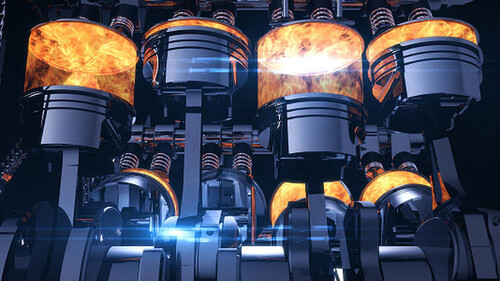
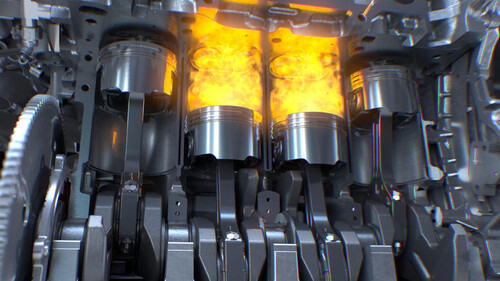
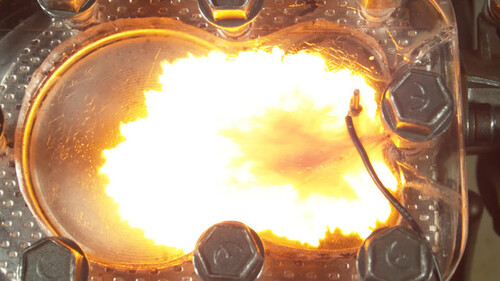
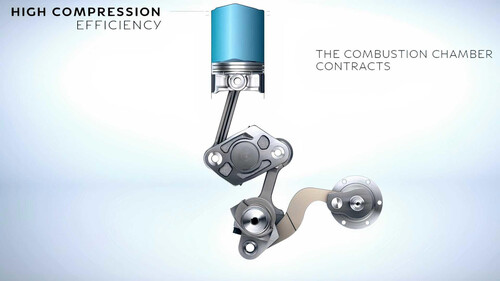
Close-up of V8 engine with four two-barrel carburetorsIf there's one question that's forever on the lips of car enthusiasts, it's how much horsepower an engine makes. Answering that question is deceptively complicated, however, because of what the term "horsepower" means. Horsepower is the result of a wide range of factors, but the gist of it is that it's a measure of how much work can be done in a certain amount of time. The more work performed in a shorter time, the more horsepower. Engines do this work through controlled explosions in a combustion chamber, and displacement and compression ratio both directly impact this process.To elaborate further, an engine's displacement is measured by the engine's bore and stroke. What does this mean? Simply put, bore is how wide the cylinder is, while stroke is how long the piston moves up and down. Plug those numbers into the formula to find the area of a cylinder, then multiply that by the number of cylinders, and you have your displacement. The bigger the displacement, the more air the engine moves in a single piston stroke, which means more power.Next, we look at the compression ratio. All that air is sealed off by the valvetrain closing and compressed by the piston forcing its way up. The difference in volume between the bottom and top is the compression ratio – for instance, a 10:1 compression ratio means the volume goes from ten spaces to one. The higher the compression ratio, the more air is in a given volume, which also means more power. Of course, it's a bit more complicated than that in both cases, so let's break this down further. How displacement affects engine powerFrontal view of a double overhead cam V8 engine on test standBoth compression and displacement involve getting more air into a given space, but the way displacement does it is by simply making more space. More space, more air, more power — simple as that, right? Yes and no. Displacement provides a solid baseline, but the actual power comes from the amount of air the engine can process at any one time. There are three ways of using displacement to boost engine power: increasing an engine's bore, stroke, or both. The relationship between bore and stroke plays a big role in an engine's power.Increasing an engine's bore relative to stroke means you now have an oversquare engine. Oversquare pistons don't travel as far to move the same volume of air, meaning you can rev the engine higher because there's less inertia behind the pistons. This produces higher peak horsepower but less torque, since the pistons have less leverage on the crankshaft because they're physically closer to the crank and don't move as far.Increasing an engine's stroke has the opposite effect and is known as an undersquare engine. The piston remains narrow, but travels a further distance in the same revolution. This means that for two engines running at the same RPM, the higher stroke engine has a faster piston speed because that piston must cover more distance to achieve that RPM. This produces more torque at the cost of peak horsepower; the engine simply can't draw the air in fast enough, and the mechanical limitations of the materials prevent engines with long strokes from achieving high RPMs efficiently and reliably. Nevertheless, more stroke also means more power, since it's still more air being moved for the same RPM. How compression ratio affects engine powerCutaway of inline-four engine showing pistons inside cylinder wallsCompression ratio is somewhat more complicated than displacement. The CliffsNotes version is that it's the volumetric difference between the combustion chamber's volume of space when the intake valve closes, and the space when the piston reaches the top of its travel. Imagine a sealed cylinder filled with air and a can on top of it. You press that can down to create compression; the more you press, the higher the compression ratio.What's important here is how the can (or the piston, in this scenario) reacts when that air explodes. Depending on how tightly packed that air is, it'll force the can out at higher speeds. The more compressed it is, the more explosive the result. There's a careful balance to achieve here; you don't want to damage the internals, but you do want more compression, which in turn means that an engine will produce more power during combustion.There are many ways to achieve higher compression ratios, the most obvious being forced induction via a turbocharger or supercharger. As the name suggests, this pushes already pressurized air directly into the cylinder, producing higher compression ratios. One can also simply compress the air into a smaller space in a naturally aspirated engine, usually with mods like new cylinder heads. Compression is also why some cars actually need premium gas; higher octane ratings are designed to withstand pre-ignition (also known as knocking), which can be set off by high compression ratios messing with the engine's timing. Want the latest in tech and auto trends? Subscribe to our free newsletter for the latest headlines, expert guides, and how-to tips, one email at a time. You can also add us as a preferred search source on Google.