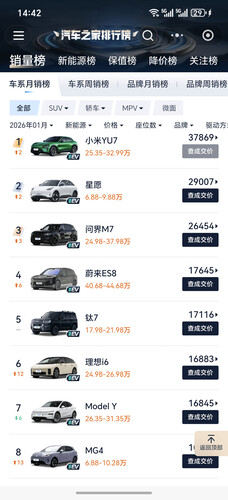
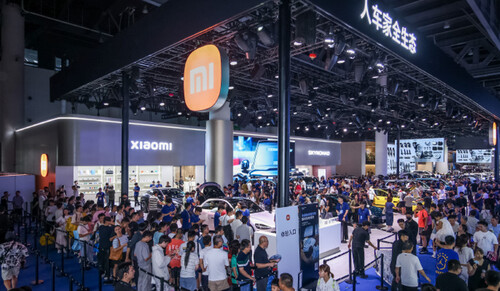
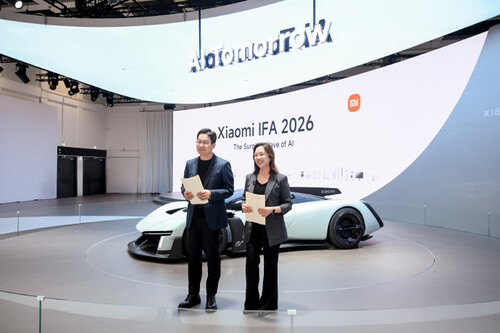
Gasgoo Munich-Xiaomi Auto delivered roughly 80,000 vehicles in the first quarter of 2026. To hit its annual target of 550,000 units, it will need to sell more than 52,000 cars a month for the next nine months.With NIO, Li Auto, XPENG, and Huawei's "Five Jie" alliance rolling out new models, the 200,000 to 300,000 yuan segment has turned into a battlefield. So, is Xiaomi Auto's 550,000-unit target still within reach?After Q1, a 52,000-Unit Monthly KPI RemainsThe first quarter of 2026 is in the books. Official data from Xiaomi Auto shows deliveries topped 39,000 units in January, followed by more than 20,000 in both February and March. That puts the estimated quarterly total at roughly 80,000 vehicles.Notably, Xiaomi Auto has set a sales target of 550,000 units for 2026. That means hitting the annual goal requires averaging over 52,000 deliveries a month for the remainder of the year.Looking back, December 2025 set a brand record with over 50,000 monthly deliveries. Scaling up from the current 20,000 level to more than 52,000 presents a clear challenge.The 550,000-unit annual target was announced by Xiaomi founder Lei Jun during a livestream in January. At the time, the 2025 full-year deliveries of over 410,000 units had bolstered market confidence.Official figures show the YU7 delivered 37,869 units in January and 20,196 in February. The new-generation SU7, meanwhile, began deliveries on March 23 and racked up over 7,000 units by month's end.Image Source: Xiaomi AutoFor Xiaomi Auto, the pressure isn't just numerical—industry competition is heating up.In March 2026, the retail penetration rate of new-energy passenger vehicles in China hit a historic 52.9%, surpassing internal combustion engine cars for the first time in a single month. With NEVs now the dominant market force, the industry has fully shifted from "incremental expansion" to "intense competition for market share."Across the broader NEV market, NIO, XPENG, and Li Auto are accelerating product cycles, while Huawei's HarmonyOS Mobility is closing in with its "Five Realms" lineup.In the first quarter of 2026, numerous automakers flooded the market with new launches and pre-orders, covering everything from family cars to high-end luxury. As the Beijing Auto Show approaches, a fresh wave of flagship model battles is set to kick off an even more brutal elimination round.Clearly, 2026 calls for a genuine sales miracle from Xiaomi Auto.To Support 550,000 Sales, Xiaomi Auto Revs Up Capacity and ChannelsIn fact, Xiaomi Auto began preparations early to ensure deliveries of the new-generation SU7.Before the new SU7 hit the market, Lei Jun openly admitted: "We never expected the first-generation SU7 and YU7 to be this popular. We prepared massive production capacity, but the orders we received far exceeded even that."To improve the buying experience, Xiaomi Auto started ramping up mass production two months ahead of schedule.Lei Jun has high hopes for the new SU7's delivery performance, though he also noted that a flood of initial orders isn't always ideal. Balancing production with sales, he emphasized, is the only way to truly resolve customer experience issues.Image Source: Xiaomi AutoXiaomi Auto isn't standing still amid the sales pressure. Capacity and channels are the "two wings" in this tough fight, and the company is tackling both.On the capacity front, Xiaomi Auto is moving fast. Reports suggest the Beijing plant's total capacity has reached 450,000 units. Phase I and II are running at full tilt, delivering 300,000 to 330,000 units annually, while Phase III came online after the 2026 Lunar New Year with a designed capacity of 150,000 units. Additionally, the Wuhan plant is set to begin production in May 2026, adding another 150,000 units. With multiple plants working in tandem, conservative annual capacity could exceed 600,000—enough to cover the 550,000 target on paper.On the supply chain side, development of in-house motors and smart-driving chips is underway. A power battery plant with a planned annual output of 15 GWh is scheduled to reach full production this year.The power battery project of Shidai BAIC (Beijing) New Energy Technology Co., Ltd. is reportedly nearing production. A joint venture between CATL, BAIC, Jingneng, and Xiaomi Auto, the facility spans 260,000 square meters and sits adjacent to Xiaomi's Yizhuang plant. It is a key component of Beijing's 2024 "3-100" major engineering projects.Expansion is also accelerating on the channel front. As of March 31, there were 274 service outlets covering 160 cities and 492 stores across 143 cities. Plans call for growing the store count to 500 this year, with a focus on tier-three and tier-four cities.The data suggests that the impact of capacity release and store expansion will become increasingly visible in upcoming deliveries.Notably, multiple media outlets report that Song Gang, the former executive who spearheaded Tesla's Shanghai Gigafactory, has joined Xiaomi Auto as plant manager. The move is seen as a critical step for Lei Jun to bolster manufacturing capabilities. While Xiaomi has not officially confirmed the news, it notably hasn't denied it either—a shift from its previous stance.Taken together, the 14% completion rate in the first quarter means the numerical pressure is real. Yet if Xiaomi Auto can quickly deliver on capacity expansion, new model volume, and channel growth in the second quarter, it still has a fighting chance.Since entering the auto sector, Xiaomi's brand has been defined by its ability to pull off miracles—the first-generation SU7 sold 380,000 units in under two years, and the YU7 topped 150,000 within six months of launch. Who's to say the 2026 sales miracle can't happen again? Whether the 550,000 target holds up may find its answer in the second-quarter delivery numbers.