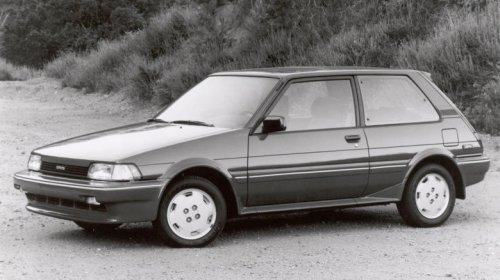
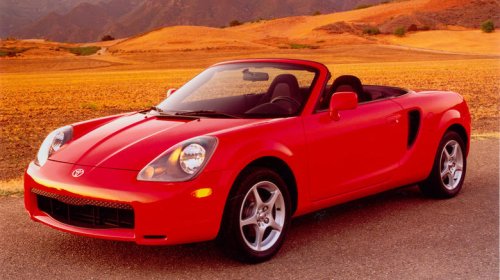
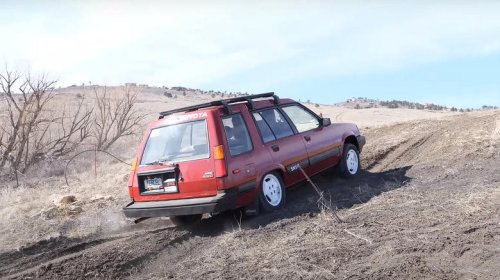
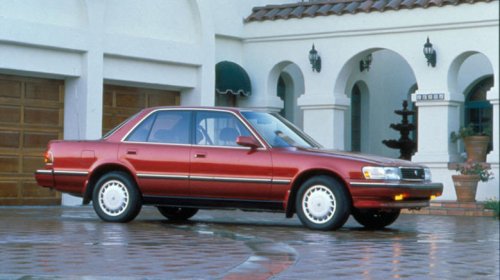
Toyota Corolla FX16 (1987 to 1988)Continuing with the hot-hatch theme, here is another Toyota that frequently flies under the radar: the 1987-1988 Corolla FX16. It might not be the best Corolla ever — that title belongs to the yearned AE86, but it has all the prerequisites for a fun ride on a budget. It weighs less than a modern city car, has a close-ratio five-speed manual near your right hand, and a rev-happy 4A-GE engine up front with a 7500-rpm redline. Some might lament the FWD platform, but hot hatches never had an RWD drivetrain to begin with.On the outside, the Corolla FX16 is a quirky-looking subcompact car. The rear end looks like a crookedly cut cake, and the sporty body trim on the FX16 adds little character. However, the beauty here is that few bystanders will ever know what this car packs under the bonnet. Isn't that the definition of a hidden gem? This is a car you will enjoy driving — not one you will show off. Work that stick-shift well and put the 1.6-liter engine through its paces, and there will surely be a smile on your face. The solid handling and good steering feel only add to the fun.Like most Corollas, the FX16 is reliable, and maintaining its simple mechanics is straightforward. The 4A-GE engine also enjoys excellent aftermarket support, so adding more power won't be an issue. Not that it needs it, but doubling the stock 108 hp in a chassis as light as the FX16's is a tempting proposition.Toyota MR2 Spyder (2000 to 2007)Most enthusiasts associate horsepower and speed with fun. However, ask seasoned drivers, and they will tell you it is all about lightness. Lotus, one of the most successful companies in racing, built its reputation on the "Simplify, then add lightness" mantra, producing some outstanding road cars in the process. Toyota followed the same recipe with the third-gen MR2 Spyder — a car that was less powerful than its predecessors, but lighter.The 1.8-liter VVT-i engine borrowed from the Corolla is the main reason why this particular MR2 is forgotten. Its 138 hp and 125 lb-ft of torque seemed underpowered even when the third MR2 launched. However, this economy engine propelled the roadster to 60 mph in a reasonable 7.1 seconds, courtesy of the featherlight 2,260-pound curb weight. The decision to go with this engine also means easier maintenance, fewer breakdowns, and more parts availability. Still, you can easily swap the stock engine for the 180-hp 2ZZ from the Matrix XRS and maximize performance!Thanks to its low weight, the MR2 handles like a go-kart. It reacts almost telepathically to steering input, stops quickly, and the engine is responsive at all times. The near-perfect 47:53 (front to rear) weight distribution further helps the MR2 Spyder feel balanced in the corners. Crucially, Toyota almost eradicated the "snap oversteer" issue of the first two MR2 generations, meaning even less-experienced drivers can enjoy its full potential. If you aren't interested in winning traffic light sprints, the MR2 Spyder might be the most fun-to-drive car out there!Toyota Tercel 4WD Wagon (1983 to 1988)Volvo might be the company that keeps the off-road wagon thing alive, but in the 1980s, Toyota was the fashionable brand among adventurists with the Tercel 4WD Wagon. With a raised suspension, a special 4WD system with a transfer case, and an unconventional 6-speed manual with a reduction gear, Toyota's lifestyle wagon was a capable off-roader. It even had an inclinometer on the dashboard — how cool is that? The only thing it lacked was performance; the 1.5-liter engine produced 71 hp and 80 lb-ft of torque. As a result, 0-60 mph took 16 seconds!What it lacked in thrust, the Tercel 4WD Wagon more than made up in functionality. Its cargo area measures 20 cubic feet (575 liters), or up to 60 cubic feet (1,700 liters) with the rear seats collapsed. Combined with the capable 4WD system, this would make the old wagon a bargain overlanding vehicle. In fact, the Tercel 4WD Wagon has an enthusiastic fanbase and good aftermarket support, so finding a lift kit or roof rack to make it even more adventure-capable isn't that hard.Since it is based on a Toyota economy car and shares the same internals, the Tercel 4WD Wagon is a fairly reliable vehicle. It is also easy to maintain and repair — great news for tinkerers and DIYers. So, if your concept of fun is going deep into the wilderness and your budget is tight, this boxy wagon might be the perfect four-wheel companion!Toyota Cressida (1978 to 1992)Straight-six engine. Rear-wheel drive. Comfortable, well-appointed interior. Are we talking about a BMW or a Mercedes-Benz? No — it's the Toyota Cressida. Before Lexus was a thing, this was Toyota's answer to the German and American executive cars. Sold from 1977 to 1992 in North America, the Cressida was the car you'd buy when you wanted a buttery-smooth ride, plush cabin, and Toyota reliability.Toyota's proto-Lexus luxury car had a lot going for it. The initial engine, for example, was borrowed from the Celica Supra MKII. Initially, it only made 116 hp, but Toyota later massaged the 2.8-liter inline-6 to 143 hp in the second-gen and third-gen models. The last, fourth generation of the Cressida received a 3.0-liter inline-6, making 190 hp. A four-speed automatic transmission, standard on all generations, was praised for being very smooth. But that was the overall mantra of the vehicle – it was designed to give passengers the calmest driving experience possible.Although overshadowed by the appearance of Lexus, the Cressida was a true luxury car. It might not win races, but for people who value comfort and quiet, it can be a hidden sanctuary. Moreover, the Cressida is much simpler than modern luxury cars. It has no screens to distract you inside, reminding you of the laid-back life of yore. Not to mention, it is mostly mechanical and rarely breaks down, so maintenance should be a breeze. True unnoticed excellence!



















 +26 others