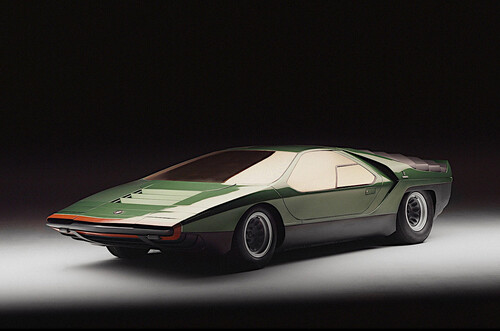
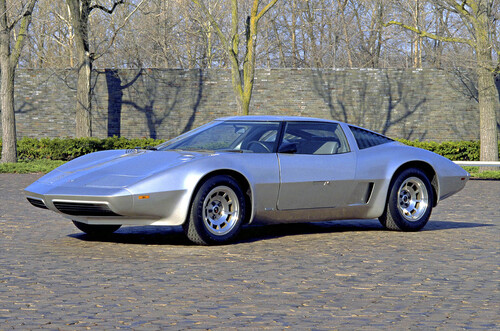
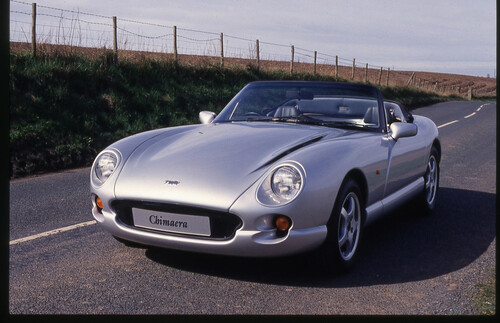
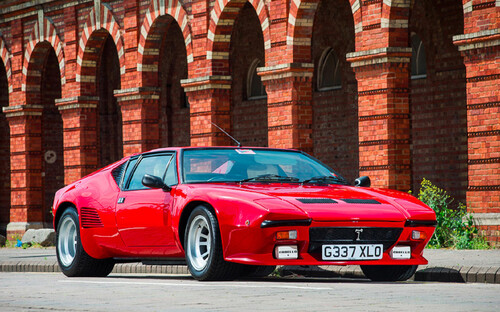
Concept cars have always represented a peek into the future of a brand, or even a designer's view as to what the entire industry ought to prioritize. We'd argue that the ideas a concept car presents are even more exciting than the car itself at times. Back in the 1970s, nobody knew that a real car would come from the Lancia Stratos HF Zero concept, but the idea ended up being so mind-blowing and revolutionary that it inspired a whole generation of Italian design.Not every concept is as successful as the Zero, but we thought we'd compile a list of eight concept cars whose ideas were so outlandish, bold, and futuristic that the industry never gave them a shot at production. We're quite optimistic that you've never heard of a few of these, but let us know if we're wrong.In this article, historical information and specifications are sourced from each car's respective manufacturer. If information/specs are not available from an OEM, they are sourced from reputable automotive outlets like Hagerty and others. 1961 Ford Gyron Ford The Ford Gyron was so out of the box that it ditched the standard of four wheels altogether. As you might be able to deduce from its name, the Gyron can stand on two wheels because of a series of powerful spinning gyroscopes that keep the vehicle upright. When turned off, it used a pair of smaller deployable wheels and stabilizers to make sure it didn't keel over. How fast was it? Well, there was one electric motor powering the singular rear wheel, and it had a maximum speed of 5 mph – blistering, no?Presented initially at the 1961 Detroit Auto Show, the Gyron was a complete departure from what anyone could consider a personal vehicle, and even Ford knew it. In fact, as is common among concept cars, the Gyron was never intended for a possible run of production because its design was more of a research case study than anything else.Ford The Gyron, unfortunately, has a sad ending to its story. In 1962, the only functioning Gyron concept was destroyed in a fire, and the other two non-functional concept cars were all that was left of this fascinating idea. 2008 Mazda Furai Mazda Unlike the Ford Gyron, the Mazda Furai had practical use – inspiring the design language of future models. Even though this ridiculous hypercar body looks nothing like a real Mazda production car, chief designer Laurens van den Acker wanted a flowing and fresh idea for the future of the brand.Mazda was critical of other car companies that displayed concept cars that had no functional use, so the Furai had to be a drivable machine. Thus, the concept's underpinnings were actually a Courage C65 LMP2 chassis, which raced in the American Le Mans Series from 2005 to 2006. Under the hood was a three-rotor rotary that made around 450 horsepower.Mazda The Furai debuted at the 2008 Detroit Auto Show, but made several other appearances at events around the world – most notably, the Goodwood Festival of Speed. If you would believe it, the Furai had the same exact tragic arc as the Gyron, burning to the ground during a Top Gear shoot. 1951 General Motors XP-21 Firebird 1 GM Though it looks the part, this concept car was not intended to fly. The XP-21 Firebird 1 was a huge point of pride for GM, being the first gas-turbine automobile to be tested in the U.S. The Firebird 1 was conceptualized and executed by GM's Styling Vice President Harley J. Earl and Research Division Manager Charles L. McCuen, and would be displayed at several Motorama shows throughout the 1950s.The XP-21 Firebird 1 used turbine power to operate, but not in the same way as an airplane. Instead of using the turbine's exhaust to propel via a tailcone, the Firebird 1's "Whirlfire Turbo-Power" engine propelled the rear wheels and generated 370 horsepower with a maximum turbine rpm of 26,000. And at just 2,800 pounds, this thing was probably a rocket ship.GM Though the Firebird 1 was never intended for production, GM claims that this research was crucial to their laboratory divisions and the betterment of the company's technology, and if nothing else, it's an incredibly cool piece of automotive innovation and history. The Firebird 1 was thankfully not destroyed in a fiery blaze, and it usually sits at the GM Heritage Center in Michigan. 1995 Chrysler Atlantic Via Weird Wheels One look at the Chrysler Atlantic, and you'll know exactly where its inspiration came from. Yes, the Atlantic concept car, which debuted at the 1995 Detroit Auto Show, took heavy cues from the iconic (and incredibly rare) Bugatti Type 57 Atlantic. Its bubble cabin and elegant flowing lines brought the 1930s Bugatti styling back to life in a very 1990s way.Though it was never officially considered for production, Chrysler's engineers did build it with proper steel body panels, according to Below The Radar, which suggested that they were at least giving it a thought. They even tried to fit a Viper V10 engine in the thing, and though it would have fit, the Atlantic was never truly destined for the streets.Via Stellantis So, if there wasn't a V10 inside, what was? Chrysler did an interesting engineering trick and mated two Dodge Neon 2.0-liter inline-four engines end-to-end, creating a 360-horsepower 4.0-liter straight-eight, an engine configuration America hadn't seen since the end of World War II. 2013 Lamborghini Egoista Lamborghini The Lamborghini Egoista was a one-off special edition concept car that Lamborghini released in 2013 to celebrate the 50th anniversary of the company. Inspired by fighter jets, the Egoista had a single-seater design with a transparent orange canopy that enclosed the driver.Everything about this car was excess on top of more excess. The engine was a 600-horsepower version of the well-known 5.2-liter V10, and its body panels were made with anti-radar material (like a fighter jet). Not to mention, the interior looked straight out of an F-35 – yolk steering wheel, harnesses and all.Lamborghini The single example was actually bought by a private collector shortly after the Egoista's 2013 debut, costing a whopping $117 million, according to TopSpeed. 1957 Ford Nucleon via Ford Evidently, Ford likes to give their concept cars extremely on-the-nose names, and as you might imagine, the Nucleon was all about nuclear power. The 1940s and 1950s saw a huge boom in the interest and research behind nuclear energy, and Ford, being curious, wanted to see what a nuclear-powered car would look like.Debuting in 1957, the Nucleon was designed with Ford's present styling in mind, but the real headline was outback. Where the trunk or bed would typically be, Ford envisioned a compact fission reactor sitting behind the cabin. Up front, the passengers sat nearly completely in front of the front wheels, much like an airport tow, in order to offset the weight of a heavy nuclear reactor.Ford Obviously, a reactor was never installed in the car, and in truth, it never actually made it beyond the scale model phase, but according to Ford, if it ever had been made possible, the uranium-powered Nucleon could theoretically travel 5,000 miles before needing to be replenished. It will be remembered as one of the most visionary concept cars in history. 1990 Plymouth Voyager III Stellantis If you've ever seen a NASA shuttle detach from its engines midair and thought "that should be on a public street," the Plymouth Voyager III is the vehicle for you. Designed in 1989 and presented at the 1990 Detroit Auto Show, the Voyager III was created during an era when small, economical vehicles were being pitched as a solution to global warming. But at the same time, the minivan fad was taking off.As such, Plymouth thought people should have both in one vehicle. The Voyager III was comprised of a small city car up front, and the rear two-thirds of a minivan out back that could be detached. When the two parts were connected, the city car's rear wheels would be lifted, using the van module's rear axles as the acting rear end. Essentially, this was a glorified trailer that could be detached if you didn't need all the space of the full set.Stellantis The Voyager used two engines, one for the city car and one for the van module. The former was a 1.5-liter unit that was proposed to operate on alternative fuel, and the latter engine (attached to the van's rear end) would be a 2.2-liter turbo-four, for a final combined output of 250 horsepower. According to Plymouth, the whole shebang could seat eight people, with the interior capable of folding into multiple different accommodations, as well as a functioning bed. Ferrari 512 S Modulo Via FerrariDesigned by Pininfarina's Paolo Martin, the Ferrari Modulo was a passion project born from a real Ferrari racecar – the 512S. Once the 512S had served its purpose, Ferrari had essentially no further use for the leftover chassis, and because Pininfarina was gearing to bring a new concept to the 1970 Geneva Motor Show, they allowed Paolo Martin to use one as his base.Bearing a similar design to the Lancia Stratos Zero concept of the same year, the Modulo was as low, wide, and futuristic as possible. It was admittedly gorgeous and won several awards throughout its tour in the early 1970s, all with the decommissioned 5.0-liter Ferrari Can-Am V12 still in the engine bay.FerrariIts shape was so dramatic that the door opening wasn't really a door at all – instead, a sliding glass canopy would allow passengers to enter from the top. The Modulo probably has the happiest ending of any car on this list, as legendary car collector Jim Glickenhaus acquired the prototype and carefully modified it to be legal for road use. Yep, that spaceship is insured and is frequently driven to events.Sources: Hagerty, Ford, GM, Lamborghini, Mazda, Stellantis.