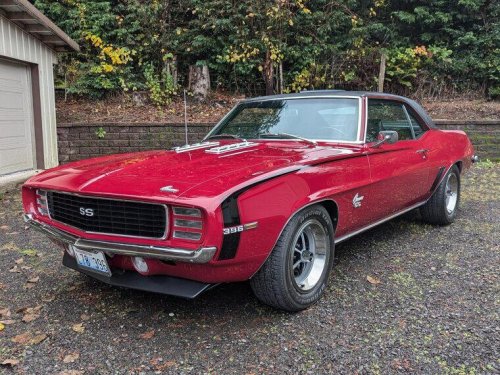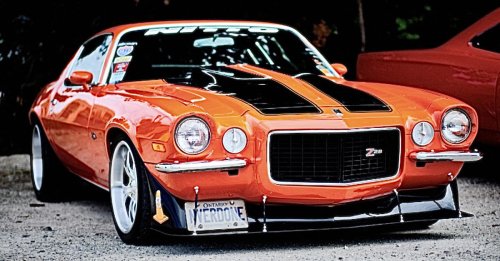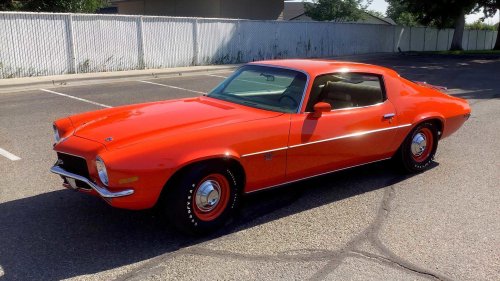
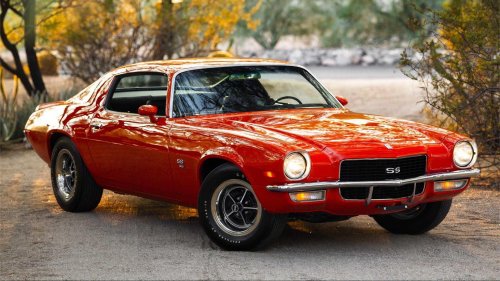
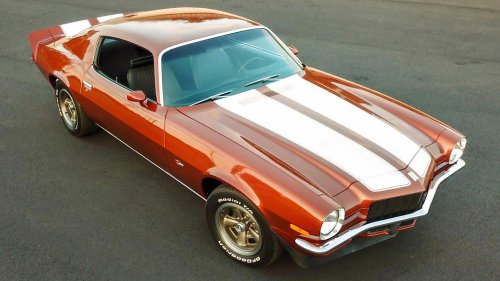
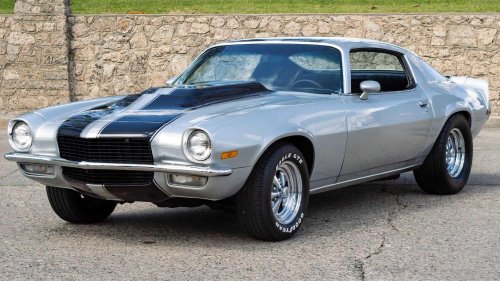
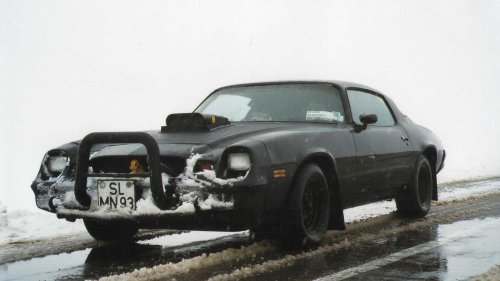



















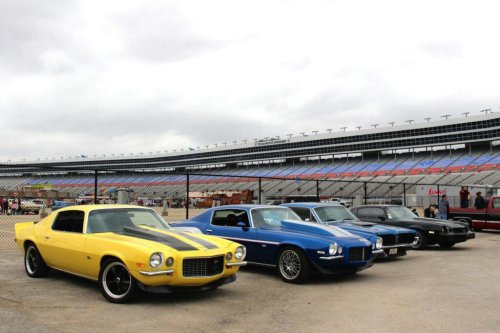
Jump LinksChevy Camaro SS 350Chevy Camaro SS 396Chevy Camaro Z/28Chevy Camaro 454 Big-Block V8Chevy Camaro Trans-Am Race CarGhost CamaroF-Bomb CamaroThough much loved and respected, since its production ended at the tail end of 2023, the Chevy Camaro remains in a state of limbo, and while a successor has been teased, it’ll be at least a year or two away. Even then, we still don’t know if the future Camaro will retain its pony car roots, or if it’ll take the shape of a four-door sedan, an EV, or (gasp!) a crossover. Until then, at least we get time to relish the Camaro’s incredible heritage and legacy up to this point, and what better place to start than the 70s Camaro?The Malaise Era was smack-dab in the middle of the second-generation Chevy Camaro, with production spanning from 1970 to 1981. Although most cars normally tend to get better over time, the second-gen Camaro got worse as the 70s dragged on and into the 80s. Between the 1973 Oil Crisis, the CAFE emissions standards in 1975, rising insurance rates, and changing consumer tastes, the 70s Camaro didn’t have an easy life. Despite that, if you look closely, there are still hidden gems in the 70s Camaro. What Do You Need To Know About The Second-Generation Chevy Camaro? First introduced in 1970, the second-generation Chevrolet Camaro was very similar to the first-generation Camaro in terms of its basic mechanical layout and form factor. It had a unibody design, with a big, hearty V8 engine at the front, and it sent all that raw power and torque to the rear wheels. That said, if you’re new to the 1970s Camaro, here’s a quick rundown of how it’s different from the first-gen car:It grew in comparison, as it was lower, longer, wider, and sleeker, with a more European design. It was only sold as a Coupe, and the Chevy Camaro Convertible was nowhere to be seen. GM’s own engineers claimed that it was even more of a driver’s car than before. A more refined suspension and chassis meant that it had improved comfort, ride quality, road-holding, and soundproofing. Chevy’s motorsports experience from taking the first-gen Camaro racing trickled down to give the second-gen car better steering, braking, and balance. Special '70s Camaro Models You Probably Forgot About To celebrate one of the most memorable Pony Cars of the Malaise Era, here are some of the most special 70s Chevy Camaro models you might’ve forgotten about, from the ultra-cool to the ultra-rare: Chevy Camaro SS 350 1970 Chevrolet Camaro SS 350 Exterior (4)A staple of the first-generation Camaro, the SS (Super Sport) name made a return in the second-generation Camaro, too, starting with the 1970 Chevy Camaro. It was even offered with two different engines, but more on that next. For now, though, the base, standard engine, if you ordered the RPO Z27 Camaro Super Sport package, was the 350 cubic-inch (5.7-liter) ‘L48’ small-block V8.For the 1970 model year, this 350 cu-in engine cranked out a meaty 300 hp at 4,800 rpm and 380 lb-ft of torque at 3,200 rpm. Nonetheless, and this will be a common theme across the rest of the Camaro lineup as it progressed throughout the 70s, power and torque only went down from here, thanks to new federal emissions standards that required engines to be optimized to run on lower-octane unleaded gasoline.For race engines like the ones in the sportier 70s Camaro models, this meant you had to drop the compression ratios. In 1971, the 350 cu-in L48s had their compression ratios reduced from 10.25:1 to 8.50:1, which saw power and torque drop to 270 hp and 360 lb-ft. By 1972, the last Camaro SS 350 model year, a change from measuring gross to SAE net horsepower also saw this drop again to a mere 200 hp and 300 lb-ft of torque. Chevy Camaro SS 396 1970 Chevrolet Camaro SS 396 Exterior (2)If you wanted a speedier Camaro SS, you also had the option to upgrade to a bigger, more powerful 396 cubic-inch (6.5-liter) big-block V8 engine instead. That said, though Chevy retained the ‘396’ badge due to its strong brand recognition, it actually nominally displaced 402 cubic inches (6.6 liters). You even had two different variants of this 402 cu-in engine to pick from for your Camaro SS 396 for the 1970 model year.There was the ‘L34’ engine, which made a respectable 350 hp at 5,200 rpm and 415 lb-ft of torque at 3,400 rpm. For a bit more oomph, you then have the ‘L78’ engine, which puts out a mighty 375 hp at 5,600 rpm and 415 lb-ft of torque at 3,600 rpm. Sadly, the 375 hp would be discontinued for the 1971 model year, and like the SS 350, the SS 396 wasn’t immune to having its compression ratio gutted, this time from 10.25:1 to 8.5:1.This meant that in 1971, power dropped to just 300 hp and 400 lb-ft of torque, before decreasing again in 1972 to 240 hp and 345 lb-ft of torque. Moreover, 1972 was the last year for the SS 396 and the last year that a Camaro was offered from the factory with a big-block V8 engine. There is a silver lining to this, though. Thanks to production issues, only 970 examples of the SS 396 were built in 1972, making it exceptionally rare. Chevy Camaro Z/28 1970 Chevrolet Camaro Z28 Exterior (3)While the Super Sport was nice and all, there was another sporty factory option you could spec your 1970 Chevy Camaro with: the RPO Z28 Special Performance Package. Otherwise known as the Z/28, it came with a 350 cubic-inch (5.7-liter) LT1 small-block V8. This engine came out of a Corvette, as it had even more power than the smaller Trans-Am-derived 302 cu-in (5.0-liter) V8 engines that were used in the previous Z/28s.It had more torque, a simpler cam design, and a 780 cfm Holley four-barrel carburetor. In all, this LT1 produced a healthy 360 hp at 6,000 rpm and 380 lb-ft of torque at 4,000 rpm, and it was paired with either a three-speed Turbo Hydramatic 400 automatic or a four-speed manual transmission. Alas, like clockwork, strict emissions regulations and the then-new fuel economy standards came into view once again to kill all the fun.By 1971, power dropped to 330 hp and 360 lb-ft, which is still pretty solid, but then, in 1972, it fell off a cliff to a mere 255 hp and 280 lb-ft of torque. Plus, 1972 saw the badges simplified from “Z/28” to just “Z28,” and by 1975, despite offering two optional 350 cu-in V8 engines, they only made 145 hp and 155 hp, respectively. The Z28 was revived in 1977, but this time, it was no longer an RPO option, and it became its own standalone model. Chevy Camaro 454 Big-Block V8 1970 Chevrolet Camaro 454 V8 Exterior (2)This is a bit of a cheat since it never went into production, but it’s still a cool historical what-if of the 70s Camaro. See, some of the 1970 model year early sales brochures and spec sheets gave you the choice of two other meaty engines, both of which were 454 cubic-inch (7.4 liter) big-block V8s. This was the same engine found in a lot of other period Chevys: the Caprice, Impala, Chevelle, Monte Carlo, C3 Corvette, and the El Camino.While neither the ‘LS6’ nor the ‘LS7’ (not to be confused with the modern LS7) was ever officially offered by Chevy, these 454 cu-in mills are popular engine swap projects on both the first- and second-gen Camaros. Using the C3 Corvette as an example to show you how powerful these engines were, if Chevy had actually put them into production with the 1970 Camaro, the LS6 made an incredible 450 hp and 500 lb-ft of torque.The beefier LS7, meanwhile, could easily manage at least 465 hp and 610 lb-ft of torque! It’s hard to estimate engine swap projects, of course, since each engine is an individual build, but official, period-correct 454 cubic-inch crate engines were rated for at least 500 hp. So, if you have an old Camaro, and you’ve been itching to restomod it, it might be worth shopping around for a 454 CID crate engine if you’re eager for more power. Chevy Camaro Trans-Am Race Car Like all Camaros past and present, the second-generation 70s Camaro did go racing, even though it wasn’t as successful as the first-gen cars in the Trans-Am championship. Perhaps the most notable 70s Camaro Trans-Am racers were three cars built for the 1970 season by Chaparral Cars (remember them in Gran Turismo?) and its co-founder, Jim Hall, who was also a pioneer of early aerodynamics and ground-effect aero.The Chaparral Trans-Am Camaros had fender flares that made them much wider than the road-going cars, in addition to aero improvements inspired by the real Chaparral race cars. These included the flexible, transparent front splitter made from Lexan, and the stock trunk lid spoiler was replaced with the one used on the Pontiac Firebird, as it actually generated more downforce than the standard 1970 Chevy Camaro rear spoiler.Later, the bodies were acid-dipped to help minimize weight, which was reflected in how Spartan the interior was, too. Under the hood, you’d get a 302 cubic-inch small-block V8, where engineers enlarged this engine to barely squeeze under Trans-Am’s 5.0-liter displacement limit. In race-spec, this engine produced 440 hp with a four-barrel Holley carburetor, and it was mated to a four-speed Borg Warner manual transmission. Ghost Camaro 1979 Ghost CamaroOnce again, this isn’t a production-spec car at all, but it showcased just how pliable these old Camaros can be. Originally owned by a US airman stationed at Rhein-Main Air Base in Frankfurt, Germany, it was then bought by Helge Meyer, an ex-member of Denmark’s Elite Jaeger Corps special forces group. Meyer originally wanted to use it to deliver humanitarian aid to people suffering from the Bosnian War (1992 to 1995).And so, with some help from US Air Force personnel, this 1979 Camaro was modified with Kevlar and steel armor plating, a reinforced blade at the front for clearing debris, and a matte black infrared-absorbing paint (also used on fighter jets) to make the Ghost Camaro more invisible to radar detection and thermal imaging. Of course, it was fitted with night vision and infrared headlights to navigate the darkness.Bear in mind, the Ghost Camaro was driven straight into a war zone, so to make sure that Meyer knew where he was going, it came with a military-spec GPS and run-flat tires to ensure he could keep moving, even after getting a puncture or the tires shot out by gunfire. And, the engine was upgraded to make 220 hp, or with nitrous oxide, it could put out as much as 440 hp for quick getaways and to haul 800 lbs of critical supplies. F-Bomb Camaro This is also not factory-spec at all, though it’s still worth giving a shout-out to the iconic ‘F-Bomb’ Camaro, which was even featured in Fast & Furious. Granted, while those cars were movie replicas, the real F-Bomb Camaro did exist. Based on a 1973 Chevy Camaro Z28 with the RS (Rally Sport) styling package, it was originally built by David Freiburger, Chief Editor of Hot Rod Magazine, for drag racing and to showcase the car’s tunability.After some tweaking, it now sports a 406 cubic-inch small-block V8 engine, mated to a couple of turbos. Thanks to this twin-turbo setup, this 70s Camaro whipped out an almighty 1,540 hp, and even more impressively still, 1,527 lb-ft of torque at 6,000 rpm, with 25 psi of boost, and using pump gas at that! It was designed to run an eight-second quarter-mile, though so far, its best time is a (still) wicked 9.08 seconds at 154.86 mph!FAQQ: How much did a Camaro cost in 1970?In 1970, the then-new second-generation base-spec Chevy Camaro retailed for $2,749 if you wanted the six-cylinder model and $2,839 for the V8. Of course, Chevy offered a ton of different options and modifications under their RPO (Regular Production Option) catalog. If you wanted the RS (Rally Sport) appearance package, that would’ve cost you $188.35 back in 1970, while the SS (Super Sport) package gave you a 350 cu-in V8 with 300 hp for $289.65. Meanwhile, the Z/28 Special Performance package gave you a 360 hp V8 engine for an extra $572.95.Q: Was there a 1970 Camaro?Yes, there was! 1970 saw the introduction of the second-gen Chevy Camaro, which was considered the most desirable model year amongst the early second-gen 70s Camaro models. In the later years, starting with 1971 and onto the late-70s Camaro, power gradually declined with the introduction of period emissions control systems, reduced compression ratios to meet the fuel economy and tailpipe emissions standards, and the inclusion of heavy government-mandated crash bumpers. The 1970 Chevy Camaro still remains highly desirable today.Q: What gen is a 1972 Camaro?A 1972 Camaro would belong to the second-generation of the Chevy Camaro family. Unlike the earlier 1970 Chevy Camaro, the 1972 Camaro actually became less powerful over time due to strict new emissions and fuel economy standards. However, the 1972 model year Camaro is noteworthy for its rarity, as production issues meant that only 970 examples of the SS 396 were produced in 1972. This was also the last model year for the SS 350 and the SS 396, the last year that a big-block V8 engine was offered from the factory, and the “Z/28” badge was simplified to “Z28” instead.