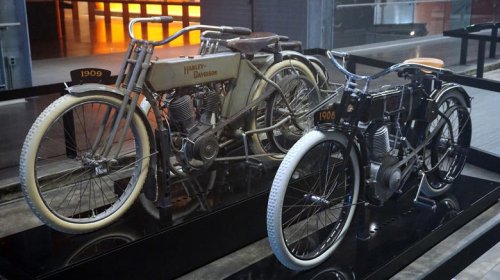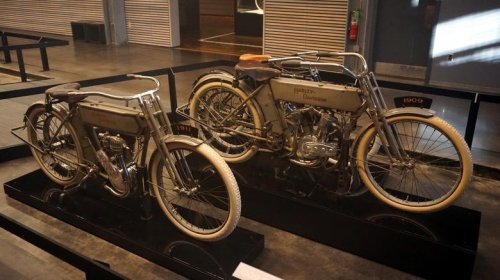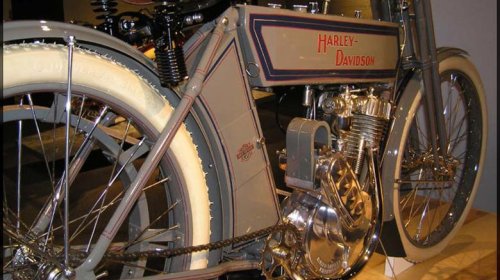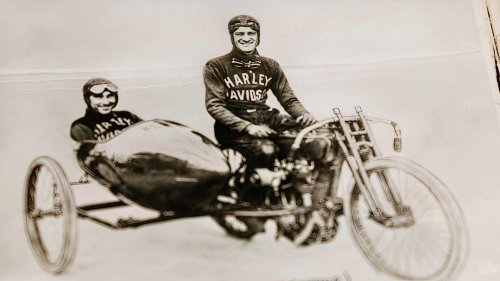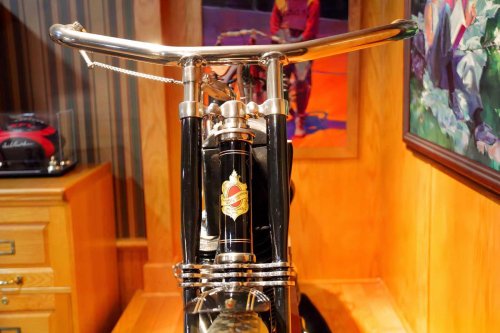
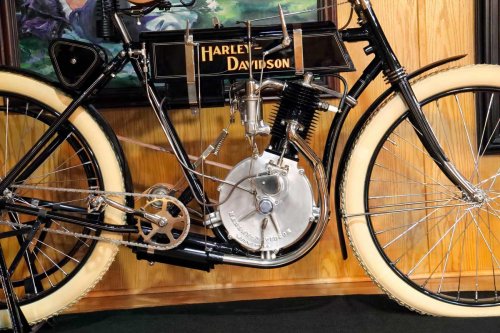
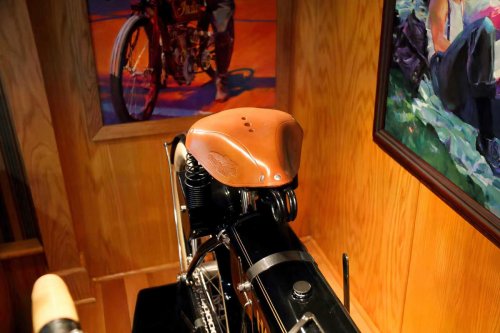
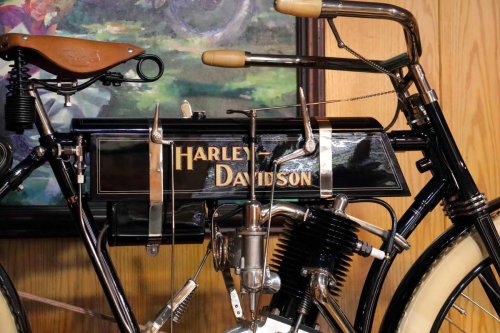
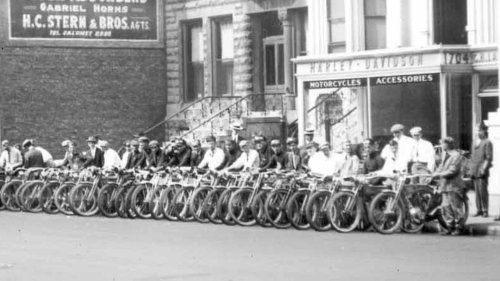
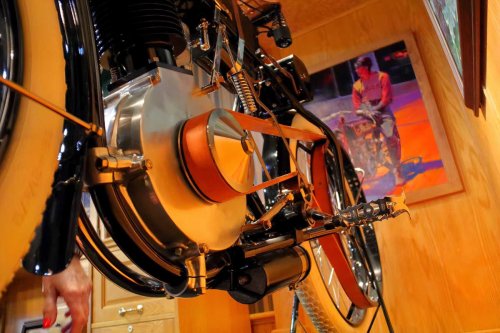
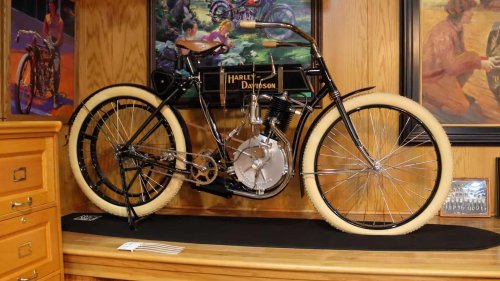
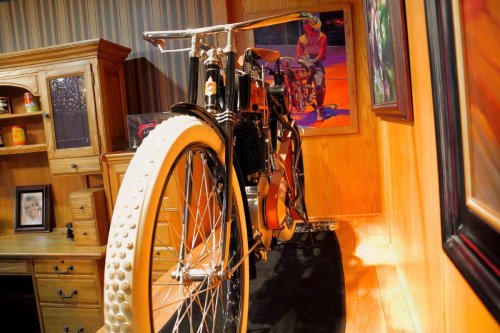
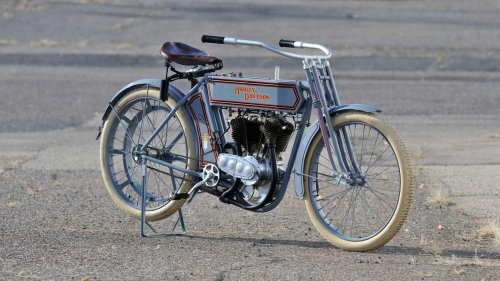



















With a rich history that dates all the way back to 1903, Harley-Davidson motorcycles are more than just machines; they’re living testaments to the evolution of two-wheeled culture here in the United States. For even though many models have come and gone over the years, there are still some early 20th-century examples that survive to this day. Of course, the unforgiving passage of time means that many of those very first Harley-Davidson models are few and far between.But which of the Motor Company's models has the lowest production numbers? While early Harley-Davidson production records suggest that several motorcycles could satisfy this criterion, there's one in particular that's especially elusive. Having scoured the web for only the scarcest of Harley motorcycles, we have for you today what we believe to be the rarest of the lot. In our estimation, it's all the more fitting because it's the model that established Harley-Davidson as a bona fide motorcycle manufacturer. Harley's First Production Model Is A Rare Breed Mecum If you have your heart set on finding the rarest Harley-Davidsons ever produced, you'll want to look to the Milwaukee brand's formative years. Before securing a factory to increase their manufacturing capabilities, William S. Harley and Arthur Davidson built bikes out of a 10-foot by 15-foot shed. Accordingly, the first complete motorcycles were constructed on an extremely limited basis. Some sources suggest that Harley-Davidson built as many as 24 examples of its Model 1 Single between 1904 and 1905, while others indicate that the count may have been as low as eight. Regardless, you'll find that few original Model 1 bikes exist today; those that have survived are kept under lock and key in museums and private collections. Production Picks Up With Factory Acquisition Mecum After William S. Harley and Arthur Davidson sold their first few shed-built bikes through Chicago dealer Carl H. Lang, they expanded the operation with a new 28-foot by 80-foot factory space in 1906. At six employees strong, the Chestnut facility allowed the pair to increase their production capacity to 50 bikes for the year, significantly reducing turnaround time. In 1907, the Harley-Davidson Motor Company was incorporated; by 1908, production had increased to as many as 450 bikes a year.Mecum Between racing campaigns, V-twin success, and military contracts, Harley-Davidson's growth only continued to pick up pace from that point. By 1912, the Motor Company had more than 200 dealers across the United States, and the onset of the First World War soon meant that as much as 50% of Harley's production went to the military. Thus, come 1920, Harley-Davidson was the largest motorcycle manufacturer in the world with over 2,000 dealers in 67 countries. Though most of these wartime examples are scarcely seen today, they were produced in enormous quantities at the time – as many as 20,000 Harley-Davidsons went to the United States military alone. A Limited Run Of Faithful Recreations Mecum Because Harley-Davidson's Model 1 singles are of such rare stock, they rarely (if ever) come into the public eye. However, back in the 1990s, a team of experts completed a limited run of five replica bikes built to factory specifications. From the engine case studs to the thread and pitch of various fittings and fasteners, everything about the bike was painstakingly recreated with the utmost attention to detail. In fact, Harley-Davidson itself commissioned one of the five replicas for display purposes. A Bike That Proved Harley's Performance Prowess Harley-Davidson1905 Harley-Davidson Single Specs In its early years, Harley-Davidson wasn't concerned with competition. In fact, its founders had actually denounced racing because of the inherent danger to both the riders and the spectators. Come 1908, however, the call for publicity became too great to ignore, and Walter Davidson, then President of the company, decided to personally enter an endurance competition in New York.Though other manufacturers, like Indian, had already moved to the V-Twin configuration, Harley-Davidson was still producing a bike based on the single that had debuted in 1905. It couldn't match the competition when it came to speed, but it proved a veritable threat over longer distances. Walter Davidson scored a perfect 1,000 points in that first competition, and he followed up his performance with a resounding victory at the Long Island Economy Run the following weekend. In an incredible feat of efficiency and reliability, he managed an impressive 188 miles to the gallon.Mecum Harley-Davidson Model 1 Performance Facts The Model 1 featured a pedaling mechanism to provide extra power Early competition bikes were built without fenders Harley finished fourth with a Model 1 in a race at Wisconsin State Fair Park in 1904 The success and resulting publicity translated to increased sales, and Harley-Davidson eventually fielded its first factory-supported team. In no time at all, the squad was dominating race podiums, taking the top three to five finishing positions. The authoritative performances earned the Harley-Davidson race team the fitting name of the "Wrecking Crew." What A Harley-Davidson Single Will Cost You Today Mecum Harley-Davidson Single Values HagertyGiven the low production volume and limited number of examples that exist today, you're unlikely to find an authentic 1905 Harley-Davidson Single crossing the auction block. Even still, some online pricing tools provide valuations that can give us some idea of what to expect should an example of Harley's first production bike ever come up for sale. By Hagerty's estimates, a 'Good' condition 1905 Single is worth a healthy $576,000 while 'Excellent' and 'Concours' examples would run as high as $855,000 and $1,050,000, respectively. Of course, that's assuming any of the surviving 1905 Harley-Davidson Singles would satisfy Hagerty's condition criteria. In the unlikely event that an early prototype ever surfaced (no 1903 examples are known to exist) it would likely fetch more than Harley's most expensive model. 1905 Model 1 Replica Values Mecum In the event that you're looking to add an unforgettable Harley to your collection, your best bet would be one of the bikes built during the run of factory replicas. While they don't come up for sale all too often, a few examples have appeared at auction over the last 15 years.For instance, RM Sotheby's sold one recreation in 2012 for some $39,200, and it was listed as having over $80,000 invested in the materials, paint, and plating alone. Interestingly, Bonhams offered another example during the same weekend that sold for $100,000. While it managed to clear more than double that of the replica sold through RM, it still fell on the lower end of its valuation -- estimates had predicted bidding could have climbed as high as $140,000.In 2023, Mecum listed a large collection from the National Motorcycle Museum as part of the John Parnham Estate, and a 1905 Harley-Davidson Single Replica numbered among the completed sales. Although the auction result was not made public, the listing over on Heroes Motors of Los Angeles, California can provide some context for what sellers are expecting. It's currently listed with an asking price of $245,000. The 1911 Model 7D Twin: Another Elusive H-D Mecum If you're curious about other exceptionally rare Harley-Davidson models, we'd suggest taking a look at the 1911 Model 7D Twin. As the first production-ready Harley V-Twin, it's an incredibly important part of the brand's history. Moreover, even though reports state that Harley-Davidson built as many as 5,625 7D Twins for the 1911 Model year, just four are known to exist to this day. They're among the most valuable Harleys you can find. Harley-Davidson 7D Twin Specs MecumThe design came about in response to the Milwaukee brand's first V-Twin prototype efforts. While Harley-Davidson had a Model 5-D Twin ready for the market as early as 1909, the bike needed some fine-tuning before it could hold its own . The early design essentially merged a pair of 440-cc Inlet-Over-Exhaust (F-Head) singles on a shared crankshaft, doubling the displacement as well as the available power. For all of its innovation, though, the design was limited by its vacuum-operated inlet valves. With two cylinders breathing through a single carburetor, the engine had difficulty revving out at higher speeds.To remedy this issue, William S. Harley ditched the atmospheric inlets in favor of a new design incorporating rockers and pushrods. The engine was slightly smaller in displacement at 811-cc compared to 880-cc, but the improved rev range resulted in a more usable 6.5 horsepower. Harley-Davidson continued to iterate on the design after the introduction of the 7D Twin, and it proved a mainstay in the Motor Company lineup until the arrival of its Flathead replacement in 1929. 1911 Harley-Davidson 7D Values Hagerty values a 1911 Harley-Davidson 7D Twin in 'Good' condition at $167,000 Mecum sold the last two Harley 7D Twins for $143,000 and $176,000 Chassis 922A sold for $187,000 in 2006; it did not sell at $200,000 during Mecum's auction last year