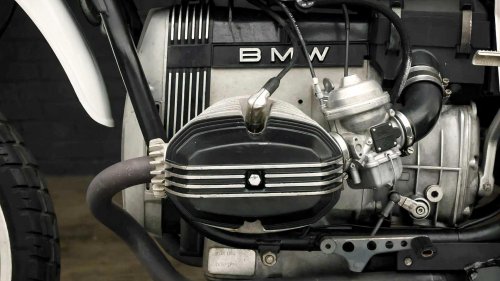
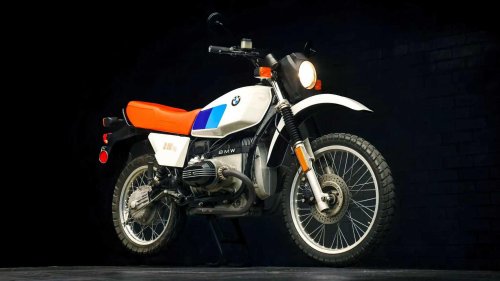
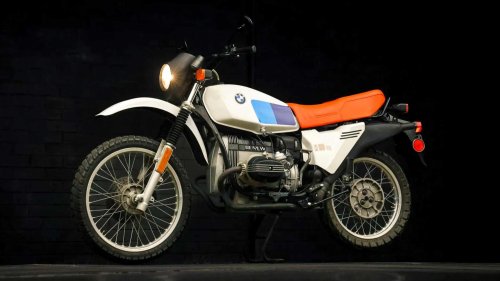
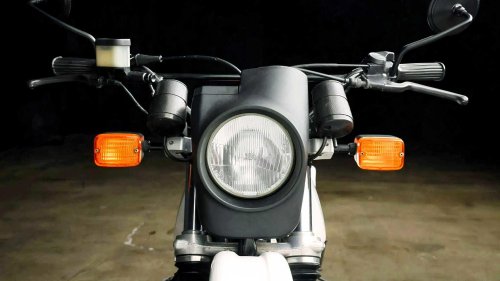
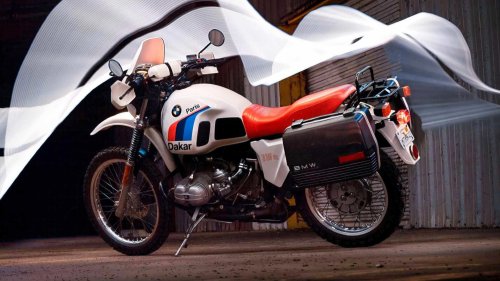
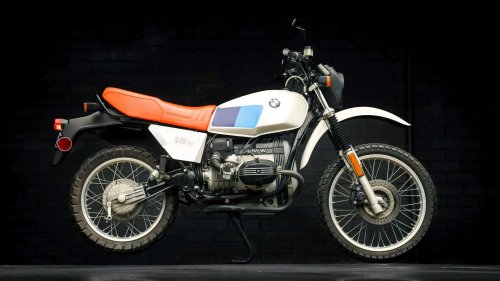
Adventure bikes are all the rage on today’s motorcycling landscape, and every major brand has at least one ADV model attempting to capitalize on their popularity. When you think about it, people’s affinity for these machines makes perfect sense, as they are often just as feature-rich as tourers, great for long-distance riding and perfectly capable of taking the party off the pavement from time to time. There's no shortage of options for those who want to get into the adventure game, ranging from relatively affordable machines like the Yamaha Tenere 700 to the more exclusive Harley Pan America, Ducati Multistrada, or BMW R 1300 GS. The Birth Of Adventure Bikes As We Know Them Bring a TrailerBut today we’ll be taking you on a trip down memory lane to remember where it all began. The Paris-Dakar Rally was still in its infancy at the time and so was the dual-sport segment, with only a rough framework laid by motorcycles such as the Yamaha DT-1. People were yet to grasp the concept of adventure riding, and it wasn't until 1980 that a German bike embodied it for the first time. It came from BMW Motorrad, of course, cementing the marque’s reputation as a force to be reckoned with among off-roading aficionados. Not only that, but it is also credited with being the world’s very first adventure bike. The BMW R 80 G/S Emerges In Bavaria Bring a TrailerIf you haven’t already guessed, the specimen we’re referring to here is the iconic BMW R 80 G/S, which went on to become a Dakar legend shortly after its debut. Nothing like it had been seen before, as motorcycles were either built for the tarmac or as dedicated off-roaders at the time. None of them excelled all-round, and even models like the aforementioned DT-1 were essentially just enduro bikes with lights, speedometers and license plates to make them road-legal. BMW sought to create a truly versatile machine that could do it all, which resulted in something downright revolutionary.Rüdiger Gutsche and Hans Muth were put in charge of the bike’s development, a process based around a few key ideas. The G/S needed long suspension travel in order to handle off-roading duties with ease, as well as a 21-inch front wheel for that same reason. In addition, it introduced Bavaria’s innovative Monolever arrangement — a single-sided swingarm with the driveshaft seamlessly integrated into its construction. This would allow for easier maintenance and the quick removal of the rear wheel, while also reducing unsprung weight and mechanical complexity. Then there was the engine, borrowed from the R80/7 and known for its durability.Bring a TrailerDisplacing 797.5cc, the boxer-twin mill came with four pushrod-actuated valves, dual Bing carburetors, and a compression ratio of 8.2:1. It had 50 horsepower and 41 pound-feet of torque to play with, transmitting this force to the rear wheel by way of a five-speed gearbox and a dry single-plate clutch. The powertrain componentry is encased in a steel double cradle frame derived from the R65, resting on telescopic forks with nearly eight inches of travel at the front. Yet another notable trait of the R 80 G/S was its lightness, as it weighed in at just 410 pounds with all the necessary fluids. Dominating The Paris-Dakar Rally Bring a TrailerThat’s genuinely remarkable for a big bike released more than four decades ago, and it served racers rather well on their grueling rides across the Sahara. Speaking of which, it would be nigh on impossible to talk about BMW’s game-changer without mentioning its success in the Paris-Dakar Rally. It played a huge role in establishing the model’s reputation as an off-roading phenom, so let’s go ahead and see how it dominated the racing event during the early and mid-eighties. First, there was Hubert Auriol's win in 1981, followed by yet another victory of his in 1983.The next two years saw the G/S taking first place once again, this time ridden by Belgian motocross hero Gaston Rahier. Needless to say, the bikes they rode weren’t exactly stock, having been modified by HPN Motorradtechnik with much bigger fuel tanks, even more suspension travel and reinforced frames. Despite being heavier than the traditional enduro machines used by other competitors, these BMWs proved more reliable and extremely capable over long distances. This gave them the upper hand overall, enabling BMW to establish a firm foothold in the rally world while also boosting the R 80’s commercial success far beyond expectations. Life After Dakar: The R 80 G/S Becomes A Cult Classic Bring a TrailerMoreover, BMW capitalized on this racing success with the special-edition R 80 G/S Paris-Dakar, whose most notable feature was a massive 8.4-gallon fuel tank signed by Gaston Rahier. This rare version is one of the most desirable classic airheads you can get your hands on today, regularly exceeding $15k at auction and sometimes climbing way higher. But even the standard G/S will fetch a pretty penny, and the most notable example is a low-mile 1981 variant sold on Bring a Trailer back in 2023. It changed hands at a whopping $42,500, which speaks volumes about the nameplate’s collectability!BMW took things further with the R 100 GS for the model-year 1987, dropping the slash while employing a larger 980cc engine and improved suspension. The lineup continued to evolve as time went by, bringing us to the current R 1300 GS with its 145-horsepower, 1300cc engine. However, just about every ADV out there from Honda’s Africa Twin to the KTM 890 Adventure owes its existence to the R 80 G/S, as they may have never seen the light of day without it laying the groundwork all these years ago. The Dakar Rally is no longer dominated by BMW nowadays, but no one can deny the marque’s historical significance in the event. The G/S Legacy Lives On To This Day Bring a TrailerAnd its impact is felt far beyond the racing world, as the adventure segment holds a huge market share in the motorcycle industry today. Things might’ve been very different if it weren’t for that first G/S and its racing achievements in the eighties, so take a minute to practice gratitude and acknowledge its significance next time you take your modern ADV out for a spin. Bikes will regularly make incremental changes to their respective segments from one model-year to the next, but you don’t often get to see a machine that gives birth to an entirely new category. This is precisely what the R 80 G/S did back in the day, though, and its contribution to the motorcycle world as a whole cannot be overstated.



















 +63 others