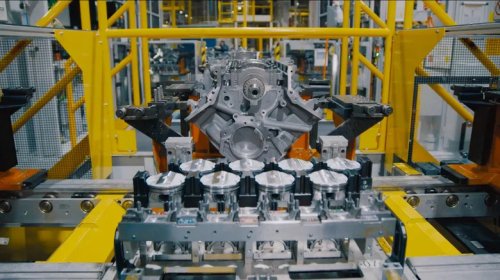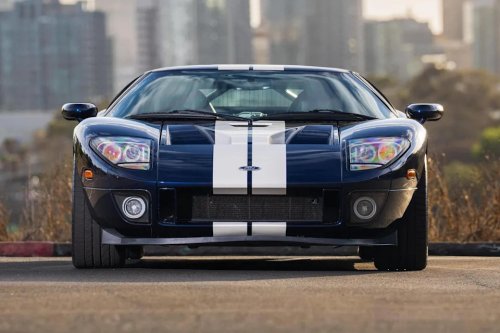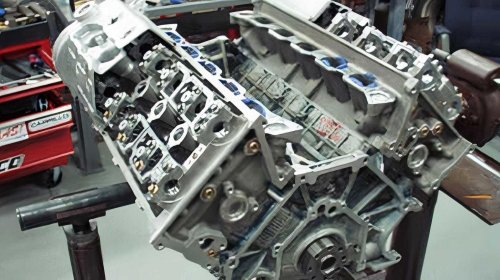
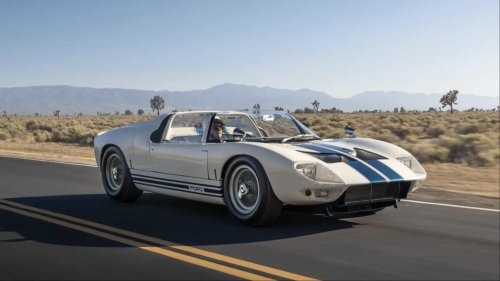
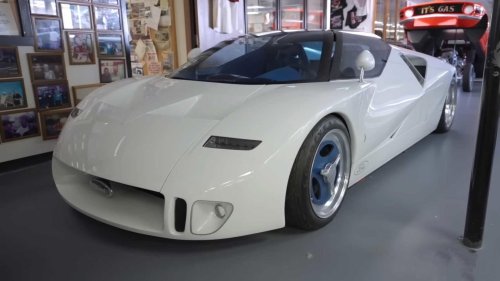
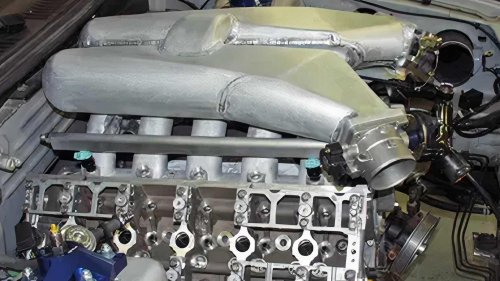
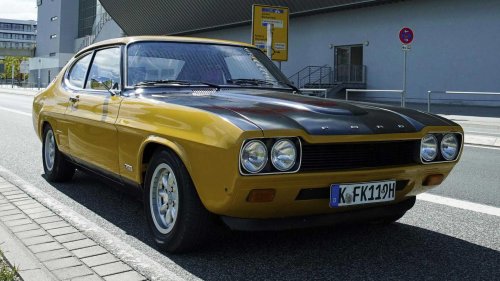





















Ford's back catalog of engines is one of the richest in the car industry, ranging from efficient and reliable turbocharged four-cylinders to some of the most powerful V8s ever produced. Like every manufacturer, Ford has done its fair share of experimentation as it looks to stumble across the next big thing in vehicle engines, before bringing it to market.Several of these ideas never made it to fruition in the public forum, though, with some being hidden away in random locations while others managed to make a life for themselves in racing. HotCars conducted in-depth research to find the rarest engines the American brand has ever produced, and one stands above all others. The Modular V10 Prototype Is The Rarest Engine Ford Ever Made Ford Developed by a special team of Ford engineers in the early 2000s, the Ford Modular V10 is the rarest engine Ford ever produced. Only one unit has ever been made. Here's how it came to be.According to SAE International, who talked to one of the program supervisors, Kevin Byrd, a group of eight engineers from Ford's Powertrain Research & Advanced Engines department evaluated designing a new engine in the early 2000s. The Modular V10 Was Intended To Power A New GT40 RM Sotheby's Ford Modular V10 (Source: Ford)In the mid-1990s, Ford engineers were chasing a dream: a rebirth of the GT40 supercar that would remind the world what Dearborn was capable of. But there was a problem: Ford didn’t have a proper halo engine. The Modular V8 was solid, but it didn’t scream supercar. So, a small skunkworks team inside Ford’s Advanced Powertrain division decided to go rogue — if they couldn’t find the perfect engine, they’d build one.Ford Rather than design something from the ground up, the team took a clever shortcut. They started with the 4.6-liter DOHC Modular V8 from the Mustang Cobra and grafted on two extra cylinders (one to each bank), creating a 5.8-liter, all-aluminum V10 unlike anything Ford had ever built. It wasn’t just an engineering exercise; it was meant to power what would become the GT90 concept, a radical preview of a next-gen Ford supercar.YouTube - That Racing Channel Only one complete 5.8-liter V10 was ever assembled, and it lived under the glass engine cover of the 1995 Ford GT90 concept. It was a futuristic, wedge-shaped supercar that stole the Detroit Auto Show that year. The engine was fully functional and hand-built, mated to a Graziano six-speed manual transmission and mounted midship in a custom spaceframe chassis.Ford The setup was surprisingly sophisticated for its time. According to Ford, the V10 was paired with a six-speed manual transmission and ran on dual ECMs, each managing one bank of five cylinders as if they were separate inline-fives working in perfect sync. It used twin 70-mm throttle bodies, dual cam and crank sensors, and custom exhaust headers that gave it a wailing, exotic tone more akin to a European hypercar than a Detroit muscle machine.Output figures were impressive: 426 horsepower and around 400 lb-ft of torque, all naturally aspirated. But despite the potential, the project was too ambitious for the bean counters. Ford killed it before it could reach production, and the GT90 ended up a one-off concept. Only one working example of the 5.8-liter Modular V10 was ever built — and it still exists, sitting deep in Ford’s archives as a living reminder of what could’ve been.So while it was technically a V10, not a V8, it stands as the rarest Ford engine ever made – a Frankenstein blend of Mustang muscle and Le Mans ambition, forged at a time when Ford engineers were still allowed to dream big. The Ford Cologne 2.6 RS V6 Is The Rarest Production V6 Ford Ever Built Ford 1972 Ford 2.6 RS Cologne Specs (Source: Ford)The award for the rarest production Ford engine goes the way of the Ford Cologne 2.6 RS. The 2.6-liter V6 engine was part of the overall extended Cologne family of powertrains, though it was one of the earlier first-generation versions of the six-cylinder unit. It was the only of the first-gen engines to feature fuel injection, making it fairly advanced for the time, and it only ever featured in one car: the Ford Capri RS2600. The Ford Capri RS2600 Is A Road-Going Version Of The Group 2 Touring Car Collecting CarsThe Ford Capri was Europe’s take on the Mustang formula – an affordable two-door coupe built to deliver style and performance without breaking the bank. But while American buyers got big, burly V8s under the hood, Europeans had to make do with smaller-displacement engines, often inline-fours or V6s. Still, Ford of Germany and the motorsport-minded folks at Ford of Cologne weren’t content to leave it at that.Built to meet Group 2 racing homologation rules, the RS2600 took the standard 2.6-liter Cologne V6 from the Capri 2600 GT and sent it off to Weslake Engineering in the UK for serious reworking. The biggest change was a new set of lightweight aluminum cylinder heads, replacing the stock cast-iron ones to improve breathing and shave weight. The carburetors were also ditched in favor of a cutting-edge Bosch mechanical fuel injection system, which was a rare feature at the time and a major advantage for endurance racing.The result? Around 148 horsepower and 170 lb-ft of torque, sent to the rear wheels through a four-speed manual. That was enough to shove the featherweight coupe (just over 2,300 lbs) to 60 mph in about 8.6 seconds and on to a 124 mph top speed. Keep in mind, this was serious pace for an early-’70s European streetcar.Under the skin, the RS2600 also got reinforced suspension, vented front discs, and lightweight steel panels to shave mass. In full race trim, the car went on to dominate the European Touring Car Championship, setting the stage for the more famous Capri RS3100 that followed.Only 3,532 Capri RS2600s were built between 1970 and 1973, all in left-hand drive, as the model was never officially sold in right-hand-drive markets. Since the fuel-injected 2.6-liter Weslake-tuned V6 was exclusive to this car, it makes the RS2600 one of the most special Capris ever produced – a pure homologation hero that brought real motorsport pedigree to Ford’s European lineup. The 1967 Cammer V8 Also Never Made It To Mass Production Bring A Trailer 1967 Cammer V8 Another of Ford's mighty creations also joined the modular V10 in never making it into mass production. The 427 ci was designed by Ford in the mid-1960s as its answer to Chrysler's formidable 426 ci Hemi 'elephant' powertrain, which it used to great success in NASCAR at the time. The Ford Cammer V8 Was Banned From NASCAR Ford's unit, which utilizes a single overhead camshaft layout, never got to take on Chrysler's beast in NASCAR as series boss Bill France banned the engine before it made its debut. This was on the grounds of it being 'too exotic' according to Hemmings. It featured a four-barrel carburetor, cast-iron cylinder heads, magnesium-finned valve covers, and a high-rise aluminum intake manifold.After the engine was outlawed from competing in NASCAR, Ford elected not to waste the powerplants and repurposed them in drag racing. Roughly 500 Cammer V8s Exist While it's difficult to pinpoint exactly how many engines were built during its limited production run, an old Ford engine production record sheet from 1966 outlines that a total of 455 examples of the engines were built that year. As some would likely have been built toward the end of 1965, too, the number produced likely sits around the 500 mark.While the 427 cubic inch Cammer V8 never made it to mass production, three examples of the engine did make it into a trio of Galaxie sedans. Hemmings reported that the vehicles were built by Ford directly, rather than one of its chief race partners, Holman Moody. One of the remaining examples sold in 2019 for a handy $112,000, a relative bargain, bearing in mind it's reportedly one of only two remaining in the world.The engine also remains valuable even without a vehicle to use it in, as a zero-mile example of the Cammer sold for an eye-watering $140,000 on Bring A Trailer early in 2023. It came with a service manual from the original supplier, Holman Moody.Sources: Ford, SAE International, Bring A Trailer, Hemmings, Iconic Auctioneers, Car and Classic.