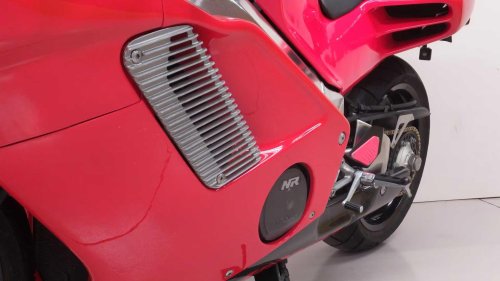
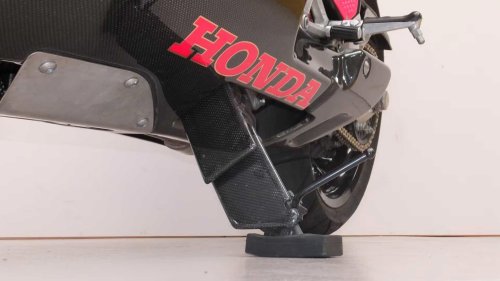
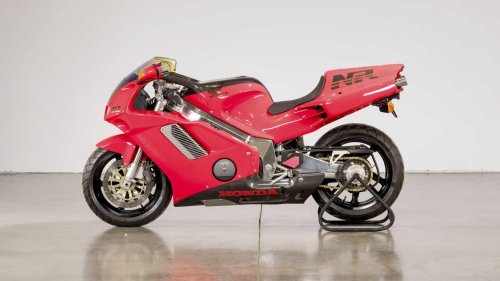
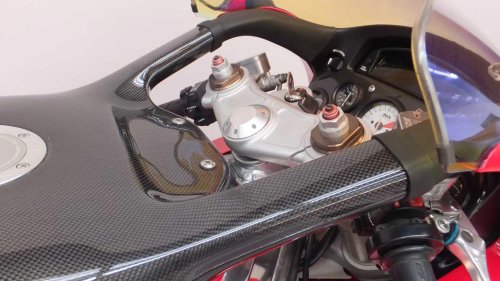
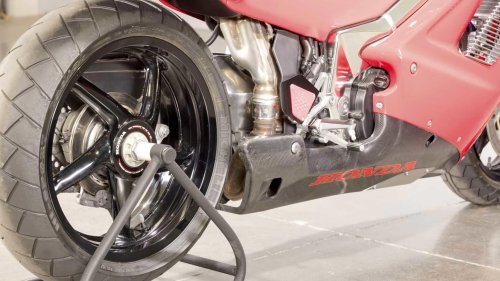
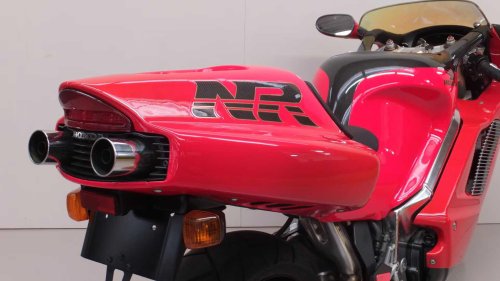
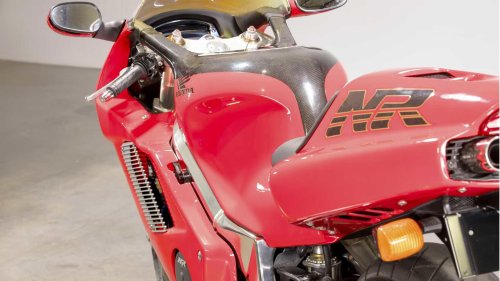
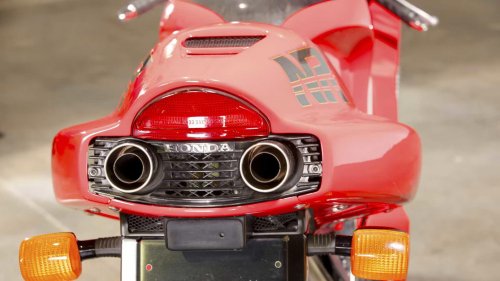
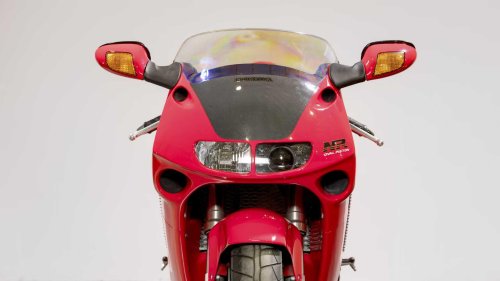
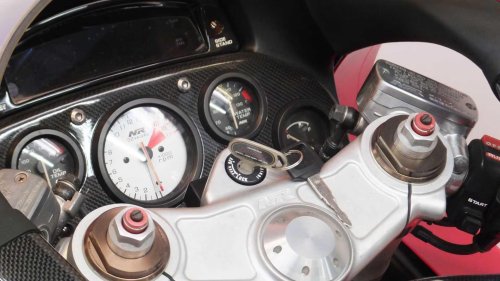
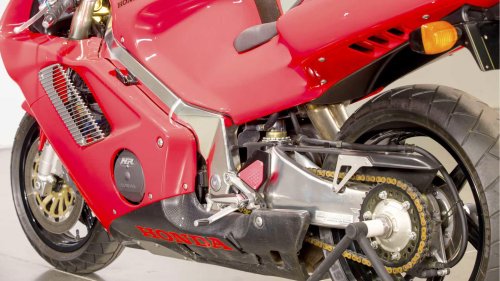


















Honda has always been a pioneer of the motorcycle, pushing it forward and rewriting what a motorcycle is. Having first started producing purpose-built motorcycles in 1949, in 1958, they released the Super Cub — a four-stroke bike that has since sold over 100 million units.Eleven years later, they unveiled the 1969 Honda CB750. Commonly thought of as the first superbike, it had such impressive technology and ride advancements for the time that it almost killed the entire British motorcycle empire. Other hits came with the release of the Goldwing in 1974, the CBX1000 in 1978, and the RC30 in 1987. They followed suit again in 1992, releasing the most technologically advanced production motorcycle of the time — and intimidating riders the world round in the process. Japanese Sports Bikes Pushed Boundaries In The 1980s MecumThe late 1980s and early 1990s were an incredibly strong time for Honda motorcycles. On track, they won the first two World Superbike seasons in 1988 and ‘89 with the Honda RC30, and looked certain to take the 1992 Grand Prix Motorcycle Racing (now MotoGP) title, as Australian Mick Doohan won five of the opening seven races and finished second at the other two on the back of his NSR500.Unfortunately for the brand, it didn’t come to fruition; Doohan suffered a career-altering crash during practice for the Dutch TT, which caused him to miss four rounds and lose the title by four points to American Wayne Rainey.MecumThings were going from strength to strength on the road, too. They released the road-going version of the RC30 — the VFR750R — in 1987, and they iterated on the CBR series they’d introduced in 1983 with bikes like the CBR500F and CBR900RR Fireblade. While they were all successes, they hadn’t quite shaken the industry in the same way as some of their other bikes — like the CB750 — had. And so, in 1992, they released a bike unlike any before and dubbed it the Honda NR (or The Honda NR750 as it’s sometimes referred to). Enter The Honda NR MecumShort for New Racing, this was a road-legal bike with a 750cc engine that made 125 hp at 14,000 rpm and had a top speed of 159.8 mph. Only 300 were ever made. The NR took inspiration from the racing bikes of the same initials. While they weren’t especially successful on track, often suffering mechanical issues, the road bike was more of a technical showcase of what Honda can do and was “the result of a decade’s perfection”, as stated by an engraving on each bike’s gas cap.As design choices go, it was fittingly futuristic. Carbon Fiber fairings helped to both keep weight down and make them stronger, while the underseat exhaust gave the bike a more streamlined, race-inspired look. A single-sided swingarm helped to speed up endurance race wheel changes and made the road bike look sportier. There were also two great big arms reaching from the tank to the front fairing, adding rigidity and an additional air intake.MecumWhile these are all interesting, arguably the most outlandish aspect is one that most riders don’t even see — the pistons. Something Honda had initially worked on for their race bikes, the NR had oval-shaped pistons instead of the regular circular ones. This meant the bike had eight valves per cylinder and two conrods each, emulating a V-8 engine rather than the V-4 it realistically had. This gave the bike a higher redline and more power, and instantly gave the NR a unique feature that it would be remembered for.Though the design was originally implemented on Honda’s racing bikes, it wasn’t particularly successful and was dropped in favor of circular pistons on the NSR, which came after. Still, the oval pistons and emulated V-8 were proof from a technical perspective that it could be done, and it made its way onto the road-going NR. Automotive Intimidation, But Not For The Reason You Think Mecum The impressive stats certainly made some riders apprehensive. However, they had plenty of other reasons to be afraid — one of which was the price. The bike retailed for $50,000 new ($116,000 adjusted for inflation), making it the most expensive production bike at the time. This was at a time when Americans were spending an average of $16,336 on a new car (per energy.gov), so the price was intimidating in and of itself.Nobody wants to drop a bike, but dropping a bike that costs more than three new cars is a big issue. And given the bike weighed 538 lbs wet — around 90lbs more than the CBR900RR — it wasn’t exactly light.MecumThen there’s the famous oval pistons. Technologically advanced? Yes. Prone to failures on the race bikes? Also yes. Racing puts a huge spotlight on your machinery and can make or break a commercial offering. The Honda NR500 struggled on track, with some motorcycle journalists jokingly reporting that “NR” stood for “Never Ready.”It competed in three Grand Prix Motorcycle Racing seasons, 1979 to 1981, and while American Freddie Spencer ran as high as fifth place at the 1981 British Grand Prix, his NR500 broke down before the end of the race. Of the three seasons it competed in, its best finish was thirteenth place at the 1981 Austrian Grand Prix — one lap down on the leader — with Japanese rider Takazumi Katayama on it. Honda dropped the NR500 in favor of their NS500 a year later, and Katayama went on to win that year’s Swedish Grand Prix, with Spencer winning the 1983 title on the NS500.With such public failures of the NR name (albeit over a decade before the road bike came out), it was inevitably going to fill riders with a bit of apprehension.Mecum Of course, speed was another aspect that could intimidate people. It wasn’t the fastest production bike on the market — that accolade belonged to the Kawasaki Ninja ZX-11, which set a top speed of 169 mph, though it wasn’t far off. Peak torque was 49 lb-ft at 11,000 rpm — again not the highest number on the market, but no slouch either. Italian magazine Motosprint recorded a 0-60 mph time of 3.76s at the time, which is the quicker end of what performance bikes of the day were capable of.Rarity was also a reason to fear the Honda NR. With only 300 bikes ever produced, any damage or any miles on the bike would severely impact resale value. That rarity could also affect the parts — with so few bikes made and the race bikes of the late 1970s and early ‘80s showing poor reliability, could they even source spare parts? And if so, it’s unlikely they’d be able to work on the bike themselves — it was one of the most technically advanced production motorcycles of its era, so owners would be unlikely to have the know-how to fix things themselves. What Riders Made Of It MecumDespite the multitude of reasons to be dubious of the bike, it has had some positive reviews. Cycleworld said in 1992 that “What it is, forgetting that astronomical price tag for a moment, is the ultimate real-world motorcycle. It’s comfortable and handles superbly, brakes as well as a Superbike, and is extremely satisfying to ride.”Motosprint gave the bike a 7.97 out of 10, with the bike faring the worst on mpg (4.5/10) and pick-up (6/10), though it did score a perfect 10 on gearbox and transmission.MecumMeanwhile, seven-time Grand Prix Motorcycle Racing podium-finisher Niall Mackenzie told Visordown: “To ride the NR is smooth, comfortable, and unassuming.” With the passage of time and as technology catches up, though, reviews have started to mellow. Bike-urious reported that “Even if the NR750 were something I could afford to crack up, I would still think that nowadays it functions better as a museum piece than a rider.” How Much The Honda NR Is Worth Today MecumThe fact that the NR launched as the most expensive production bike is undoubtedly part of its legacy, and it still commands a very high asking price to this day. Being such a rare bike, too, means that sales don’t come up often, but when they do, they still go for big money.A model with just three miles sold at auction for $150,000 in 2021, though prices over $100,000 are the norm. Expect to pay six figures unless you find a bargain or one with more use. There’s currently one for sale on Iconic Motorbike Auctions for $125,000, with the most recent sale after that being for $72,332 in August 2024, so the scarcity is definitely going to play a part in the price.MecumThe incredibly limited number of them is very much part of the bike’s legacy. Honda didn’t create the bike to try and make money — they did it to show what they were capable of. The NR was never about being the fastest bike; it was about Honda saying, “We’re the only people capable of making a bike this advanced, this forward-thinking, this expensive.”Whether it scared riders by being too radical or too expensive is irrelevant — it was about Honda doing it because only Honda could. And in doing so, it immediately wrote its legacy — a legacy that continues to this very day, over 30 years later.Sources: Energy.gov, Motorcycle News, Cycleworld, Motosprint, Visordown, Iconic Motorbike Auctions