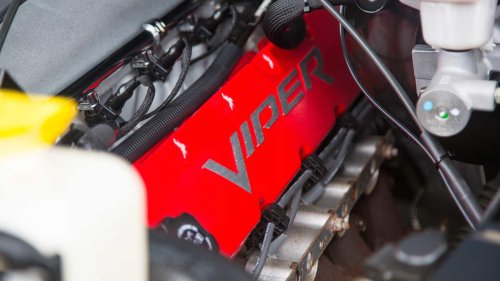
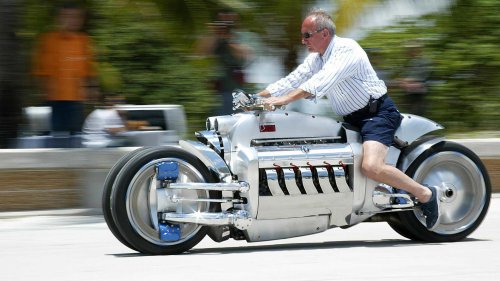
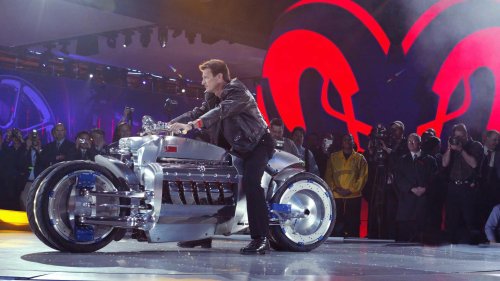
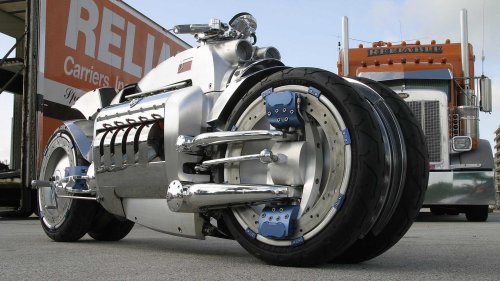
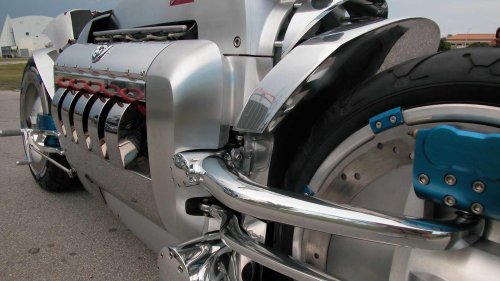
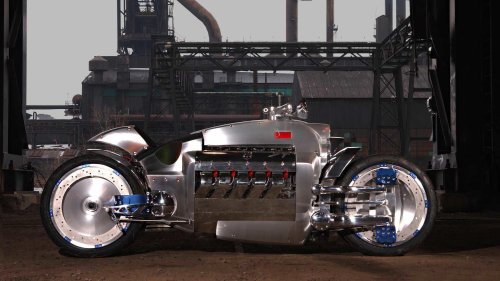
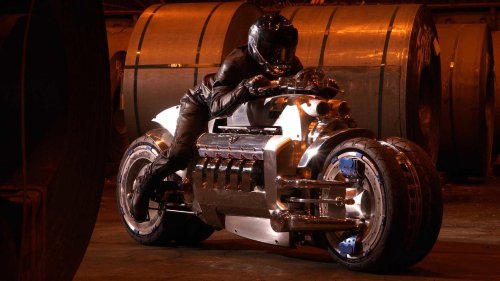
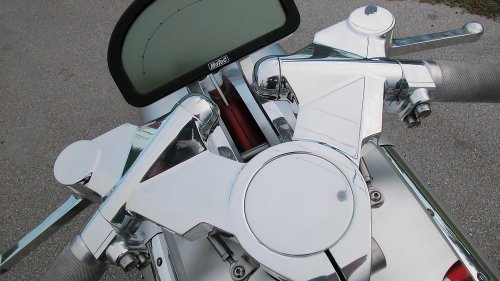
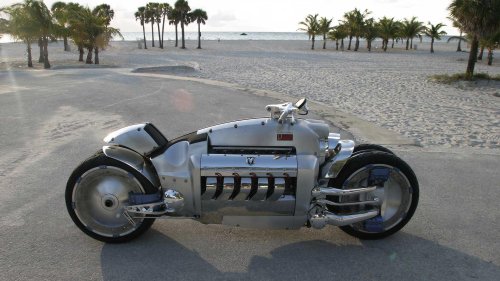
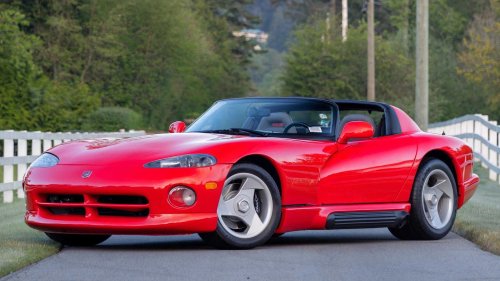
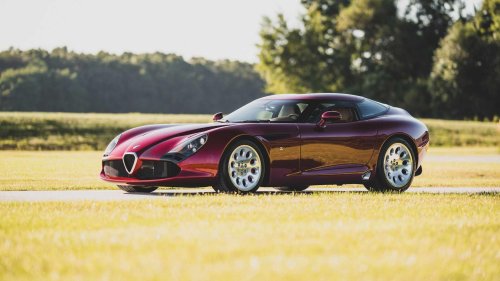
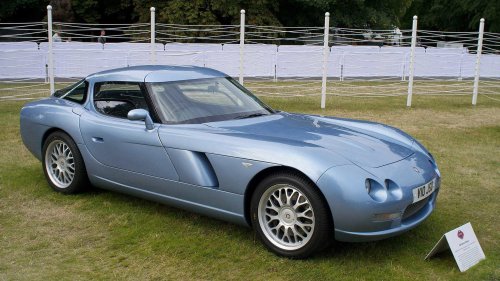
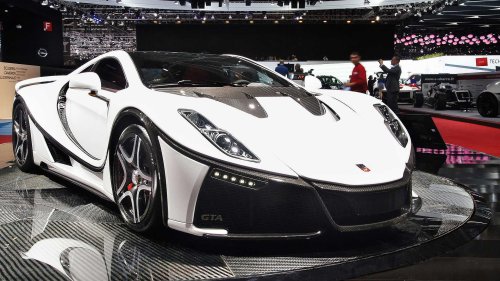



















What do you call a vehicle created by Dodge that has four wheels and a Dodge Viper V10 engine? If you answered “A Dodge Viper”, you’d be correct. But if you’d said a motorcycle, you’d also, surprisingly, be correct.In the early 2000s, Dodge decided to set about working on a vehicle based around the Viper’s V10 engine that would cause controversy in the automotive world such that it’s still debated today.The ludicrous bike was never meant to be a production machine, instead being a showcase of what the company was capable of, and making some headlines in the process.What emerged was a bike too wild for the street, too expensive for The Legendary Dodge Viper V10 Engine Via: Mecum AuctionsThe Viper V10 has gone through a few iterations, starting off as an 8-liter in 1992. The second generation took power from 400 hp to 450 hp, while the third-gen - which the Tomahawk uses - increased displacement to 8.3-liters and 510 hp. It proved to be popular, too, as it went into the road-going Viper SRT-10 from 2003-2006 and the 2004-2006 Dodge Ram SRT-10. Subsequent generations of the Viper engine have increased power further - the fourth taking it to 600 hp and the fifth and final a whopping 640 hp, with the engine stopping production in 2017. The Dodge Tomahawk — A Four-Wheeled Motorcycle Never Meant For The Streets StellantisThe Dodge Tomahawk was a four-wheeled concept motorcycle made around a Viper V10 engine. Being a concept it was never intended, nor was it made, to be street legal, but that didn’t mean that the bike didn’t get more than its fair share of attention. Inception StellantisThe Dodge Tomahawk concept was first cooked up around 2001, when Chrysler employees Bob Schroeder and Dave Chyz wondered what a Viper engined motorcycle would be like. Assuming it would look something like the Chevrolet V8-powered Boss Hoss motorcycles, they took the idea to Chrysler’s Senior Vice President of Design Trevor Creed.The idea was initially shot down but was pushed further after sketches were made, and the controversial four-wheel Tron-style wheels came in before the design was finalized.By Spring 2002, it was presented to Chrysler Group COO Wolfgang Bernhard and CEO Dieter Zetsche, who approved the project. Design StellantisThe bike was essentially designed around the Viper V10, which naturally required some changes — most notably, the four wheels.Incorporated into the design to make the width of the engine seem less imposing, the bike has two 20”x4” tires on the front, and two 20”x5” on the rear. This is loosely two of what a normal motorcycle would have, though the bike’s 1,500 lb weight is comprehensively more than double what most sports bikes would weigh.This double-tire design did present some benefits, like the bike not needing a side stand due to its girth, though the 27.7” width (thanks largely to the engine) meant it required a completely new approach to suspension.StellantisMost motorcyclists use counter-steering which, for the uninitiated, is when a rider will turn the handlebars in the opposite direction to the corner, helping the bike lean into the turn.Two sets of tires on each end would make this almost impossible, so Dodge created and patented a new suspension design which allowed the bike to lean up to 45 degrees before any tires came off the ground. It did this by having parallel upper and lower arms running from the frame to the middle of the front wheel, while the rear had inboard swing arms to help turn it.How successful these were is up for debate, but a video of the Tomahawk going up the hill at Goodwood Festival of Speed in 2003, ridden by RM Motorsports’ Bud Bennett, shows the unwieldiness of the bike, with Bennett having to lean just to keep the bike going in a straight line. Power And Speed StellantisThe Viper V10 engine they used — the 8.3-liter, 506.5 cubic inch V10 — made 500 hp and 525 lb-ft of torque. These helped Dodge to claim a hypothetical top speed as high as 420 mph, though this was never even close to being tested, with internal speed tests going up to 100 mph. Production And Cost StellantisThe Tomahawk was never intended to be a production bike, and it never even became road legal. Still, the company did create ten models and keep one itself, listing the remaining nine on the Neiman Marcus website for $550,000 in 2003 (or a whopping $968,842.93 in today’s money). The Tomahawk's Mixed Reception StellantisUnconventional machines always divide, and that was certainly true of the Tomahawk. Opinions seemed to mainly be drawn around how someone viewed the bike, with people who saw it as trying to be a bonafide motorcycle being unimpressed, while those who saw it as a concept viewed it more favorably.People taking it as a serious motorcycle noted the lack of fairings and windscreen, the dubious top speed figures, and the fact that it only had a fuel tank capable of 50 miles of range, while those who saw it as a concept enjoyed the uniqueness and outside-the-box thinking. The Tomahawk Gets The Axe StellantisThe Tomahawk was never intended to be a serious production bike, but was instead about showing what Dodge could do. That they could take the Viper engine, and put it into something weird and different enough that it would steal headlines. And that they had the know-how to do so.While other companies have come along and used the Viper V10 in other cars, only one other person — British engineer Allen Millyard — has thought about putting it into a motorcycle. His one-off Millyard Viper V10 was used to set the tandem motorcycle world speed record, setting 183.50 mph at Elvington Airfield in the UK.But, arguably, that’s not the one that people remember. Sure, it was fast, and it set a world record, but it wasn’t as outlandish as the Tomahawk.What Dodge created with the Tomahawk was something so unique, so insane that it questioned what a motorcycle really is and is still debated now. And at the end of the day, isn’t that what you want from a concept? Other Viper-Engined Vehicles Bring a TrailerThe Viper engine is an iconic piece of American automotive history, famed for its unapologetic performance. Such is its notorious shove that it hasn’t just been used in Vipers — it’s been used by other automakers, too. Alfa Romeo Zagato TZ3 Stradale Via Motor1Designed by legendary Italian coachbuilder Zagato, the Alfa Romeo Zagato TZ3 Stradale was an incredibly limited-run car released to commemorate Alfa Romeo’s 100th anniversary in 2011. Designed around the 2010 track-only Viper ACR-X, the Zagato took the same 8.4-liter engine and powered it down slightly, taking it from 640bhp to 600bhp to make the engine slightly more pliable for the road. Just nine of the Stradale cars were produced, with one “Corsa” track-only version, and while they sold for $1,000,000 new, one of the nine sold in June 2025 for $675,000 — far below where you’d expect for a car of that heritage. Bristol Fighter Wikimedia - EdvvcBritish brand Bristol created the Bristol Fighter, which would be their penultimate model before their 2020 liquidation. The two-door coupe Fighter used a second-generation 8.0-liter Viper engine and made 525 bhp and 525 lb-ft, hitting 60mph in four seconds. They were sold with a £229,125 ($308,230) price tag and, unlike the Alfa, they’ve retained their value. Reports suggest that you’re looking at around £230,000 ($309,407) for a decent model and £350,000 ($470,837) for one in mint condition. Spania GTA Spano Wikimedia - Mehmet.dundarSpain also had a go creating a car with the Viper engine, with the Spania GTA Spano using the first, second, and third-generation engines since its 2012 release (though it was first unveiled in 2009). Just 99 cars are expected to be built, with the car being intended to showcase technological improvements. To that end, the second generation car used graphene in the chassis, with the aim of increasing rigidity and decreasing weight.Whether that helps or not is open for debate, but the reported 2.9s 0–60 mph time would suggest it does. The company uses the 8.0-liter Viper engine in the current model, and has modified the engine to make 900 hp — considerably more than the 460 bhp they usually make.While all these cars use the Dodge engine, there’s one non-Viper vehicle from Dodge itself that utilizes the Viper engine — and it does so in a completely unexpected manner.