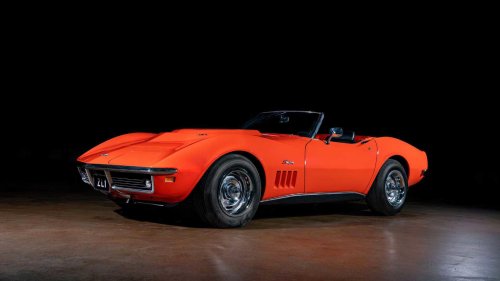

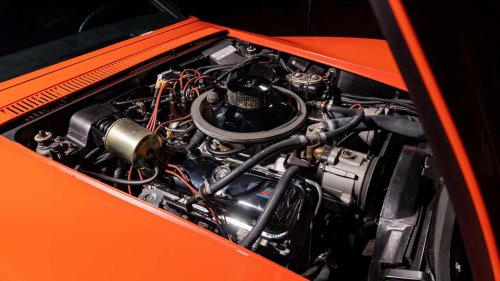
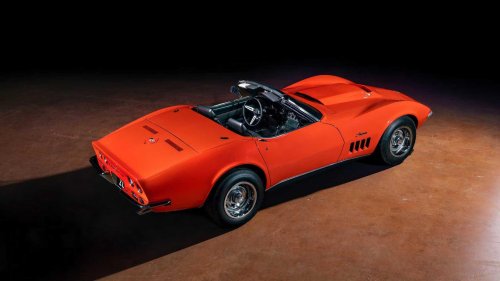


















By the late 1960s, America had become the battleground for a horsepower war. Ford, Mopar, and GM were all fighting for dominance on the streets and strips, each pushing the boundaries of what a factory-built car could deliver. While Mustangs and Chargers grabbed headlines, Chevrolet’s Corvette had quietly matured into something far more serious than a fiberglass-bodied cruiser. It had become a proper performance machine, backed by big-block muscle and growing credibility on both road courses and drag strips.The Stingray of this era had already earned a reputation for combining raw power with unmistakable style. Underneath its sweeping bodywork, Chevrolet engineers continued to develop ever more aggressive hardware. But not everything they built was meant to reach the public. Behind closed doors, Chevrolet’s performance division worked on components that far exceeded what was listed in brochures. Some of this engineering served racing programs. Some remained in test labs. A select few reached the hands of customers who knew what codes to ask for.This was also the era of GM’s corporate racing ban, a policy that officially discouraged direct participation in motorsport. Yet, in practice, engineers often found loopholes. A few experimental builds managed to reach production status, at least on paper. Some were built to satisfy homologation requirements. Others were quietly offered through backdoor channels to trusted dealers and racing insiders.Among these rare machines, one Corvette stands apart. It was born in secrecy, designed for competition, and yet against all logic, this special Corvette ended up in private garages, but not many. The 1969 Corvette ZL1 Was The Secret Weapon That Wasn’t Supposed To Exist RM Sotheby'sThe 1969 Corvette ZL1 holds the distinction of being the most powerful factory Corvette of the 1960s. Its existence was never part of Chevrolet’s official sales plan. Instead, the ZL1 package was developed for racing, specifically to support Can-Am-style programs that demanded ultra-lightweight, high-output engines. The ZL1 427 V8 was born in Chevrolet’s skunkworks division, and it was never meant for mainstream production or public sale.Only two Corvette customers ever managed to order cars with the ZL1 option. They had to know what to ask for—Request Production Option (RPO) ZL1. It was never advertised and didn’t appear in showroom brochures. The ZL1 package was essentially an engineering workaround to make the all-aluminum 427 engine available outside Chevrolet’s racing department. It was a pure race engine, designed to rev higher, weigh less, and survive the punishing demands of competition.RM Sotheby's At the heart of the package was the 7.0-liter ZL1 V8, which was factory-rated at 430 hp. The price reflected its race-bred origins. The ZL1 option alone added over $4,700 to the base Corvette price, more than doubling the cost of a standard Stingray. Few could justify spending that much on what was essentially a street-legal race car.There was no marketing push behind it. Chevrolet did not build these cars for retail customers. Yet two cars slipped through special orders from well-connected dealers or customers who knew the inner workings of GM’s ordering codes.These two ZL1 Corvettes became the most powerful street-legal models of the 1960s, despite never being intended for public roads. Their rarity and raw performance place them in a league of their own among classic American performance cars. The Rare ZL1 Was The Most Powerful Corvette Of The ’60s RM Sotheby's At the heart of the 1969 ZL1 Corvette was one of the most advanced engines Chevrolet had ever built. The 7.0-liter (427 cubic inch) ZL1 V8 used an all-aluminum block and heads, making it significantly lighter than the cast-iron L88. That weight advantage directly improved handling and acceleration while maintaining the structural integrity needed for endurance racing.Chevrolet officially rated the engine at 430 hp, but that horsepower figure was deliberately understated. Independent dyno testing and Chevrolet’s internal data suggest the real output exceeded 550 hp and 470 lb-ft of torque in stock trim. The engine featured forged pistons, solid lifters, a high-lift camshaft, and a 12.5:1 compression ratio, allowing it to rev freely and withstand sustained high-rpm operation, which was ideal for road racing and drag applications.To handle the extreme performance, Chevrolet paired the ZL1 with a heavy-duty suspension setup, the extremely rare M22 “Rock Crusher” 4-speed manual transmission, and a Positraction rear axle. Buyers could also opt for competition-spec brakes and an upgraded cooling system. A special raised-hood design and lightweight body components further reinforced its racing intent.The use of aluminum not only reduced front-end weight but also allowed the ZL1 to weigh less than the already potent L88 Corvette, while delivering even more raw output. In independent testing with proper tuning and drag slicks, the ZL1 managed 0 to 60 mph in under 4 seconds and ran the quarter-mile in 12.1 seconds at 116.2 mph according to Fastest Laps.This performance came from a car you couldn’t just walk into a dealership and order. RPO ZL1 was a hidden code, known only to those with inside knowledge. That made the ZL1 not just the most powerful Corvette of its time, but also the most elusive. The 1969 Corvette ZL1 Is A Multi-Million-Dollar Legend Today RM Sotheby's Only two factory-built 1969 Corvette ZL1s were ever sold to the public. Chevrolet never intended to offer the ZL1 engine in a street car, and the staggering cost ensured that very few even knew the option existed. At over $4,700, the ZL1 package alone cost more than the base price of a new Corvette. For most buyers in 1969, it simply wasn’t on the radar.Today, that extreme exclusivity has transformed the ZL1 into one of the most valuable American production cars ever built. In 2014, RM Sotheby’s sold one of the two known examples for $3.14 million. The car had its original drivetrain and documentation verifying it as an authentic factory ZL1. The second example remains in a private collection and has never crossed a public auction block. Experts estimate it could sell for even more, depending on its condition and originality.For comparison, a well-documented 1969 L88 Corvette, which is already considered highly collectible, typically sells for between $500,000 and $700,000. While impressive, those numbers highlight just how far above the ZL1 sits in the Corvette hierarchy.Collectors prize the ZL1 not only for its rarity but also for its unfiltered performance and historical significance. With over 550 hp, a race-grade aluminum engine, and GM factory backing, the ZL1 represents a unique intersection of motorsport engineering and showroom availability, no matter how limited.The ZL1’s origin as a secret racing option, its unmatched performance, and its ultra-low production numbers make it the rarest, most expensive, and most powerful production Corvette of the 1960s. Even though it was never meant to wear a license plate, the 1969 ZL1 became an icon that now stands as a million-dollar milestone in Corvette history.