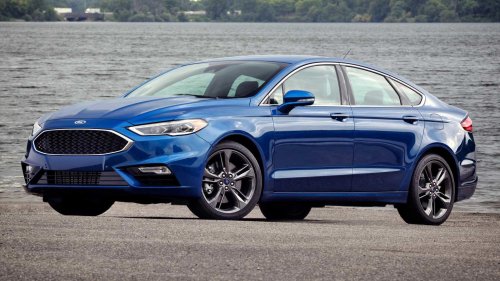
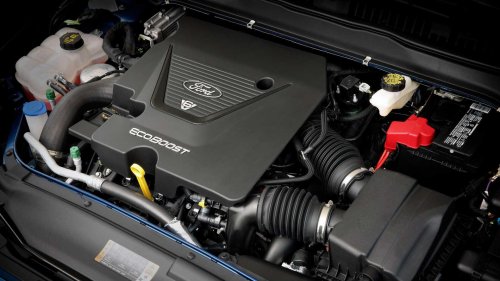
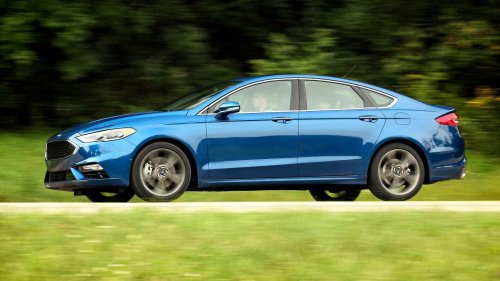




















Just a few years ago, Ford's American lineup looked much different. Sedans, hatchbacks, and even small wagons filled dealership lots. Buyers could walk in and choose from a wide range of cars tailored to different needs. Today, that variety is gone. Ford, like many other automakers, has leaned hard into trucks and SUVs, at least in North America. But hidden in that shrinking portfolio was a surprising standout – a midsize sedan that didn’t just aim to compete with rivals. It aimed to beat the best of Europe at their own game.This car wasn't built to be a commuter. It wasn't made to simply check the boxes. It was designed with purpose, with punch, and with one target in mind: performance. It had power, all-wheel drive, and a look that meant business. For enthusiasts who were paying attention, it felt like a secret project slipped into a mainstream brand. And just as quickly as it arrived, it was gone. The Fusion Sport Was Ford's Last Performance Sedan 2017 Ford Fusion Sport static photoThe Ford Fusion Sport made its debut in 2016 as part of the second-generation Fusion lineup. Positioned above the standard models, it stood out with a more aggressive design and performance hardware to match. This was no styling package. It was a full-fledged performance sedan.At the time, Ford was already planning to wind down its sedan lineup. But the Fusion Sport arrived as if to prove that Ford still knew how to make an exciting car for people who love driving. It filled a gap in the market: a midsize family sedan with real power, but without the luxury price tag.The Fusion Sport came with a 2.7-liter twin-turbocharged V6 engine, borrowed from Ford's high-end crossovers and trucks. It was tuned to deliver 325 horsepower and 380 lb-ft of torque – numbers that put it ahead of most competitors in its class. It also came with all-wheel drive, a sport-tuned suspension, and upgraded brakes.Ford marketed it as the top-tier Fusion, but in reality, it was more than that. It was a sleeper. Most people didn't expect that kind of power and grip from a Ford sedan. But enthusiasts noticed. The Fusion Sport got solid reviews for its mix of comfort and capability. Still, it never got a second chance. Ford discontinued the model after just three years, ending production in 2019. Ford Fusion Changes By Model Year 2013 (Launch Year) - All-new design with sleek, European-inspired styling; New platform shared with global Mondeo; Engine lineup: 2.5L I4, 1.6L EcoBoost, 2.0L EcoBoost; Optional all-wheel drive (2.0L EcoBoost only); Hybrid and Energi (plug-in hybrid) variants introduced. 2014 - Minor feature updates; 1.6L EcoBoost manual option dropped; Lane-keeping assist and inflatable rear seat belts added to options. 2015 - New 1.5L EcoBoost replaces 1.6L EcoBoost for better efficiency; Technology updates including enhanced voice recognition (SYNC improvements). 2016 - No major styling changes; Standard start-stop system added to 1.5L EcoBoost on SE trims; Equipment packages adjusted slightly. 2017 (Mid-Cycle Refresh) - Exterior facelift: revised grille, headlights, taillights; Interior improvements: new rotary gear shifter, improved materials; Fusion Sport introduced with 2.7L EcoBoost V6, AWD, and 325 hp; New Platinum trim adds luxury features; Sync 3 infotainment replaces MyFord Touch. 2018 - Simplified trim lineup; Co-Pilot360 driver assistance features begin rolling out; Slight adjustments to features and packaging. 2019 - Further styling tweaks and simplified trims; Standard Co-Pilot360 across all models; Discontinuation of the Fusion Sport confirmed after 2020. 2020 (Final Year) - Final production year for the Fusion; Fusion Sport and Energi Plug-In Hybrid discontinued; Focus shifts toward SUV and EV development. Twin-Turbo V6 Power, AWD, And A Balanced Suspension Ford Ford Fusion Sport Key Specs Source: FordAt the heart of the Fusion Sport was its twin-turbocharged 2.7-liter EcoBoost V6. This engine had already proven itself in the Ford Edge Sport and F-150. In the Fusion, it turned the car into a performance sleeper. With 325 horsepower and 380 lb-ft of torque, it outgunned V6 versions of the Honda Accord and Toyota Camry. It even came close to entry-level BMWs and Audis.Power went to all four wheels through a six-speed automatic transmission. While not as quick-shifting as a dual-clutch setup, it was smooth and reliable. The standard all-wheel-drive system gave the Fusion Sport grip in all weather conditions. This also meant it could put its power down more effectively than front-wheel-drive rivals.The suspension was another highlight. Ford used continuously controlled damping to adjust the shock absorbers in real time. The result was a car that could switch between soft and firm depending on the road and the driver's mood. In Sport mode, the Fusion felt sharp and composed. Steering was heavier and more direct. It didn’t match a true sports sedan, but it came impressively close for its class and price.Braking and chassis balance were also strong points. The larger brakes gave the Fusion confidence under hard stops. Body roll was minimal, and while the car was heavy, it masked its weight well. Overall, the Fusion Sport felt like it had been engineered with care, not just tuned to look fast. Ford Fusion Sport Stood Its Place Against The Competition Ford The Fusion Sport had some stiff competition. In the midsize sedan segment, buyers had long turned to the Honda Accord, Toyota Camry, and Nissan Altima. These cars were reliable, efficient, and popular. But they weren’t exciting. In contrast, the Fusion Sport aimed to add thrill to the daily drive.Against the V6 Camry, the Fusion Sport offered more power and better handling. The Accord didn’t offer all-wheel drive or a comparable engine. Nissan’s Maxima came close in performance but lacked the Fusion’s refined chassis. Then there were the premium brands: BMW 3 Series, Audi A4, and Acura TLX. Here, the Fusion Sport held its own in straight-line speed and comfort, even if it lacked the polish of a German interior. Ford Fusion Sport Vs. The Competitors Where the Fusion Sport fell short was market awareness. Ford didn’t push it hard. Most buyers didn’t even know it existed. It blended in with regular Fusions, and its price – just under $42,000 fully loaded – placed it in a tricky spot. Too expensive for mainstream shoppers, not premium enough for luxury buyers.Sales were modest. Ford didn’t break out Fusion Sport numbers separately, but the model never became a volume seller. Still, it earned praise in enthusiast circles and from reviewers who appreciated what it offered.Its rivals continued evolving. The Camry added an AWD option. The Accord stuck with turbo-fours and hybrids. The Fusion Sport, on the other hand, quietly disappeared. But for a brief moment, it stood apart as something rare: a mainstream performance sedan that didn’t chase trends. Ford Mondeo ST-Line - A Performance Brother From Europe A New Ford Mondeo Will Go On Sale In Europe Ford Mondeo ST-Line Key Specs Source: FordGlobally, the Fusion Sport had a twin: the Ford Mondeo in Europe and other markets. Both were based on the same platform and shared many parts. But while the Fusion Sport got the powerful V6 in North America, the Mondeo focused on four-cylinder engines and diesel options.In Europe, Ford positioned the Mondeo as a practical family car. Performance versions were rare. The closest thing was the Mondeo ST-Line, which looked sporty but didn’t back it up with extra power. It had stiffer suspension and sportier styling, but under the hood, it was a regular Mondeo.That said, the ST-Line carried the spirit of a performance sedan. It appealed to buyers who wanted the look and feel of something sporty, without the cost of extra horsepower. But for those who knew about the Fusion Sport, the ST-Line felt like a missed opportunity. It showed that Ford still saw value in style and handling – just not the full package. Plus, the Mondeo had a strong performance heritage with previous ST models, featuring V6 power. On the other hand, the Mondeo ST-Line was also available as a sporty-looking station wagon, something the US didn’t get.The Mondeo lasted until 2022 in Europe, ending its run quietly as Ford shifted focus to SUVs and electric cars. The Fusion had already bowed out in the US a few years earlier. Both models marked the end of an era for Ford: the era of the sporty family sedan.