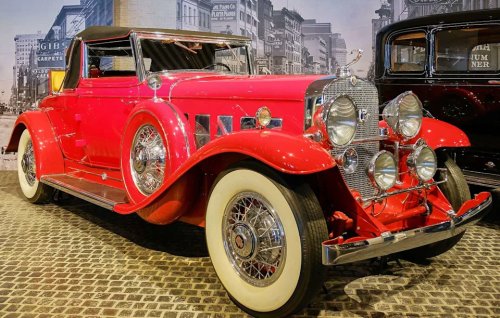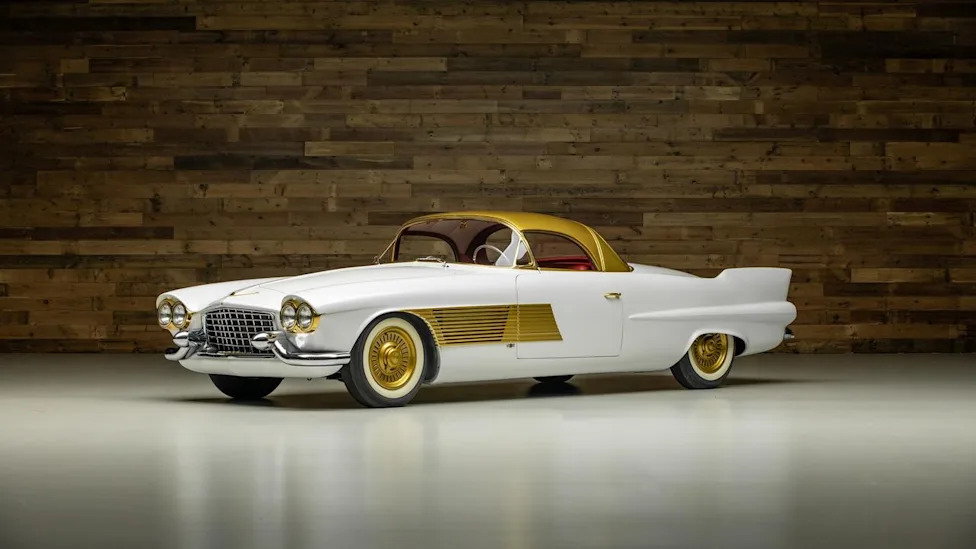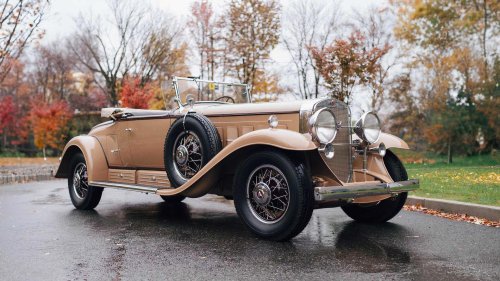
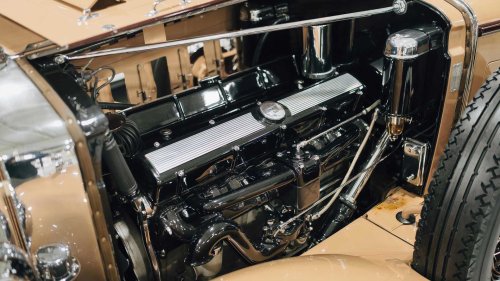
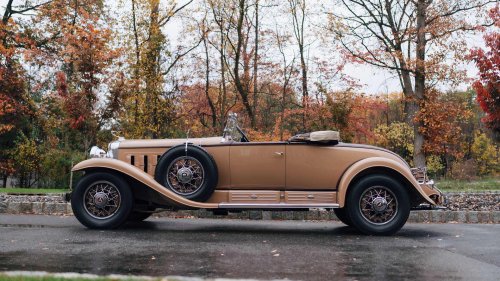
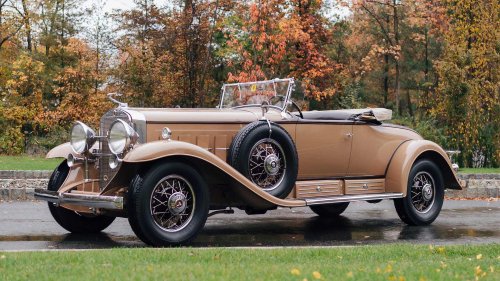
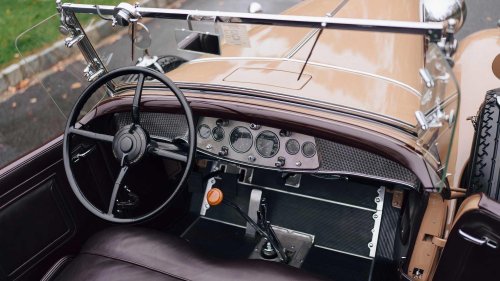
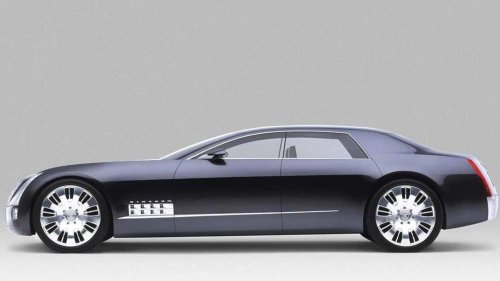



















At the dawn of the 1930s, the automobile was in flux. It had evolved and matured from this noisy, utilitarian novelty into a finely crafted luxury product. With the emergence of the private automobile, which was generally out of reach for most commuters, the wealthy emerged as niche buyers who sought machines that could not only transport them but also announce their arrival with style and sophistication unlike anything else at the time.Automakers were eager to deliver on the challenge, which, nearly 100 years later, has yielded this era as a pioneering one that pushed the boundaries of engineering and design in pursuit of ultimate prestige. Twelve-cylinder engines were considered the pinnacle of refinement, reserved for Europe’s most illustrious marques and a handful of ambitious American manufacturers.However, one young car brand from Michigan decided that even twelve cylinders weren’t enough. The result was a vehicle unlike anything the world had seen before. It was the first production car to boast a V16 engine. The Cadillac V16 Was A Pioneering Automotive Feat of the 1930s Cadillac V16 Bonhams front 3/4 When Cadillac unveiled its V16 in January 1930 at the New York Auto Show, it received an overwhelmingly positive response. No other manufacturer had ever put a sixteen-cylinder engine into full production for a road car. Experimental V16s had existed in aviation and even in some prototype race cars, but never before had an automaker offered such a powerplant to customers straight from the showroom. Cadillac was determined to leapfrog not only American rivals like Packard, Duesenberg, and Pierce-Arrow, but also European luxury marques such as Rolls-Royce and Hispano-Suiza.The 452-cubic-inch (7.4-liter) 45-degree V16 engine developed around 185 horsepower, which was an astronomical figure for the time. To put this into perspective, most cars of the era struggled to output 40 hp. Even Cadillac’s own V8 engines offered less than half the power. What made the V16 even more remarkable was the way it delivered its power, because at the time, delivering these impressive metrics often came at the cost of driveability.The engine was engineered for smoothness, with a firing order that eliminated nearly all vibration. Contemporary reviewers marvelled at how effortlessly the car accelerated, describing the driving experience as “uncannily silent” and “butter-smooth.”BonhamsOther automakers soon followed with their own interpretations of the V16. Forgotten American automaker Marmon introduced its V16 in 1931, while Peerless dabbled with experimental designs before abandoning the effort.In Europe, Auto Union (the predecessor of Audi) and Alfa Romeo famously employed massive 16-cylinder engines in their Grand Prix racing cars later in the decade, which attested to the layout's ability for all-out performance.Decades later, Cadillac itself teased the idea again with concept cars such as the 2003 Cadillac Sixteen, which featured a modern, monstrous 13.6-liter V16 engine producing 1,000 horsepower and the same number of lb-ft. But in terms of production road cars, Cadillac’s 1930 masterpiece holds the undisputed honor of being the world’s first. Cadillac’s Masterpiece Combined Art Deco Styling With Monstrous Power Bonhams As much as the engine was a technical marvel, the overall design of the Cadillac V16 aimed to impress with its stunning opulence. All of the buyers could choose from an extraordinary array of body styles, many of them hand-crafted by Fleetwood and Fisher Body. No two Cadillac V16s looked exactly the same since they were all tailor-made, which made ownership even more of a status symbol. There were sweeping convertible phaetons and stately formal limousines; if a buyer's pockets were deep enough, the V16 would serve as a blank canvas for the era’s most talented designers and coachbuilders.The long hood that was necessary to house the massive engine gave the car its dramatic proportions. This extended silhouette, paired with elegant Art Deco flourishes like chrome accents, sculpted fenders, and intricately detailed grilles, created an aesthetic that was both modern and regal. This would have looked right at home outside the equally magnificent Art Deco-style Empire State Building, as it did at a country residence just outside of the city.Similarly equipped to those extravagant home interiors, the cabins of the V16s were lavishly appointed with fine leathers, exotic woods, and plush carpeting. Again, many interiors were customized to the buyer’s wishes, which further reaffirmed its place as one of the most opulent cars of all time.Those very few who got to drive them remarked on the theater that was required. The V16’s whisper-quiet operation allowed passengers to glide along boulevards in serene comfort, while pedestrians would have the opportunity to marvel at the outright opulence. Keep in mind that this arrived, like a symbolic product of ambition and wealth, during an era when most cars were boxy and modest. Why the Cadillac V16 Will Forever Remain a Symbol of Pre-War Automotive Grandeur Bonhams 2030 is less than 5 years away, which means that it will soon be celebrating its centenary. To this day, the Cadillac V16 remains one of the most respected and admired cars from the pre-war era. Its legacy isn’t merely about being the first with a sixteen-cylinder engine but about what the engine represented instead. The car symbolized Cadillac’s belief that American engineering could equal or surpass Europe’s finest, and in this scenario, it certainly did without a doubt on the engineering front. Today, the V16 is celebrated at concours d’elegance events like Pebble Beach, where pristine examples are shown alongside Bugattis, Rolls-Royces, and Duesenbergs. Collectors consider it a crown jewel of pre-war American motoring, not only for its rarity but for the sheer audacity of its conception. Only a few thousand were built during its decade-long production run, making surviving examples incredibly valuable and historically significant.It’s also important to place the V16 in the context of its time. In the 1930s, cars were an unknown and evolving quantity. What is now taken for granted in the industry, aspects like refined powertrains, silent operation, and smooth performance were engineering challenges being solved in real time. How the Great Depression Doomed Cadillac’s Most Ambitious Car of The Era Bonhams For all its brilliance, the Cadillac V16 was a victim of circumstance. Its debut in early 1930 could not have come at a worse time. Just months earlier, the Wall Street Crash of October 1929 had sent the U.S. economy into freefall, ushering in the Great Depression. The market for ultra-luxury automobiles, already small, collapsed almost overnight, and those few who could afford to get one on their driveway would be deterred by the pessimistic outlook on opulence.While Cadillac initially managed to attract wealthy buyers eager to flaunt their resilience in tough times, sales quickly dwindled. In its best year, 1930, Cadillac sold just under 3,000 V16s. By the mid-1930s, annual production had slowed to a trickle, with fewer than 100 units built annually. Between 1930 and 1940, only about 4,000 examples were produced before Cadillac quietly ended the program. The V-16 was eventually renamed Series 90 in 1936, and the following year, the Cadillac's V12 outsold the model in question 10 to 1. Despite their best efforts with changes, including increasing engine power, it was futile.The V16’s fate illustrates a broader truth about the era because even the most remarkable feats of engineering could not withstand the harsh realities of a collapsed economy. Duesenberg, Pierce-Arrow, and other luxury automakers faced similar struggles, with some being banished to the annals of history and disappearing entirely from the new car market. Cadillac, however, weathered the storm thanks to its broader lineup and support from General Motors.Via: Cadillac Though the V16 was discontinued before the advent of World War 2, the marque retained its reputation for luxury and innovation well into the post-war years and even rebirthed the moniker (somewhat) with the Sixteen concept car at the 2003 New York International Auto Show.Unlikely to ever be seen in the bare chrome and coachbuilt metal, the V16 will forever remain the first production V16 and a declaration of intent by Cadillac to be the best in the business.Sources: Cadillac, RM Sotheby's.